Alibaba dropped its biggest model yet on August 3, 2026, and the AI world barely had time to digest DeepSeek’s latest before the goalposts moved again. Qwen3.8 Max is a 2.4-trillion-parameter flagship that the company claims beats GPT-5.6 Sol and Claude on a stack of benchmarks — while charging a fraction of Western frontier prices. So is it the real deal, or another benchmark-day headline that fades once people actually use it?
This is a research-based review built from Alibaba’s release, independent benchmark aggregators, and pricing pages, published two days after launch while the numbers are fresh. If you are deciding whether to route production traffic to Qwen3.8 Max, this is the buyer’s-eye breakdown.
How we assess: research/news-based analysis, not hands-on testing.
Is Qwen3.8 Max worth switching to? For cost-sensitive, high-volume workloads it is one of the most compelling frontier options released in 2026: a 2.4T-parameter Mixture-of-Experts model with a 1-million-token context window, priced at roughly $2 in / $6 out per million tokens — far below comparable US flagships. It leads several agentic and reasoning benchmarks, though it still trails the very top coding models on FrontierSWE. If your bottleneck is inference cost at scale, it is worth a serious pilot. If you need the single best autonomous coder, keep a Western flagship in the mix.
Key takeaways
- 2.4 trillion total parameters in a Mixture-of-Experts design — the most capable Qwen model to date.
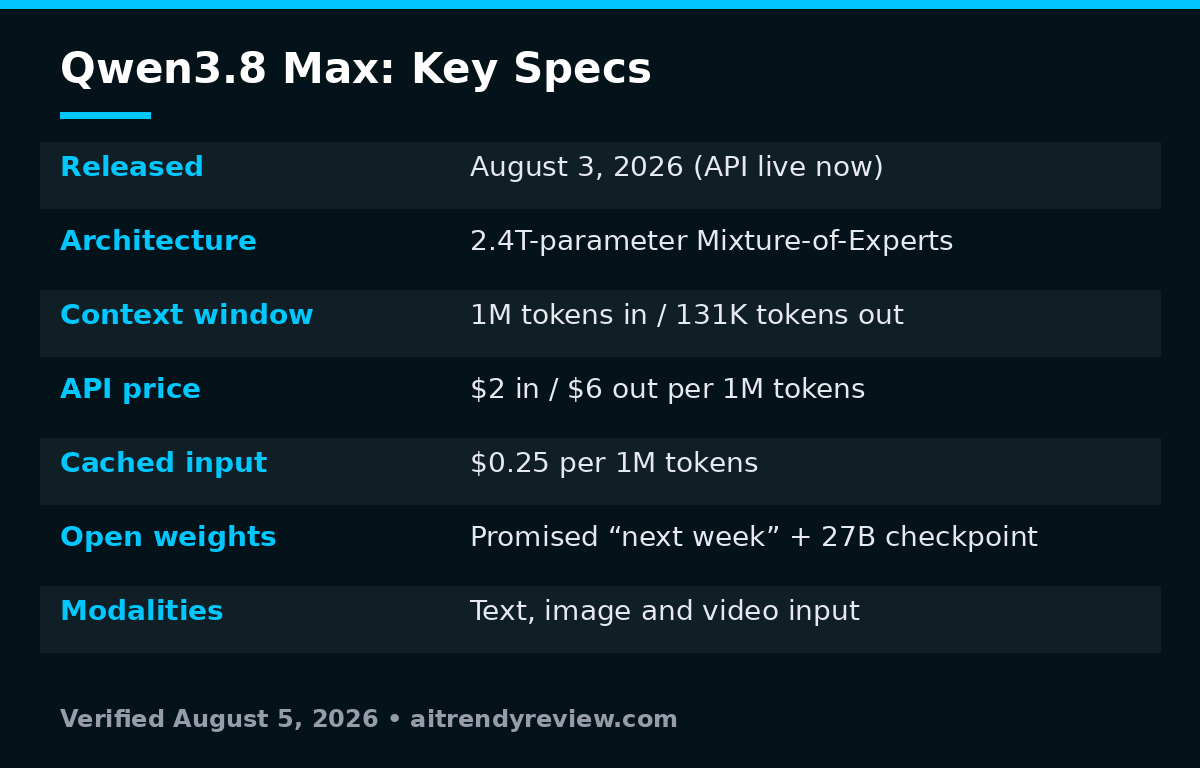
- 1,000,000 tokens of context (about 991K in, 131K out), with text, image, and video input.
- $2 / $6 per million input/output tokens, with cached input at just $0.25 — roughly 8x cheaper than a fresh read.
- 86.6 on Terminal-Bench 2.1, edging Claude Opus 4.8’s 84.6; but 73.5 on FrontierSWE trails Claude Fable 5’s 88.8.
- Open weights promised “next week,” plus a smaller 27B checkpoint for on-premise GPUs.
What exactly is Qwen3.8 Max?
Qwen3.8 Max is the new top of Alibaba’s Qwen line, announced on August 3, 2026 and available immediately through the company’s hosted API on DashScope, with OpenAI-compatible endpoints so teams can point existing code at it with minimal changes. Under the hood it is a Mixture-of-Experts model totaling 2.4 trillion parameters, meaning only a slice of those parameters activate on any given token — the trick that lets a model this large stay affordable to serve.
The pitch is straightforward: frontier-class intelligence at open-ecosystem prices. That is a different value proposition from the one Claude Opus 5 or GPT-5.6 make, and it is why this launch matters even to teams committed to Western labs. When a credible 2.4T model lands at $2/$6, it drags the whole market’s price expectations down with it.
Qwen3.8 Max specs and architecture
The context window is the first headline. At one million tokens, Qwen3.8 Max can hold roughly 991,000 tokens of input (about 983,000 when reasoning mode is active) and produce up to 131,000 tokens of output. That is enough to drop an entire codebase, a book-length contract set, or hours of transcripts into a single call. It is natively multimodal on the input side, accepting text, images, and video, and returns text.
Alibaba also ships the model with built-in tooling: function calling, structured outputs, batch processing, prefix completion, fine-tuning support, and five integrated tools including a code interpreter, web search, web extraction, text-to-image, and image-to-image search. Rate limits are generous at launch — 2 million tokens per minute and 15,000 requests per minute — which signals Alibaba wants high-volume customers, not just curious testers.
Qwen3.8 Max benchmarks: how good is it really?
Benchmark-day numbers deserve skepticism, so here is the claim-by-claim read. On Terminal-Bench 2.1, an agentic terminal-use benchmark, Qwen3.8 Max posts 86.6, ahead of Claude Opus 4.8 at 84.6. On GPQA Diamond, a hard graduate-level science set, it scores 92.6. On PaperBench it hits 93.0, and on OSWorld-Verified, which measures computer-use agents, it reaches 86.1. Those are genuinely strong, frontier-tier results across reasoning and agentic tasks.
The honest counterweight is coding. On FrontierSWE, a demanding software-engineering benchmark, Qwen3.8 Max lands at 73.5 — respectable, but well behind Claude Fable 5’s 88.8. The pattern that emerges is a model that is elite at reasoning, science, and agentic tool use, and merely very good at the hardest end-to-end coding. Its biggest jump over the previous Qwen3.7 is multimodal, where DeepSWE-style scores leapt from 21.6 to 56.6, a signal that Alibaba poured effort into vision-language ability this cycle.
Qwen3.8 Max pricing: the part that changes the math
Here is where the model earns its attention. Input runs $2.00 per million tokens, output $6.00 per million, and cached input just $0.25 per million — roughly an eight-fold saving when you reuse context, which matters enormously for agents that re-read the same system prompt thousands of times. Compare that to the going rate for US frontier flagships and the gap is large enough to reshape a budget.
To put it in practical terms: a workload that pushes millions of tokens a day, a support bot, a document pipeline, a research agent, can cost a fraction of what the same volume runs on a premium Western model. Even against aggressively priced options like DeepSeek V4, Qwen3.8 Max is competitive while offering a larger context window and stronger multimodal input. For anyone whose real constraint is inference spend rather than the last two points of coding accuracy, that is the whole ballgame.
What the Mixture-of-Experts design actually buys you
The 2.4-trillion-parameter figure sounds absurd until you understand how a Mixture-of-Experts model works. Instead of firing every parameter for every token, an MoE model routes each token to a small subset of specialized “expert” sub-networks. The total parameter count is huge, but the active count per token is a fraction of it. That is the engineering trick that lets Alibaba advertise a 2.4T model at $2/$6 pricing rather than the eye-watering cost a dense model that size would demand.
For a buyer, the practical upshot is that you get the knowledge capacity of an enormous model with the serving economics of a much smaller one. The tradeoff MoE models historically carry is consistency: routing can occasionally send a token to a less-ideal expert, and edge-case behavior can be spikier than a dense model of equivalent quality. That is one more reason the pilot-before-you-migrate advice matters here. Averages on a benchmark chart do not always capture how a routed model behaves on your specific, weird, real-world prompts. The only way to know is to run your own traffic through it and watch the tails, not just the mean.
Alibaba has not disclosed the number of activated parameters per token, which is the single most useful number for modeling self-hosting cost. Until that lands with the open weights, treat efficiency claims as directionally credible but not yet independently verifiable. The hosted API price is the concrete fact; the self-hosting economics are still a question mark.
Qwen3.8 Max vs the competition
| Model | Context | Price (in/out per 1M) | Strength | Weakness |
|---|---|---|---|---|
| Qwen3.8 Max | 1M tokens | $2 / $6 | Reasoning, agentic, price | Trails top coders on FrontierSWE |
| GPT-5.6 Sol | Large | Premium | Ecosystem, polish | Higher cost |
| Claude flagship | Large | Premium | Best-in-class coding | Higher cost |
| DeepSeek V4 Flash | Large | Very low | Price efficiency | Smaller multimodal edge |
Reading the benchmarks without fooling yourself
Vendor benchmarks are marketing until an independent party reproduces them, so it is worth understanding what each number does and does not tell you. Terminal-Bench 2.1 measures how well a model operates in a command-line environment, chaining tool calls to complete tasks. Qwen3.8 Max’s 86.6 there is meaningful because agentic terminal use is one of the hardest things to fake — it requires planning, error recovery, and following through across many steps. Beating Claude Opus 4.8’s 84.6 on that axis is a real claim, if it holds up under third-party testing.
GPQA Diamond at 92.6 speaks to graduate-level scientific reasoning, the kind of questions where memorized patterns do not rescue you. PaperBench at 93.0 tests the ability to understand and reproduce research. Together these paint a model that reasons unusually well. But notice what is being measured and what is not: none of these is a pure long-horizon coding benchmark, and the one that is, FrontierSWE, is where Qwen3.8 Max is weakest at 73.5. A responsible reading is that Alibaba optimized hard for reasoning and agentic breadth, and that end-to-end software engineering was not the top priority this cycle.
The multimodal jump deserves its own note. Going from 21.6 to 56.6 on a vision-language coding measure between Qwen3.7 and 3.8 is a large single-generation gain, and it suggests the team invested heavily in making the model see. If your workload involves screenshots, diagrams, charts, or video frames, that improvement may matter more to you than any text benchmark on the list. As always, the number that counts is the one you generate on your own data.
Who should actually switch to Qwen3.8 Max?
Use-case mapping makes this concrete. If you run a high-volume production agent — customer support, document processing, retrieval pipelines — the cached-input price alone justifies a pilot, because your repeated context becomes almost free. If you build research or analysis tools that reason over long documents, the million-token window plus strong GPQA and PaperBench scores fit well. If you need multimodal understanding of images or video at scale, this generation’s big leap is exactly there.
If you are shipping an autonomous coding product where the last few points of end-to-end accuracy translate to real developer trust, keep a top coder like the model behind your code editor in the loop and treat Qwen as the cost-optimized tier for lighter tasks. And if data governance requires on-premise inference, wait for the promised open weights and the 27B checkpoint rather than the hosted API.
The open-weights question
Alibaba says open weights ship “next week,” which, if it holds, is the more disruptive half of this announcement. A hosted 2.4T model is impressive; a downloadable one reshapes what self-hosting teams can run. The catch is scale: the full Max needs multi-node datacenter infrastructure, and Alibaba has not disclosed the number of activated parameters, so nobody can model self-hosting cost precisely yet. For most teams the practical open-weights story is the smaller 27B checkpoint, which suits a single capable GPU box and slots in next to models like the leading open-source options for private deployment.
Until the weights actually land, treat “open weights next week” as a stated plan rather than a shipped fact. Alibaba has a strong track record of following through on Qwen open releases, but a launch-day promise is not the same as a download link.
Where Qwen3.8 Max fits in your model stack
Very few serious teams run a single model anymore, and Qwen3.8 Max is best understood as a tier in a portfolio rather than a one-model answer. A sensible 2026 stack often looks like this: a top-end coder for the hardest engineering tasks, a fast cheap model for high-volume simple calls, and a strong mid-frontier workhorse for the broad middle of reasoning, analysis, and agentic work. Qwen3.8 Max is a compelling candidate for that middle-to-upper tier, especially where long context and multimodal input show up together.
Consider a concrete pipeline: a research assistant that ingests long PDFs, reasons over them, occasionally reads a chart or screenshot, and calls tools to fetch more data. That workload leans on exactly Qwen3.8 Max’s strengths — the million-token window swallows the documents, GPQA-grade reasoning handles the analysis, the multimodal input reads the figures, and the cached-input price keeps the repeated system prompt nearly free. Swap in a task that is pure autonomous code generation across a large repo, and you would likely keep a specialist coder in front instead. The art is matching each model to the shape of the job, and Qwen3.8 Max widens the set of jobs where a cheaper option is genuinely good enough. Teams already comparing tools like AI code editors know this portfolio instinct well; the same logic applies at the API layer.
How to try Qwen3.8 Max
The fastest path is the hosted API through Alibaba’s Model Studio / DashScope, which exposes OpenAI-compatible endpoints so most existing SDK code works with a base-URL swap. Casual users can also reach the Qwen family through Alibaba’s chat.qwen.ai interface to sanity-check quality before wiring up billing. For teams already abstracting providers, adding Qwen3.8 Max behind your router and A/B testing it against your current model on real traffic is the cleanest way to see whether the cost savings survive contact with your actual workload.
One practical caution on data governance: the hosted API runs on Alibaba Cloud infrastructure, and some enterprises have policy or regulatory constraints about where inference data lives. If that describes you, the hosted route may be a non-starter regardless of price, which pushes you back toward waiting for the open weights and the 27B checkpoint for on-premise use. Evaluate the compliance question before the cost question, because a cheaper token is worthless if it violates your data policy.
What this launch means for the AI price war
Zoom out and Qwen3.8 Max is a data point in a trend that has defined 2026: the price of a token keeps collapsing while capability keeps climbing. OpenAI cut GPT-5.6 Luna’s price by 80% at the end of July. DeepSeek keeps shipping models tuned for price efficiency. Now Alibaba lands a 2.4T flagship at $2/$6. Each of these moves pressures the others, and the beneficiary is anyone building on top of these APIs.
The strategic wrinkle is that Chinese labs are increasingly pairing frontier capability with open weights, a combination that puts structural pressure on closed Western labs’ pricing. When a comparable model can be self-hosted, the hosted price cannot drift too far above the cost of running it yourself. For teams evaluating models like the latest OpenAI flagships or Google’s Gemini tier, Qwen3.8 Max is useful not only as a candidate but as bargaining power: a credible, cheaper alternative changes the negotiation, even if you never fully switch.
None of this means Western labs are in trouble. Ecosystem, tooling, enterprise trust, and the very best coding performance still favor the incumbents for many buyers. But the era where frontier intelligence commanded a large, stable premium is visibly ending, and launches like this one are why.
Alibaba’s Qwen track record
Context on the vendor matters when you are weighing a launch-day promise. Alibaba’s Qwen family has become one of the most-downloaded open-model lineages in the world, with a consistent history of shipping open weights after hosted launches and maintaining smaller checkpoints that developers actually use in production. That history is why “open weights next week” is more believable coming from Alibaba than it would be from a lab with no open-release habit. Earlier Qwen generations, including the widely deployed open checkpoints that competed with models like other large open-weight releases, established the pattern this launch is following.
That said, past follow-through is not a guarantee for this specific, unusually large model. The full Max is a different beast to release than a 7B or 72B checkpoint, and the infrastructure required to run it is a real barrier even if the weights are free. The credible expectation is that the smaller 27B checkpoint will be the version most teams actually adopt for private deployment, while the full Max lives mainly as a hosted API for those who need its ceiling.
Confirmed vs. still-unproven
In the spirit of not overclaiming on a two-day-old model: what is confirmed is the architecture, the context window, the launch pricing, and the vendor-reported benchmarks. What is not yet confirmed is real-world reliability at scale, how the numbers hold up under independent third-party testing, and whether the open weights arrive on schedule and prove practical to run. Benchmark leadership on launch day is a strong signal, not a guarantee. The responsible move is a scoped pilot on your own evaluations, not a wholesale migration on the strength of a press release.
Frequently asked questions
When was Qwen3.8 Max released?
Alibaba announced Qwen3.8 Max on August 3, 2026, with the hosted API available immediately through DashScope and open weights promised for the following week.
How much does Qwen3.8 Max cost?
Roughly $2.00 per million input tokens and $6.00 per million output tokens, with cached input at $0.25 per million — about an eight-fold saving when you reuse context. That undercuts most Western frontier flagships substantially.
Is Qwen3.8 Max better than GPT-5.6 or Claude?
It depends on the task. Qwen3.8 Max leads several reasoning and agentic benchmarks like Terminal-Bench 2.1 and posts strong science scores, but trails the best coders on FrontierSWE. Its biggest edge is price for comparable capability.
What is the Qwen3.8 Max context window?
One million tokens total, approximately 991,000 tokens of input and up to 131,000 tokens of output, with text, image, and video accepted as input.
Can I self-host Qwen3.8 Max?
Open weights are promised, but the full 2.4T model requires multi-node datacenter hardware. Most teams wanting on-premise inference will use the smaller 27B checkpoint, which fits a single capable GPU server.
Is Qwen3.8 Max multimodal?
Yes on input. It accepts text, images, and video and returns text. This generation’s largest improvement over Qwen3.7 was in multimodal understanding.
Should I migrate my production app to Qwen3.8 Max now?
Pilot before you migrate. Route a slice of real traffic through it, compare quality and cost against your current model on your own evaluations, and expand only if the savings hold without a quality drop that matters for your use case.
The bottom line
Qwen3.8 Max is the clearest sign yet that the price of frontier intelligence is falling fast. It is not the single best model at everything — the top Western coders still win on the hardest software tasks — but it is arguably the best value at the frontier right now, pairing a million-token window and genuine multimodal ability with pricing that makes high-volume work affordable. Run a pilot on your real traffic. For a large share of teams, especially those bleeding money on inference, this is the model that makes the spreadsheet finally work.
Sources (verified August 5, 2026):
MarkTechPost — Alibaba Qwen releases Qwen3.8-Max
LLM Stats — AI model release tracker
OpenRouter — Qwen3.8 Max pricing and benchmarks
OfficeChai — Qwen3.8 Max benchmark comparison

Naveen Kumar Durai is the founder of Naveen AI Automation and the reviewer behind AITrendyReview. He builds AI automation systems daily and reviews AI tools from official docs, live pricing pages, and verified user reports — updated monthly as tools change.