Twelve months ago, Suno vs Udio was a genuine coin flip. Producers argued about vocal realism, Redditors ran blind tests, and both tools cost the same $10 a month. That debate is over, and it did not end because one model started sounding better. It ended on October 29, 2025, the day Udio announced its settlement with Universal Music Group and switched off downloads for every user on the platform. Since then the two products have been running in opposite directions: Suno shipped v5 and then v5.5, kept its download button, and settled with Warner on terms that let it keep operating roughly as before. Udio kept its creation tools live but became, in practice, a streaming app for your own AI songs. Picking between them in 2026 is less about sound and almost entirely about what you are allowed to do with the output.
Which is better in 2026, Suno v5 or Udio? Suno v5 is the better choice for almost every creator in 2026. Both start at $10 per month, but Suno still lets you download tracks with commercial use rights on paid plans, while Udio has kept downloads disabled since October 29, 2025 as it rebuilds as a licensed, in-app platform.
How we assess: this review is based on official documentation, pricing pages, changelogs, and verified user reports, not hands-on testing.
Key takeaways
- Both tools cost $10/month at entry ($8/month billed annually); Suno Pro includes 2,500 credits vs Udio Standard’s 2,400.
- Udio downloads have been disabled since October 29, 2025, apart from one 48-hour retrieval window; nothing had changed as of August 5, 2026.
- Suno’s free tier hands out 50 credits every day; Udio’s free tier gives 10 daily with a 100-per-month cap.
- Suno’s current model line runs to v5.5 (released March 26, 2026); Udio’s last named model is Allegro v1.5 from March 18, 2025.
- Suno settled with Warner on November 25, 2025 but is still litigating against Universal and Sony, with dispositive motions now scheduled for April 2027.
- Udio’s UMG deal reportedly pays $0.002–$0.005 per generation in royalties and points toward a walled-garden platform that had not launched as of July 2026.
Suno v5 vs Udio: which one wins in 2026?
Suno wins for anyone who needs finished, usable audio files, because Suno still exports MP3, WAV, and stems while Udio cannot export anything. That single difference decides the comparison for YouTubers, podcasters, indie artists, and agencies before sound quality even enters the discussion.
Here is the strange part: Udio the model is not bad. Before the October 2025 settlement, plenty of producers preferred Udio’s vocal phrasing and its Sessions timeline editor, and those tools still work inside the app. Udio’s problem is structural. A music generator that cannot hand you the music is a demo, and Udio has been a demo for over nine months now while its licensed successor platform stays unlaunched.
Suno, meanwhile, has been shipping like a company that smells an open lane. Suno v5 arrived in late 2025, and Suno v5.5 followed on March 26, 2026 with personal Voices, custom fine-tuned models, and a taste-learning system. The gap in momentum is now wide enough that this comparison is mostly about whether Udio’s licensing bet pays off later, not about which tool serves you better today.
| Tool | Price | Free plan | Best for | Key limit |
|---|---|---|---|---|
| Suno v5/v5.5 | Pro $10/mo ($8 annual); Premier $30/mo ($24 annual) | 50 credits/day, v4.5-all model, no commercial use | Creators who need downloadable, monetizable tracks now | Ongoing UMG/Sony litigation; free tier locked to older model |
| Udio (Allegro v1.5) | Standard $10/mo ($8 annual); Pro $30/mo ($24 annual) | 10 credits/day, capped at 100/month | In-app experimenting while awaiting the licensed relaunch | No downloads of audio, video, or stems since Oct 29, 2025 |
What happened to Udio after the UMG settlement?
Udio settled Universal Music Group’s copyright lawsuit on October 29, 2025, agreed to build a licensed platform with opt-in artist participation, and disabled all downloads the same day. Warner Music Group signed a similar deal weeks later, with a dismissal filed November 25, 2025. Sony never settled and is still suing Udio in the Southern District of New York, with document discovery running through August 25, 2026.
The settlement’s reported economics explain the product change. According to legal-industry analysis of the deal, UMG receives per-generation royalties in the range of $0.002 to $0.005, with higher rates for commercially distributed outputs, plus content-identification requirements and audit rights over Udio’s training data. Royalties per generation only work if the platform can meter every generation, which is exactly what a walled garden does and an MP3 on your hard drive does not.
Users were not consulted, and they noticed. The deal triggered enough anger on Udio’s subreddit that Billboard covered the backlash and raised the possibility of legal claims from paying subscribers who lost access to work they had already created. Udio briefly reopened downloads for 48 hours so people could pull out their back catalog, then closed the door again.
The promised joint platform, described at announcement as launching in 2026, had not publicly launched as of July 2026. Udio’s own changelog shows the last named model, Allegro v1.5, shipped back in March 2025, with later entries covering features like the Sessions editor and an iOS app rather than new models. The company is clearly holding its powder for the relaunch. Whether its remaining subscribers wait around for it is another question.
Can you still download your music from Udio?
No. Audio, video, and stem downloads remain disabled for Udio users as of August 5, 2026, and there is no announced date for their return. Songs you generate on Udio today can be played inside the app and shared through Udio links, and that is the full extent of it.
This is worth spelling out precisely, because it surprises people who knew Udio from 2024 and 2025. You can still write prompts, generate full tracks, remix, extend, and edit in Sessions. Every one of those outputs lives on Udio’s servers. There is no export button, third-party “Udio downloader” sites do not work because files are locked server-side, and the only workaround that exists is recording your computer’s audio output while a song plays, which loses quality and gives you a flat stereo mix with no stems.
Udio has said it hopes to enable some form of downloading after the licensed platform launches, but the UMG deal’s structure makes generous export terms unlikely. Even Suno’s Warner settlement, which is far friendlier to users, reportedly includes download caps for the licensed models planned for 2026. The whole industry is moving toward metered, tracked output; Udio simply moved there first and hardest.
If you have an old Udio catalog trapped behind the disabled button, keep your account and watch official announcements. If you are choosing a tool today and downloads matter at all, this section is your answer.
How much do Suno and Udio actually cost in 2026?
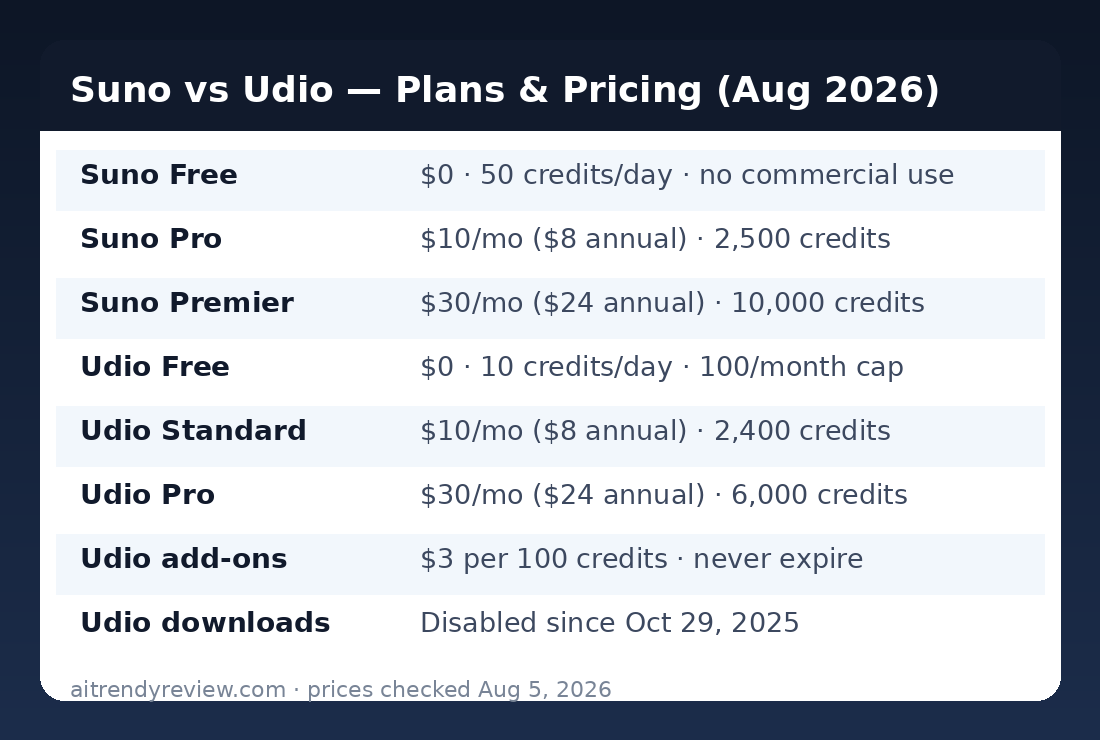
Both platforms charge $10 per month for their first paid tier, dropping to $8 per month when billed annually, and both top out at a $30 monthly plan ($24 annual). The prices mirror each other so closely that cost alone will not pick your winner; what differs is what each dollar buys.
On Suno’s pricing page, checked August 5, 2026, Suno Pro at $10/month includes 2,500 monthly credits, commercial use rights for songs made while subscribed, a priority queue of up to 10 songs at once, 30 minutes of audio upload, and two stem types. Suno Premier at $30/month raises that to 10,000 credits, three stem types, and access to Suno Studio, the company’s multitrack editing environment. Paid users can generate with every model from v4 through v5.5. Suno’s free plan is unusually generous on volume, 50 credits renewing daily, but it locks you to the older v4.5-all model and grants no commercial rights.
Udio’s ladder, per its pricing page and current third-party breakdowns, runs: free with 10 credits daily capped at 100 per month, Standard at $10/month with 2,400 credits, and Pro at $30/month with 6,000 credits. Udio also sells non-expiring add-on credit packs at $3 per 100 or $25 per 1,000, something Suno matches only with plan-linked add-ons. Features like audio uploads, Voice Control, and Style Blending unlock at Standard and above.
Now apply the download filter and the symmetry collapses. A Suno Pro credit becomes a WAV you can ship to a client. A Udio Standard credit becomes a stream inside Udio. Measured in usable output per dollar, Suno is not slightly cheaper. It is the only one of the two currently selling a finished product.
Who owns the music you make on Suno vs Udio?
Suno grants commercial use rights for songs created on its Pro and Premier plans, so paid subscribers can distribute and monetize their tracks. Udio’s position is murkier: with downloads disabled and its terms in transition, generating a song there today gives you no practical path to commercial release at all.
Suno’s rights come with an asterisk you should understand before building a business on it. Suno settled with Warner Music Group on November 25, 2025, a deal that included Suno acquiring Songkick, artist opt-in controls, and plans for licensed models with download caps arriving in 2026; the court dismissal landed January 28, 2026. But Universal and Sony are still suing Suno in Massachusetts, and a June 30, 2026 scheduling order pushed dispositive motions to April 9, 2027. Translation: the fair-use question hanging over Suno’s older models will not be resolved before 2027, and Suno is betting it wins. Songs you have already made and distributed under a paid plan are very unlikely to be clawed back, but the ground rules for future models could shift with one ruling or settlement.
Udio inverted the risk. By settling with UMG and Warner, Udio bought legal certainty for itself, and paid for it with its users’ freedom. The coming platform is designed around opt-in artist catalogs, content identification, and royalties flowing back to rights holders on every generation. If it launches well, Udio could become the one AI music tool where making something in a signed artist’s style is affirmatively licensed rather than legally gray, and that would be a real differentiator no current rival matches. Today, though, “you own what you can stream in our app” is not ownership in any sense a working creator cares about.
For a deeper look at how Suno’s commercial terms play out in practice, our full Suno v5 review walks through the licensing details plan by plan.
How do Suno v5.5’s features stack up against Udio’s toolset?
Suno v5.5 is the newer and more complete creative suite, pairing its latest model with personal voice cloning, custom style models, and the Suno Studio editor. Udio’s feature set froze in a strong 2025 state: its Sessions timeline editor and Styles reference-audio system remain excellent, but nothing major has shipped since the settlement.
The headline additions in Suno v5.5 are aimed squarely at repeat users rather than one-off novelty seekers. Voices lets Pro and Premier subscribers record and verify their own singing voice, then generate songs that sing in it, with Suno stating that “Your Voices on Suno are private — only you can use them.” Custom Models go further: upload your own original tracks and Suno fine-tunes v5.5 to your style, up to three models per account. My Taste, available to everyone, quietly learns which genres and moods you keep, so the tool drifts toward your preferences over time. Add Premier’s Suno Studio, stem separation, and 30-minute audio uploads, and Suno now resembles a lightweight production environment more than a prompt toy.
Udio’s tools deserve honest credit. Sessions, its timeline view launched in June 2025, made Udio the better in-app arranger for a while, and Styles, which generates from an uploaded reference clip, predates Suno’s equivalent. Udio’s iOS app is polished. The catch repeats itself: all of it feeds a library you cannot take anywhere, running on Allegro v1.5, a model now roughly seventeen months old.
If your interest is voice specifically rather than full songs, a dedicated voice platform is the better tool for the job; our ElevenLabs review covers the strongest option for narration and spoken audio, and Google’s music entry gets the same treatment in our Lyria 3 Pro review.
Which sounds better, Suno v5 or Udio?
Neither tool holds a decisive audio advantage; third-party comparisons in 2026 tend to score Suno v5 ahead on vocal clarity and production polish while giving Udio credit for natural phrasing and instrumental warmth. The honest summary is that both clear the “would fool a casual listener” bar on a good generation.
Because this site does not run hands-on tests, sound-quality judgments here lean on named third parties and aggregate user reports, and those paint a consistent picture. Tom’s Guide ran a seven-prompt head-to-head between the two platforms and came away preferring Suno overall while noting Udio’s strengths on certain genres. Publication-level comparisons from 2026, including Jam’s mid-year update and Born to Produce’s producer-focused breakdown, repeat the same split: Suno v5 for radio-ready pop, rap, and cinematic tracks; Udio for looser, more human-feeling folk and jazz phrasing. Community threads add a wrinkle worth knowing, which is variance. Users on both platforms report that one generation in three or four is keeper quality, so the real cost of a finished song is several generations’ worth of credits, not one.
Two structural facts tilt the audio race toward Suno going forward. First, Suno’s model line is still moving: v5.5 shipped in March 2026, and paid users can generate across five model versions to match a song’s style. Udio’s Allegro v1.5 has now sat unchanged since March 2025, and however good its training was, a frozen model loses ground every quarter. Second, Suno’s stem separation, two stem types on Pro and three on Premier, gives producers a way to rescue a nearly-great generation in a DAW. Udio’s equivalent tooling is locked inside an app that will not let the audio out, which makes its remaining audio strengths difficult to bank.
Suno or Udio: which should you choose?
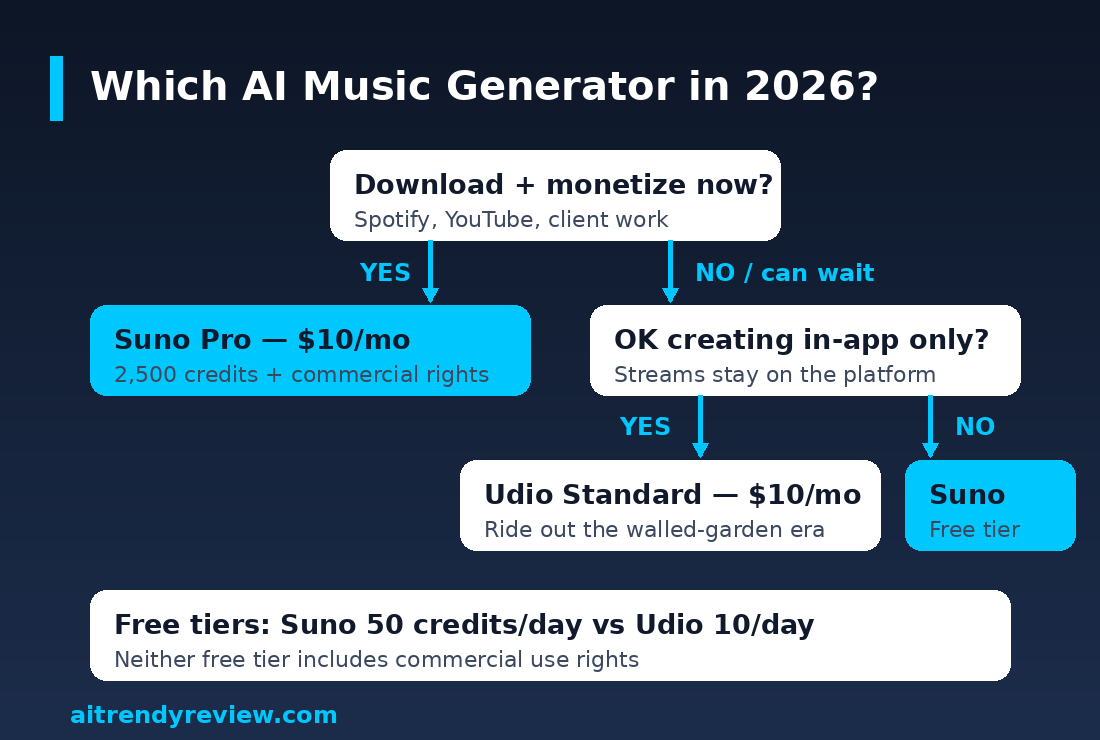
Choose Suno if you need music you can publish, and Udio only if you are content creating inside an app while its licensed future takes shape. That single sentence covers about ninety percent of buyers; the mapping below covers the rest.
If you make YouTube videos or podcasts, get Suno Pro at $10/month. You get commercial rights, 2,500 credits, and files you can drop straight into an edit. Background scores for a video workflow pair naturally with the tools in our Runway Gen-4 review.
If you are an indie artist releasing to Spotify, Suno Pro or Premier, plus a distributor like DistroKid. Keep records of your subscription dates, since commercial rights attach to songs made while subscribed. Be aware of the unresolved UMG and Sony litigation before betting a full catalog on it.
If you run an agency or produce client work, Suno Premier at $30/month. The 10,000-credit pool absorbs revision rounds, three stem types survive client remix requests, and Suno Studio handles arrangement changes without leaving the platform.
If you loved Udio’s sound and own a back catalog there, keep the account, do not cancel in anger, and wait for the licensed platform. Your library is the hostage; walking away abandons it.
If you are a hobbyist who just wants to play, Suno’s free 50 daily credits are the best deal in AI music, five times Udio’s daily allowance, with no monthly cap. Neither free tier permits commercial use.
If your dream product is officially licensed artist-style generation, watch Udio. Its UMG and Warner deals make it the only major player building that future in the open.
Worth it if / skip it if
Suno is worth it if you publish content anywhere outside the app: videos, podcasts, streaming platforms, client projects, game soundtracks. It is also worth it if you want the newest model generation, since v5.5 with Voices and Custom Models has no current Udio counterpart. At $8 to $10 a month for commercial rights and 2,500 credits, the pricing undercuts nothing and matches everything, so the decision rides on output rights that Suno simply has and Udio simply lacks.
Skip Suno if your business cannot tolerate any legal ambiguity. The Universal and Sony suits will not reach dispositive motions until April 2027, and a bad outcome could reshape Suno’s model lineup and terms. Risk-averse brands may prefer waiting for Suno’s licensed 2026 models, or for Udio’s fully licensed platform.
Udio is worth it if you treat it as a $10 creative sandbox and truly do not need files, or you are holding a subscription to protect an existing catalog and a front-row seat for the relaunch.
Skip Udio if you need to export a single second of audio this year. Until downloads return in some form, that requirement disqualifies Udio no matter how good Allegro’s successor turns out to be.
FAQ: Suno v5 vs Udio
Can you still download songs from Udio in 2026?
No. Udio disabled audio, video, and stem downloads on October 29, 2025, the day it announced its Universal Music Group settlement, apart from one 48-hour retrieval window. As of August 2026 downloads remain off while Udio builds its licensed platform, and the company has not committed to a restoration date.
Does Suno v5 allow commercial use?
Yes, on paid plans. Suno’s Pro ($10/month) and Premier ($30/month) subscriptions include commercial use rights for songs created while subscribed, covering v5 and v5.5 output. Free-tier songs are for personal use only. Keep in mind that Suno is still litigating with Universal and Sony, so the legal backdrop is not fully settled.
Is Udio shutting down?
No. Udio settled with Universal Music Group in October 2025 and Warner Music Group in November 2025, and is rebuilding as a licensed, artist-opt-in platform expected during 2026. The current product still works for in-app creation and streaming. Sony’s lawsuit against Udio continues in New York, with discovery running through August 25, 2026.
Which is cheaper, Suno or Udio?
They match at the entry level: both charge $10 per month, or $8 per month billed annually, for their first paid tier. Suno Pro includes 2,500 credits against Udio Standard’s 2,400, and Suno’s free tier gives 50 credits daily versus Udio’s 10. Per usable, downloadable song, Suno is effectively far cheaper.
Can you monetize Suno songs on Spotify and YouTube?
Yes, if the song was made on a paid plan. Suno grants commercial use rights to Pro and Premier subscribers, and creators distribute tracks to Spotify, YouTube, and TikTok through services like DistroKid or TuneCore. Keep proof of your subscription dates, because rights attach to songs generated while the subscription was active.
What AI model does Udio currently run?
Udio’s official changelog lists Allegro v1.5, launched March 18, 2025, as its most recent named model. Later updates focused on features such as Sessions timeline editing and the iOS app rather than a new flagship. Third-party comparisons sometimes cite unofficial version numbers, but Udio has not announced a successor model since the UMG settlement.
Will Udio downloads come back?
Possibly, in a limited form. Udio has indicated it hopes to allow some type of export after its licensed platform launches, and the UMG agreement reportedly includes per-generation royalties of $0.002 to $0.005 that a metered system would support. Nothing was confirmed as of August 2026, and the platform’s direction is clearly streaming-first.
Is Suno v5.5 different from Suno v5?
Yes. Suno v5.5, released March 26, 2026, adds Voices, which lets paid subscribers generate songs sung in their own verified voice, up to three Custom Models fine-tuned on a subscriber’s original tracks, and My Taste personalization for all users. Treat the underlying audio quality as an incremental step over v5 rather than a leap.
Sources
Prices checked August 5, 2026.
- Suno — Pricing (plans, credits, commercial rights)
- Suno — “v5.5: More Expressive. More You.” (March 26, 2026 release details)
- Udio — Pricing (plans and credits)
- Udio Help Center — Changelog (Allegro v1.5, Sessions, Styles, iOS app dates)
- Billboard Pro — “Udio-UMG Deal Prompts Reddit Backlash” (user response to the settlement)

Naveen Kumar Durai is the founder of Naveen AI Automation and the reviewer behind AITrendyReview. He builds AI automation systems daily and reviews AI tools from official docs, live pricing pages, and verified user reports — updated monthly as tools change.