Google launched Gemini 3.6 Flash on July 21, 2026, and buried the most interesting number halfway down the announcement. The headline API price is $1.50 per million input tokens and $7.50 per million output tokens. The quieter figure: the model uses 17% fewer output tokens than Gemini 3.5 Flash to complete the same work, according to Google. That second number is the real story. List prices grab attention, but price per finished task is what actually lands on your invoice, and on that measure 3.6 Flash undercuts its own sticker.
The launch, announced on Google’s official blog by Tulsee Doshi, Senior Director of Product Management, covered three models at once: Gemini 3.6 Flash, Gemini 3.5 Flash-Lite, and a security-focused Gemini 3.5 Flash Cyber. Notice what is missing from that list. Gemini 3.5 Pro, the flagship people have been waiting on for months, remains in partner testing with no ship date. Google is shipping the workhorse while the show pony stays in the barn, and that tells you where the company thinks the money is right now: fast, cheap models that power agents at scale.
This review pulls together the pricing, Google’s reported benchmarks, the new built-in computer use capability, and the practical question of who should switch this week. Two days after launch, the picture is clearer than you might expect, provided you keep one caveat in view the whole way through: every performance number below comes from Google’s own testing, not independent evaluation.
How we assess: research/news-based analysis, not hands-on testing.
Is Gemini 3.6 Flash worth switching to?
For most API workloads, yes. At $1.50 per million input tokens and $7.50 per million output, and with 17% fewer output tokens burned per task than 3.5 Flash, the effective cost drops below what the list price suggests. Google’s own benchmarks show double-digit gains on agentic coding. Hold off only if you need independent evals before moving production traffic.
Key takeaways
- API pricing: $1.50 per 1M input tokens, $7.50 per 1M output tokens for Gemini 3.6 Flash.
- Uses 17% fewer output tokens than Gemini 3.5 Flash on the same tasks (per Google), cutting real-world cost below list price.
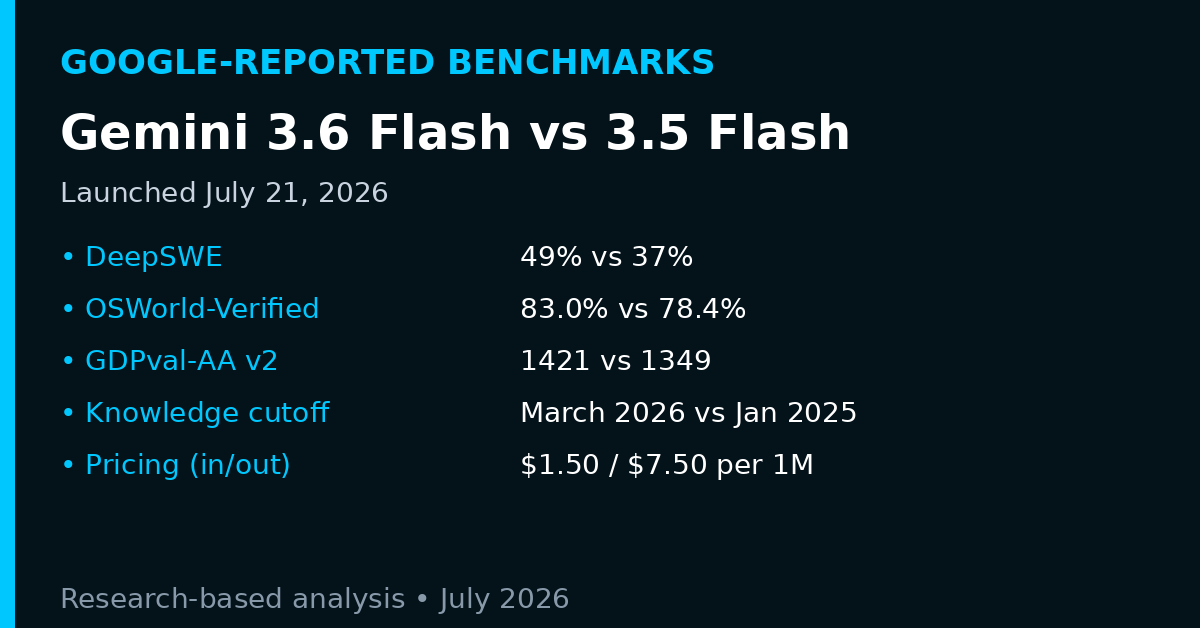
- Google-reported benchmarks: DeepSWE 49% (3.5 Flash: 37%) and OSWorld-Verified 83.0% (3.5 Flash: 78.4%).
- GDPval-AA v2 score of 1421, up from 1349 for 3.5 Flash, again per Google’s own testing.
- Knowledge cutoff advanced to March 2026, versus January 2025 for 3.5 Flash (per 9to5Google).
- Gemini 3.5 Flash-Lite launched alongside it at $0.30/$2.50 per 1M tokens with output speeds of 350 tokens per second.
What exactly did Google launch on July 21, 2026?
Three models: Gemini 3.6 Flash as the new default workhorse, Gemini 3.5 Flash-Lite as the budget speed tier, and Gemini 3.5 Flash Cyber as a restricted security model. Tulsee Doshi, Senior Director of Product Management, made the announcement on Google’s blog, and the framing was unmistakably about production workloads rather than demos.
Gemini 3.6 Flash is the centerpiece. It is available now through the Gemini API in Google AI Studio and Android Studio, through Gemini Enterprise, inside the consumer Gemini app, and in Google Antigravity, the company’s agentic development environment. That is an unusually wide release for day one. Google typically staggers availability across surfaces; this time the model landed everywhere at once, which signals confidence that it behaves predictably under load.
Gemini 3.5 Flash-Lite fills the slot below it. At $0.30 per million input tokens and $2.50 per million output, streaming at 350 output tokens per second, it targets high-volume, latency-sensitive work: classification, extraction, routing, simple chat. Google gave it configurable thinking levels, so you can dial reasoning up for harder requests and keep it off for trivial ones. Its reported jump on Terminal-Bench 2.1, from 31% for the previous Flash-Lite to 54%, is proportionally the largest gain announced that day.
The third model is the odd one out. Gemini 3.5 Flash Cyber is built for finding and patching software vulnerabilities inside Google’s CodeMender framework, and you almost certainly cannot use it. It is a limited pilot restricted to governments and trusted partners. Its significance is directional: Google now considers offensive-and-defensive security work a distinct enough discipline to deserve its own tuned model, rather than a prompt on top of a general one.
One more detail worth registering: none of these are Pro-class models. July 21 was a statement about the middle of the lineup, where the vast majority of API tokens actually get spent.
How much does Gemini 3.6 Flash cost — and what does 17% fewer tokens mean for your bill?
Gemini 3.6 Flash costs $1.50 per million input tokens and $7.50 per million output tokens through the Gemini API, and the effective price is lower than that because the model is more concise. Google says 3.6 Flash uses 17% fewer output tokens than 3.5 Flash to complete equivalent tasks. Since output tokens are the expensive side of the ledger, that efficiency compounds directly into savings.
Run the arithmetic on a realistic workload. Say your application generates 50 million output tokens a month at 3.5 Flash verbosity. The same work done in 3.6 Flash’s terser style should come in around 41.5 million tokens. At $7.50 per million, that is roughly $311 instead of $375 for the output side, a saving of about $64 a month before you have changed a single line of code. Scale that to a company pushing billions of tokens through agent pipelines and the 17% figure stops being a footnote and starts being a budget line.
There is a second-order benefit that Google’s pricing page does not spell out: fewer output tokens also means faster end-to-end responses, since generation time scales with length. Conciseness is a latency feature wearing a cost-saving costume.
The comparison that matters for buyers is against Flash-Lite, which costs $0.30 in and $2.50 out. That is a fivefold gap on input pricing, so the decision between the two models (covered in detail below) is genuinely consequential for high-volume users. And if your problem is context capacity rather than unit price, that is a different product conversation entirely; our Gemini Ultra review of the 2M-token context window covers the top of Google’s range. Full model listings live on DeepMind’s Gemini Flash page.
How big are the benchmark gains over Gemini 3.5 Flash?
Large by generational standards, with the caveat that every number here is Google’s own. The three figures the company published tell a consistent story about where the model improved: agentic work.
On DeepSWE, a software engineering benchmark that measures a model’s ability to resolve real coding tasks agentically, Google reports 49% for Gemini 3.6 Flash against 37% for 3.5 Flash. That is a 12-point absolute jump, roughly a third better in relative terms, and it is the kind of delta that usually separates model generations rather than point releases. Google’s stated goal, quoted by 9to5Google, was “higher precision with fewer unwanted code edits,” which addresses the most common complaint about fast models in coding tools: they touch files you did not ask them to touch.
On OSWorld-Verified, which tests whether a model can operate a real computer interface to complete tasks, 3.6 Flash scores 83.0% against 78.4% for its predecessor. A 4.6-point gain sounds modest until you consider that errors in computer-use tasks compound across steps. Small per-step reliability gains produce much larger improvements in whole-task completion.
The third number, a GDPval-AA v2 score of 1421 versus 1349, measures performance on economically valuable knowledge work. A 72-point rating gain suggests the improvements are not narrowly confined to code.
What Google did not publish is as informative: no comparison against OpenAI or Anthropic models appeared in the launch material. For a sense of where the competitive bar currently sits, our GPT-5.4 review breaks down OpenAI’s latest claims. Until independent evaluations of 3.6 Flash land, treat the deltas as directionally credible and precisely unverified.
What is built-in computer use, and why does it matter for agents?
Built-in computer use means Gemini 3.6 Flash can drive software interfaces directly, as a client-side tool exposed through the Gemini API and Gemini Enterprise, without developers bolting on a separate control model. The model perceives a screen, decides on an action such as a click or keystroke, and returns that action for your client to execute. Your code stays in the loop for every step, which is why Google frames it as client-side: the actions run in your environment, under your supervision, not on Google’s servers.
Why does this matter? Because most of the world’s business software has no API. Legacy dashboards, admin panels, booking systems, government portals: if an agent cannot use them the way a person does, entire categories of automation stay out of reach. A fast, cheap model that scores 83.0% on OSWorld-Verified (Google’s number) changes the economics of that work. Computer-use agents take many steps per task, so per-call price and speed matter more here than almost anywhere else. This is exactly the niche a Flash-class model should own.
The early partner commentary Google published points the same direction. Figma called 3.6 Flash “a meaningful step forward” on the balance of efficiency and quality. Harvey, the legal AI company, said it excels at “multimodal tasks like document parsing, chart analysis, and report drafting,” which is agent work of a different flavor: reading messy human documents rather than clicking through interfaces.
The honest unknown is reliability in the wild. Benchmark suites use controlled environments; real enterprise software is hostile terrain full of popups, session timeouts, and layout drift. Nobody outside Google and its early partners can yet say how 3.6 Flash handles that mess. What is confirmed is the intent: Google wants this model underneath your agents, and it priced it accordingly.
Should you use Gemini 3.6 Flash or 3.5 Flash-Lite?
Use 3.6 Flash when the task involves multi-step reasoning, coding, or operating a computer; use Flash-Lite when volume and speed dominate and each individual request is simple. The price gap makes this a real decision: Flash-Lite costs $0.30 per million input tokens and $2.50 per million output against 3.6 Flash’s $1.50 and $7.50. That is roughly a fifth of the cost on input and a third on output.
Flash-Lite is not the throwaway tier it once was. Google reports 54% on Terminal-Bench 2.1 for the new Flash-Lite, up from 31% for its predecessor, and 54.2% on SWE-Bench Pro, which beats the 49.6% Google reported for Gemini 3 Flash, a model that was the mainline Flash offering not long ago. Read that again: today’s budget model outscores yesteryear’s standard model on a hard software engineering benchmark, at a fraction of the price. Its 350 output tokens per second also make it the pick wherever a user is staring at a spinner.
The configurable thinking levels complicate the choice in a useful way. You can run Flash-Lite with thinking turned up for moderately hard requests, which pushes it into territory that used to require the bigger model. Palo Alto Networks, quoted in Google’s launch post, praised exactly this combination: Flash-Lite’s “speed, intelligence, and cost efficiency for scaling agentic workflows.”
A practical rule of thumb for architects: route by task type, not by loyalty to one model. Classification, extraction, summarization of short inputs, and first-pass triage go to Flash-Lite. Anything touching code, tools, browsers, or long chains of dependent steps goes to 3.6 Flash. Teams already doing model routing will recognize this as the standard two-tier pattern; Google has simply made both tiers better at once, which is the least dramatic and most useful kind of launch.
Where does this leave Gemini 3.5 Pro — and Gemini 4?
Gemini 3.5 Pro is still not generally available, and Google’s line has not changed: the model is in partner testing, with broad availability promised “as soon as it’s ready.” No date accompanied the July 21 launch, which is itself a data point. If Pro were weeks away, launching three mid-tier models first would be strange sequencing. We have been tracking this slippage for a while; our breakdown of what is confirmed versus hype about Gemini 3.5 Pro’s delay separates Google’s actual statements from the rumor mill.
Meanwhile, 9to5Google reports that work on Gemini 4 has already started. Both things can be true at once, and the combination sketches Google’s position honestly: the flagship is hard to finish, the next generation is already in motion, and the Flash line is what pays the bills in between.
There is a strategic reading here that buyers should take seriously. The 3.6 Flash launch, with its agent-focused benchmarks and built-in computer use, looks like Google deciding that the fast-and-cheap tier is where competitive battles are actually won in 2026. Most production AI spend goes to workhorse models running thousands of small tasks, not to flagships answering hard questions. If Pro slips another quarter, the damage to Google’s enterprise story is limited as long as Flash keeps improving at this rate.
For anyone holding a purchasing decision until Pro ships: waiting has a cost, and it is measured in months of running a worse or pricier model. The pragmatic move for most teams is to adopt 3.6 Flash now for the workloads it clearly handles and revisit the flagship question when Google puts a date on it. Nothing about the Pro delay makes 3.6 Flash a worse deal today.
Who should switch today — and who should wait?
Switch today if you already run Gemini 3.5 Flash in production: the upgrade is close to free money. Same API surface, a knowledge cutoff pushed forward to March 2026 from January 2025 (per 9to5Google), Google-reported gains on every published benchmark, and a 17% cut in output tokens that lowers your bill without any code changes. The fastest way to sanity-check it against your own prompts is Google AI Studio, where the model was available at launch.
The knowledge cutoff deserves more attention than it usually gets. Fourteen extra months of world knowledge means the model natively knows frameworks, library versions, and events through early 2026. For coding work, stale cutoffs produce a particular failure mode: confidently generated code against deprecated APIs. Moving from January 2025 to March 2026 removes a whole class of those errors before retrieval or search tools even enter the picture.
Wait if any of these describe you. First, you require independently verified benchmarks before migrating regulated or safety-critical workloads; those evals do not exist yet, two days post-launch. Second, your workload is locked to another provider’s tool ecosystem and the switching cost exceeds the token savings. Third, you are a heavy Flash-Lite candidate: if your tasks are simple and enormous in volume, the new Flash-Lite at $0.30/$2.50 may be the better upgrade, and jumping to 3.6 Flash would mean paying five times the input rate for capability you will not use.
And if you were waiting for this launch to deliver a flagship, keep waiting. July 21 improved the middle of Google’s lineup, deliberately and effectively. It did nothing for the top.
Gemini 3.6 Flash vs 3.5 Flash vs 3.5 Flash-Lite: the numbers side by side
All benchmark figures below are Google’s own reported numbers from the July 21, 2026 launch materials.
| Feature | Gemini 3.6 Flash | Gemini 3.5 Flash | Gemini 3.5 Flash-Lite |
|---|---|---|---|
| Input price (per 1M tokens) | $1.50 | Not disclosed | $0.30 |
| Output price (per 1M tokens) | $7.50 | Not disclosed | $2.50 |
| Speed / token efficiency | 17% fewer output tokens than 3.5 Flash | Baseline | 350 output tokens/second |
| DeepSWE | 49% | 37% | Not disclosed |
| OSWorld-Verified | 83.0% | 78.4% | Not disclosed |
| GDPval-AA v2 | 1421 | 1349 | Not disclosed |
| Terminal-Bench 2.1 | Not disclosed | Not disclosed | 54% |
| SWE-Bench Pro | Not disclosed | Not disclosed | 54.2% |
| Knowledge cutoff | March 2026 | January 2025 | Not disclosed |
| Built-in computer use | Yes (client-side tool) | Not disclosed | Not disclosed |
| Best for | Agents, coding, computer use | Existing workloads pending migration | High-volume, latency-sensitive tasks |
Which model fits your situation?
Model choice is a workload question, not a brand question. Here is the mapping, based on the pricing and Google-reported capabilities above.
- If you’re an indie dev on a budget, use Gemini 3.5 Flash-Lite. At $0.30 input and $2.50 output per million tokens, with configurable thinking for the occasional hard request, it covers most side-project and MVP workloads for pocket change. Move individual routes up to 3.6 Flash only when Lite visibly fails them.
- If you’re building agents, use Gemini 3.6 Flash. The built-in client-side computer use, the 83.0% OSWorld-Verified score Google reports, and the low per-step cost are all aimed squarely at you. Multi-step agents multiply every per-call saving by the number of steps.
- If you’re a document-heavy team in legal, finance, or research, 3.6 Flash is the volume workhorse; Harvey’s praise for its “document parsing, chart analysis, and report drafting” is the relevant endorsement. For final prose that has to read beautifully, many teams still pair it with a heavier writing model; see our Claude Opus 4.7 review for that comparison.
- If you’re coding in Cursor-style editors, 3.6 Flash’s “fewer unwanted code edits” claim (via 9to5Google) targets your exact pain point. Whether your editor exposes it yet depends on the tool; our Cursor AI review covers how model choice plays out inside the editor.
- If you’re an enterprise waiting on Gemini 3.5 Pro, deploy 3.6 Flash through Gemini Enterprise now for the 80% of workloads that do not need a flagship, and keep the Pro line item parked. There is no date to plan around, and the Flash tier improved enough that waiting idle is the worst option.
Confirmed vs still unverified
Separating what we know from what we are taking on faith matters more than usual with a launch this fresh. Here is the honest ledger, two days in.
Confirmed: the July 21, 2026 launch of all three models, announced by Tulsee Doshi on Google’s blog. The pricing: $1.50/$7.50 per million tokens for 3.6 Flash, $0.30/$2.50 for Flash-Lite. Availability across the Gemini API, Google AI Studio, Android Studio, Gemini Enterprise, the Gemini app, and Google Antigravity. The March 2026 knowledge cutoff, reported by 9to5Google. Built-in computer use as a client-side tool. The restricted pilot status of Flash Cyber.
Google’s claims, not yet independently verified: every benchmark number in this review. DeepSWE 49%, OSWorld-Verified 83.0%, GDPval-AA v2 1421, the 17% output-token reduction, Flash-Lite’s Terminal-Bench and SWE-Bench Pro scores. Vendor-reported benchmarks have a long history of holding up directionally while shifting a few points under independent testing. Expect third-party evals within weeks; until then, treat the deltas as Google’s homework, ungraded.
Unconfirmed entirely: Gemini 3.5 Pro’s release timing. “In partner testing” and “as soon as it’s ready” are the only official words, and they have been the official words for a while. Gemini 4 has no date either; 9to5Google reports only that work has started. Any claim you see about specific Pro or Gemini 4 launch windows is speculation, and this launch gave it no new fuel.
Frequently asked questions about Gemini 3.6 Flash
How much does the Gemini 3.6 Flash API cost?
Gemini 3.6 Flash costs $1.50 per million input tokens and $7.50 per million output tokens through the Gemini API. Effective costs run lower than list price because Google says the model uses 17% fewer output tokens than Gemini 3.5 Flash on equivalent tasks, so the same workload consumes fewer billable tokens.
What is the knowledge cutoff of Gemini 3.6 Flash?
March 2026, according to 9to5Google’s launch coverage. That is a fourteen-month jump from Gemini 3.5 Flash’s January 2025 cutoff. For developers, the practical benefit is fewer errors from outdated framework and library knowledge, since the model natively knows software versions and events through early 2026 without needing retrieval tools.
Is Gemini 3.6 Flash better than Gemini 3.5 Flash at coding?
By Google’s own numbers, substantially. The company reports 49% on the DeepSWE agentic coding benchmark versus 37% for 3.5 Flash, and describes the new model as delivering “higher precision with fewer unwanted code edits,” per 9to5Google. Independent coding evaluations have not yet been published, so treat the margin as provisional.
Does Gemini 3.6 Flash support computer use?
Yes. Computer use is built in as a client-side tool, available through the Gemini API and Gemini Enterprise. The model proposes interface actions like clicks and keystrokes, and your own client executes them, keeping your code in the loop. Google reports 83.0% on OSWorld-Verified, up from 78.4% for 3.5 Flash.
Where can I use Gemini 3.6 Flash today?
Four surfaces at launch: the Gemini API through Google AI Studio and Android Studio, Gemini Enterprise for business deployments, the consumer Gemini app, and Google Antigravity. That is an unusually broad day-one rollout for Google, which has historically staggered new model availability across products over several weeks.
What is Gemini 3.5 Flash Cyber?
A security-specialized model launched the same day, built for finding and patching software vulnerabilities inside Google’s CodeMender framework. It is not publicly available: access is a limited pilot restricted to governments and trusted partners. Its main significance for everyone else is that Google now treats security work as deserving a dedicated model.
When will Gemini 3.5 Pro be released?
No date exists. Google says Gemini 3.5 Pro remains in partner testing, with broad availability coming “as soon as it’s ready,” and the July 21 launch added nothing to that. Meanwhile, 9to5Google reports that work on Gemini 4 has already started, so the flagship roadmap is moving even if the ship date is not.
Sources
- Google: Introducing Gemini 3.6 Flash, 3.5 Flash-Lite, and 3.5 Flash Cyber — Verified July 23, 2026
- 9to5Google: Gemini 3.6 Flash launch coverage — Verified July 23, 2026
- GSMArena: Google launches Gemini 3.6 Flash, 3.5 Flash-Lite and 3.5 Flash Cyber — Verified July 23, 2026
- Google DeepMind: Gemini Flash model page — Verified July 23, 2026

Naveen Kumar Durai is the founder of Naveen AI Automation and the reviewer behind AITrendyReview. He builds AI automation systems daily and reviews AI tools from official docs, live pricing pages, and verified user reports — updated monthly as tools change.