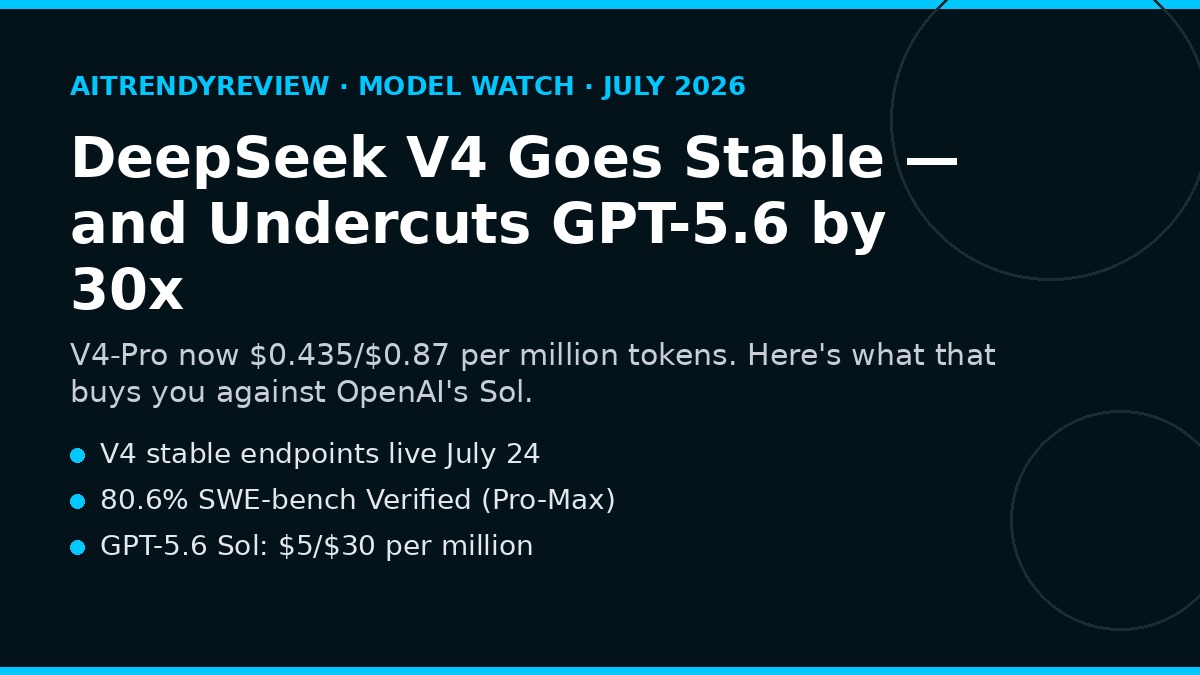
DeepSeek picked a fight on price this week, and the numbers are hard to look away from. On July 24, 2026, the company moved DeepSeek V4 to stable, retired its legacy endpoints, and posted API pricing that makes the calculator do a double take: $0.435 per million input tokens and $0.87 per million output tokens for V4-Pro. OpenAI’s GPT-5.6 Sol, the flagship it inevitably gets measured against, charges $5 and $30 for the same units. That is not a discount. That is a 34x gap on output pricing, aimed straight at every engineering team reviewing its inference bill this quarter.
How we assess: research/news-based analysis, not hands-on testing.
Should you switch from GPT-5.6 to DeepSeek V4? If you run high-volume production workloads where cost per task decides margins, V4-Pro deserves a serious pilot: it delivers roughly 85 to 90 percent of frontier coding performance at about 3 percent of Sol’s output price. If you need best-in-class agentic reliability or US-hosted inference, stay put.
Key takeaways
- 1. DeepSeek V4 went stable on July 24, 2026; older V3.x-era endpoints were retired the same day, forcing migration decisions now rather than later.
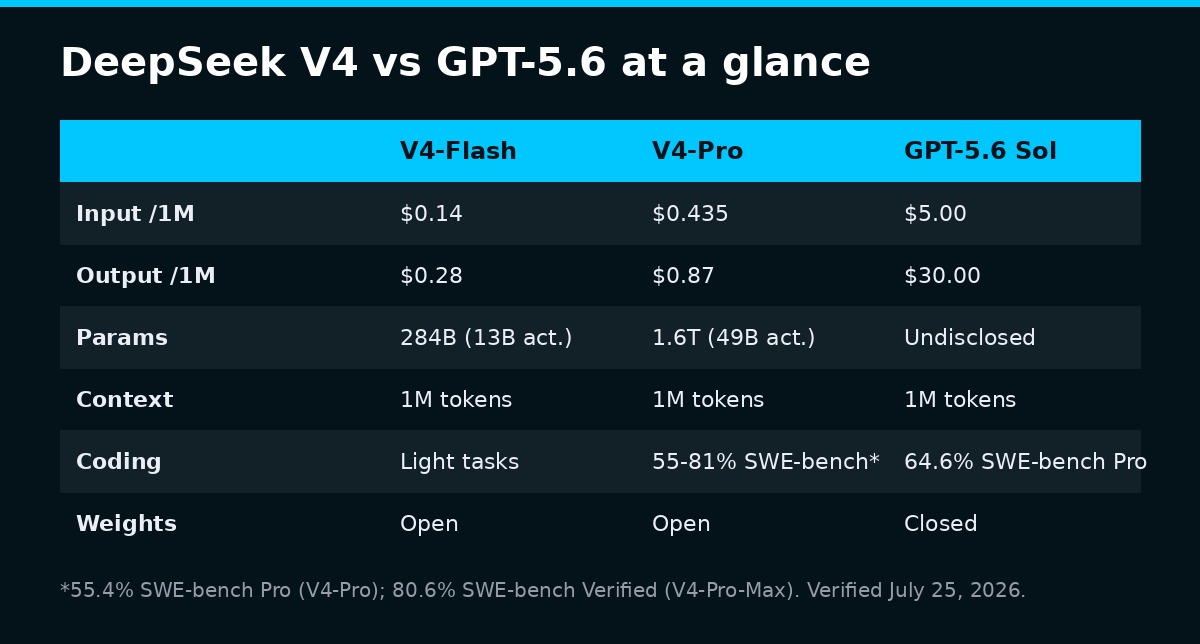
- 2. V4-Pro costs $0.435 input / $0.87 output per million tokens; V4-Flash costs $0.14 / $0.28. GPT-5.6 Sol lists at $5 / $30, Terra at $2.50 / $15, Luna at $1 / $6.
- 3. V4-Pro is a 1.6-trillion-parameter mixture-of-experts model activating 49 billion parameters per token, with a 1-million-token context window, the same context length OpenAI offers across GPT-5.6.
- 4. On coding benchmarks, V4-Pro’s published 55.4% on SWE-bench Pro trails GPT-5.6’s 64.6%, while the top-end V4-Pro-Max configuration posts 80.6% on the easier SWE-bench Verified set.
- 5. V4’s weights are open, so you can move from API to self-hosting without changing models, an exit GPT-5.6 cannot offer.
- 6. The context is a price war: V4-Flash output now costs roughly one-hundredth of Sol’s, Kimi K3’s open weights land July 27, and DeepSeek is courting a Shanghai IPO at a reported valuation of up to $71 billion.
What exactly happened on July 24?
Three things, all operational rather than ceremonial. First, DeepSeek declared the V4 family stable, ending the preview period that began with the V4 announcement earlier this year and the phased rollout we tracked in our DeepSeek V4 launch coverage. Second, it retired the legacy endpoints, which means anyone still pointing production code at pre-V4 model strings has a forced migration on the calendar — the classic lever a lab pulls when it wants its install base consolidated on one generation. Third, and most consequentially, it published stable pricing far below what early V4 access cost. During the spring preview window, V4-Pro ran $1.74 input and $3.48 output per million tokens in published comparisons. The stable price of $0.435 and $0.87 is a cut of roughly 75 percent, arriving without a quality downgrade attached. Two variants anchor the family. V4-Pro is the big one: 1.6 trillion total parameters in a mixture-of-experts arrangement that activates about 49 billion per token, paired with a 1-million-token context window. V4-Flash is the volume play: 284 billion total parameters, 13 billion active, same million-token context, at $0.14 and $0.28. Above both sits V4-Pro-Max, the configuration DeepSeek quotes for its best benchmark numbers, including 80.6% on SWE-bench Verified. Pricing that cheap from a frontier-adjacent lab reframes the whole vendor conversation, which is presumably the point.
How does GPT-5.6 justify 34x the price?
OpenAI’s answer, shipped on July 9 as the three-tier GPT-5.6 family, is capability depth and agentic plumbing. Sol, Terra, and Luna share a February 2026 knowledge cutoff, a 1-million-token context window, and 128K maximum output tokens; they differ in scale and price, from Luna’s $1/$6 through Terra’s $2.50/$15 to Sol’s $5/$30. On the benchmarks OpenAI leads with, Sol earns its billing: it set a new high of 53.6 on the Agents’ Last Exam benchmark, a 13-point jump over the nearest rival, and the API grew genuinely new machinery: programmatic tool calling that lets the model write JavaScript to orchestrate its own tool use, native subagent spawning for parallel work, and explicit prompt-cache breakpoints. Served through Cerebras hardware, GPT-5.6 has been clocked above 700 tokens per second, which changes what interactive agent loops feel like. But the coding picture is less flattering. On SWE-bench Pro, the harder repository-level suite, GPT-5.6 posts 64.6%, well behind Claude Fable 5’s 80%, a gap wide enough that OpenAI published criticism of the benchmark itself. Against DeepSeek specifically, the honest read is: GPT-5.6 is clearly ahead on agentic orchestration and terminal-heavy work (the prior GPT-5.5 already beat V4-Pro 82.7% to 67.9% on Terminal-Bench 2.0), moderately ahead on hard repository coding, and roughly at parity on knowledge and long-context retrieval, where V4-Pro’s 87.5% MMLU-Pro, 90.1% GPQA Diamond, and 83.5% MRCR at a million tokens sit within touching distance of every frontier model. Whether that delta is worth 34x depends entirely on what your tokens do all day.
What does the price gap mean in real dollars?
Abstract multipliers hide the decision, so run a concrete workload. Picture a mid-size product running an AI feature that processes 2 billion input tokens and generates 500 million output tokens a month: a support summarizer, a code-review bot, a document pipeline. On GPT-5.6 Sol that is $10,000 for input and $15,000 for output: $25,000 a month, $300,000 a year. On V4-Pro the same traffic costs $870 plus $435: about $1,305 a month, under $16,000 a year. On V4-Flash it is $420 a month. The spread between Sol and V4-Pro on this single workload is roughly $284,000 a year — a senior engineer’s fully loaded cost, recovered by an endpoint swap, if quality holds for your use case. That last clause is the entire game, and it cuts both ways. If the model writes production code where a failed patch costs review time, GPT-5.6’s benchmark edge can pay for itself. If the model summarizes tickets, extracts fields, drafts replies, or handles the long tail of internal tooling, paying frontier prices for headroom you never touch is just margin donated to OpenAI. The teams getting this right in 2026 are not picking one model; they are routing. Luna and V4-Flash for the cheap bulk lane, V4-Pro for the mid lane, Sol or Claude Opus 4.7 for the hard lane. At these prices, a router that misclassifies 10 percent of traffic still saves six figures.
Is DeepSeek V4 actually good enough for coding work?
The benchmark ladder answers in layers. At the top, no: if you need the strongest agentic coder money can buy, V4-Pro is not it, and its 55.4% SWE-bench Pro against GPT-5.6’s 64.6% (and Fable 5’s 80%) says so plainly. One step down, the answer flips. V4-Pro-Max’s 80.6% on SWE-bench Verified lands in the same neighborhood frontier models occupied within the last two generations, and the everyday reality of most coding assistance (explain this function, write this test, refactor this module, draft this migration) lives well inside that competence band. Terminal-heavy autonomous workflows are the clearest weak spot; the 15-point Terminal-Bench gap to GPT-class models means long unattended shell sessions will fail more often and need tighter guardrails. Two structural advantages partially offset that. The million-token context window means whole-repository prompting is native, not a RAG workaround, and the MRCR retrieval score suggests the long context actually works rather than merely existing. And because the weights are open, teams with compliance constraints or GPU capacity can graduate from API to self-hosted inference without a model swap — the same trajectory that made Kimi K3 the loudest open-weight story of the month before this one. For editor-integrated use through tools like Cursor, where a human reviews every suggestion anyway, the quality floor matters more than the ceiling, and V4 clears that floor at prices that make per-seat economics trivial.
How do the six models stack up line by line?
Here is the full field as of July 25, 2026, using published list prices per million tokens and vendor-quoted benchmarks.
| Model | Input /1M | Output /1M | Context | Headline coding score | Weights |
|---|---|---|---|---|---|
| DeepSeek V4-Flash | $0.14 | $0.28 | 1M | Not quoted (volume tier) | Open |
| DeepSeek V4-Pro | $0.435 | $0.87 | 1M | 55.4% SWE-bench Pro | Open |
| DeepSeek V4-Pro-Max | Premium tier | Premium tier | 1M | 80.6% SWE-bench Verified | Open |
| GPT-5.6 Luna | $1.00 | $6.00 | 1M | Family: 64.6% SWE-bench Pro | Closed |
| GPT-5.6 Terra | $2.50 | $15.00 | 1M | Family: 64.6% SWE-bench Pro | Closed |
| GPT-5.6 Sol | $5.00 | $30.00 | 1M | 53.6 Agents’ Last Exam (record) | Closed |
Read the table with one caveat: SWE-bench Pro, SWE-bench Verified, and Agents’ Last Exam measure different things, and vendors quote whichever flatters them. The safe interpretation is directional. DeepSeek owns the price columns outright, OpenAI owns the agentic ceiling, and the middle of the coding distribution is closer than the marketing on either side suggests.
Do Terra and Luna change the math for OpenAI loyalists?
They soften it without closing it. Luna at $1 input and $6 output is OpenAI’s genuine budget lane, and for teams already wired into OpenAI’s SDKs, evals, and compliance reviews, it is the path of least resistance: same API surface, same governance answers, a fraction of Sol’s cost. A workload that fits Luna’s capability band (summarization, extraction, routine drafting) costs $2,000 input plus $3,000 output on our reference 2B/500M monthly traffic, or $5,000 a month. That is five times cheaper than Sol, and for many teams it will feel like problem solved. But set it against the same traffic on V4-Pro at $1,305, or V4-Flash at $420, and the gap reopens: Luna still costs nearly 4x DeepSeek’s flagship and about 12x its volume tier, while giving up open weights and the self-hosting exit that come standard on the DeepSeek side. Terra occupies the awkward middle: at $2.50/$15 it prices like a flagship without being one, and the honest use case is teams that need better-than-Luna quality with OpenAI governance and cannot look outside the fence. The strategic read matters more than any single tier. OpenAI segmented GPT-5.6 into three prices because flat frontier pricing was leaking customers at the bottom; DeepSeek just moved the bottom two orders of magnitude further down. Tiering is what defending a price umbrella looks like. July 24 is what folding one looks like.
Why is DeepSeek pricing this aggressively now?
Because the timing serves three campaigns at once. The first is the open-weight price war. Chinese labs have spent 2026 turning efficient mixture-of-experts architectures into a cost weapon, and the current league table is stark: V4-Flash’s $0.28 output price is roughly one-hundredth of Sol’s $30. Moonshot’s Kimi K3, a 2.8-trillion-parameter MoE that topped coding leaderboards at launch, releases open weights on July 27, three days after DeepSeek’s stable drop. That sequencing is not a coincidence; it is a bid to own the migration window. The second campaign is financial. DeepSeek is reportedly targeting a Shanghai STAR-market listing at a valuation of up to $71 billion, having raised $7.4 billion in June, and nothing sells an IPO like visible market-share capture from OpenAI. Moonshot is running the same play toward Hong Kong at a reported $50 billion. The third campaign is strategic positioning under US export controls: constrained on top-end compute, Chinese labs compete on efficiency per dollar rather than raw frontier capability, and pricing at cost-plus-nothing converts that constraint into a story about abundance. None of this obligates you to care about the geopolitics, but it does tell you the discount is structural rather than promotional. A lab racing toward a public listing on usage growth is the opposite of a lab about to raise prices.
What are the real risks of switching?
Four deserve eyes-open acknowledgment. Data governance first: DeepSeek’s hosted API runs on infrastructure subject to Chinese jurisdiction, which is an automatic disqualifier for plenty of regulated workloads in the US, UK, and EU. The clean mitigation is the open weights — self-host on your own cloud and the jurisdiction question dissolves, at the price of running inference yourself or paying a US-based host that serves V4. Second, capability regressions at the edges: benchmark parity in the middle of the distribution does not guarantee parity on your weirdest inputs, so pilot with your actual traffic, not with vibes. Third, operational maturity: OpenAI’s rate limits, uptime record, SDK ecosystem, and enterprise support remain the industry’s default, and DeepSeek’s rapid endpoint retirements (including the one that just happened) show a lab that moves fast and expects its customers to keep up. Fourth, concentration risk in the other direction: teams that fled OpenAI pricing only to hard-wire DeepSeek endpoints have traded one dependency for a cheaper one. The pattern that survives contact with 2026 is model-agnostic plumbing: an abstraction layer, evals that run against any provider, and traffic routing you can repoint in an afternoon. Do that, and this week’s price cut is free money; skip it, and you are speculating on a vendor either way.
How should you run a V4 pilot this week?
A useful pilot takes five working days, not a quarter, and the shape is the same for a two-person startup or a platform team. Day one: freeze a traffic sample. Export 200 to 500 real requests from your logs: actual prompts, actual context lengths, including the ugly ones with malformed inputs and edge-case languages, because those are where cheap models earn or lose the switch. Day two: build the harness. If you already run evals, add V4-Pro and V4-Flash as providers; if you do not, this is the forcing function to stop grading models by vibes. Score whatever your product actually needs: exact-match extraction, rubric-graded summaries, unit-test pass rates for code. Day three: run all lanes. Send the sample through your incumbent, V4-Pro, and V4-Flash, and log cost, latency, and failure modes alongside quality. Latency deserves real attention: OpenAI’s Cerebras-served 700-plus tokens per second is a different interactive experience from typical V4 serving speeds, and a chat product feels that difference even when a batch pipeline never would. Day four: read the failures, not the averages. A model that scores 92 percent with random misses is safer than one that scores 94 percent but reliably fails a category your customers care about. Day five: decide per lane, not globally. The most common sane outcome is a split: bulk lane to V4-Flash or V4-Pro, hard lane stays on your incumbent, and a router in front. If the pilot says switch nothing, you have still bought something valuable: a working eval harness and bargaining power for your next OpenAI renewal conversation, which is worth the week by itself.
Verdict: the price war is the product
DeepSeek V4’s stable release is not the best model of July 2026. It is the most important pricing event of the month, and probably the quarter. V4-Pro at 87 cents per million output tokens resets what competent-tier inference should cost, the way GPT-5.4 once reset expectations at the frontier. For cost-driven production workloads, the pilot is close to obligatory: the downside is a week of eval work, the upside is five or six figures a year. For frontier agentic work, GPT-5.6 Sol and its programmatic tool calling remain worth their premium, and nothing in DeepSeek’s release changes that. The larger shift is psychological. Every procurement conversation from now on happens in the shadow of a 34x gap, every OpenAI renewal gets benchmarked against it, and with Kimi K3’s weights landing July 27, the floor is not done falling. Cheap intelligence stopped being a rumor this week. Plan like it. And if you only take one action from this analysis, make it the eval harness: the labs will keep repricing the market every few weeks through this IPO cycle, and the teams that can re-run a five-day pilot on demand are the ones who get to treat every price cut as a gift instead of a gamble. The rest will still be reading launch posts, wondering whether the numbers apply to them.
One more date for the calendar: July 27, when Moonshot releases Kimi K3’s open weights. If K3’s hosted pricing lands anywhere near its benchmark reputation, the competent-tier price floor drops again within the week, and this article’s math gets another rewrite before August.
FAQ
What is the difference between DeepSeek V4-Pro and V4-Flash?
V4-Pro is the 1.6-trillion-parameter flagship (49 billion active per token) at $0.435/$0.87 per million tokens. V4-Flash is a 284-billion-parameter model (13 billion active) at $0.14/$0.28, built for high-volume, lighter-reasoning work. Both carry 1-million-token context windows.
How much cheaper is DeepSeek V4 than GPT-5.6?
Against GPT-5.6 Sol, V4-Pro is about 11x cheaper on input and 34x cheaper on output. Against the mid-tier Terra, V4-Pro is still roughly 6x to 17x cheaper depending on direction. V4-Flash output undercuts Sol by about 107x.
Is DeepSeek V4 better than GPT-5.6 at coding?
No on published head-to-head numbers: GPT-5.6 leads SWE-bench Pro 64.6% to V4-Pro’s 55.4%, and GPT-class models hold a large edge on terminal-driven agent benchmarks. V4-Pro-Max’s 80.6% SWE-bench Verified shows the family is competent, not frontier.
Can I self-host DeepSeek V4?
Yes. The V4 family ships open weights, so you can run it on your own GPUs or through a US-hosted inference provider — the standard route for teams that like the price but cannot use a China-hosted API.
What happened to older DeepSeek models on July 24?
DeepSeek retired its legacy endpoints when V4 went stable on July 24, 2026. Applications pinned to older model strings need to migrate to V4-Pro or V4-Flash.
Which GPT-5.6 tier competes with V4-Pro on price?
None closely. Luna, the cheapest GPT-5.6 tier at $1/$6, still costs about 2.3x more on input and 7x more on output than V4-Pro, though Luna is the natural comparison for cost-sensitive OpenAI loyalists.
Does DeepSeek V4 support long documents?
Yes: the 1-million-token context window handles whole codebases or hundreds of pages in one prompt, and V4-Pro’s 83.5% MRCR score at 1M tokens indicates the retrieval quality holds up at that length.
Should a solo developer or small team switch?
If your monthly model bill is under about $100, switching costs outweigh savings; stay wherever your tooling works. Above roughly $500 a month in API spend, a one-week V4 pilot on your real traffic is easy to justify.
Sources
- Build Fast with AI: DeepSeek V4 stable release and pricing (July 24, 2026) (Verified July 25, 2026)
- ThursdAI: July 2026 model release tracker (GPT-5.6 family pricing) (Verified July 25, 2026)
- Simon Willison: The new GPT-5.6 family — Luna, Terra, Sol (Verified July 25, 2026)
- DataCamp: DeepSeek V4 benchmarks and architecture (Verified July 25, 2026)
- DeepSeek official site (Verified July 25, 2026)
- LLM Stats: July 2026 release dates (Verified July 25, 2026)

Naveen Kumar Durai is the founder of Naveen AI Automation and the reviewer behind AITrendyReview. He builds AI automation systems daily and reviews AI tools from official docs, live pricing pages, and verified user reports — updated monthly as tools change.