Pilot and Bench used to be the two obvious answers to “who should do my startup’s books?” Then one of them died. On December 27, 2024, Bench shut off access for thousands of small businesses overnight, and the comparison stopped being about features. In 2026, Bench is back under new ownership, Pilot has pushed hard into AI-assisted bookkeeping with a $99 entry plan, and the real question founders are asking has changed shape. It is no longer just “which one is cheaper?” It is “which one can I trust with my financial records, and what exactly am I paying for?”
Should you choose Pilot or Bench Accounting in 2026? Pilot is the safer, more capable pick for funded startups: it runs on QuickBooks Online, offers accrual bookkeeping, tax filing, and CFO services, with plans from $99/month. Bench is cheaper for simple small businesses at $199–$599/month, but it shut down in December 2024 and now operates under Employer.com, so continuity risk is real.
How we assess: this review is based on official documentation, pricing pages, changelogs, and verified user reports, not hands-on testing.
Key takeaways
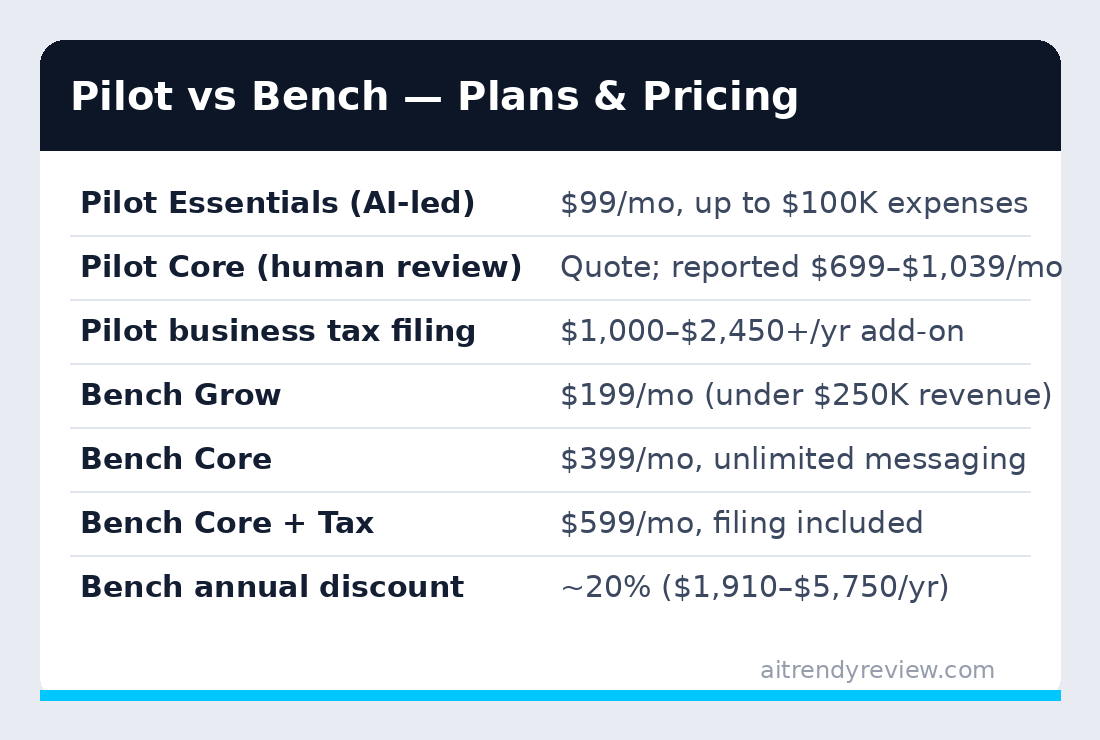
- Pilot’s entry plan costs $99/month (AI-led, covers up to $100,000 in monthly expenses); its human-reviewed Core plan is quote-based, with third-party reporting placing it around $699–$1,039/month.
- Bench costs $199–$599/month across three plans, or $1,910–$5,750/year with the roughly 20% annual discount.
- Bench shut down abruptly on December 27, 2024, leaving about 650 employees jobless and clients locked out; Employer.com bought it days later for a reported $9 million.
- Pilot works exclusively on QuickBooks Online and supports accrual-basis books; Bench uses its own proprietary software and its Grow plan caps clients at $250,000 in annual revenue.
- Bench’s Core + Tax plan bundles federal and state income tax filing at $599/month; Pilot prices tax separately, from $1,000/year for a single-member LLC to $2,450+/year for C-corps.
- At least 1 lawsuit (filed March 2025) accused the new Bench of charging customers for services they had already paid for under the old company.
What Happened to Bench Accounting, and Is It Safe to Use in 2026?
Bench Accounting collapsed without warning on December 27, 2024, was bought by HR-tech firm Employer.com on December 30, 2024, and relaunched in January 2025. It still operates in 2026 and still sells bookkeeping plans, but the shutdown, a reported $65.4 million in liabilities, and post-acquisition billing disputes mean the trust question is legitimate.
The details matter here, because they explain why this comparison reads differently than it did two years ago. Bench was founded in 2012, raised over $100 million in venture funding, and served tens of thousands of small businesses with its own proprietary bookkeeping software. According to Wikipedia’s documented timeline, its bankruptcy filing revealed $65.4 million in liabilities against just $2.8 million in cash. When the doors closed, roughly 650 employees lost their jobs with no notice, and customers lost access to their own financial records mid-tax-season.
Employer.com stepped in within 72 hours and bought the brand and assets for a reported $9 million. Bench 2.0 was live again by January 2025. That sounds like a rescue, and in some ways it was. But the transition was not clean. In March 2025, TechCrunch reported that customers were being asked to pay again for services already prepaid under the old Bench, including completed 2023 tax returns. One customer, Qorum, filed a lawsuit alleging exactly that. Employer.com’s CMO disputed the claims and said prepaid services were being honored, but the founder involved contradicted that account on the record.
Here is the honest read: Bench in 2026 is a functioning bookkeeping service with new ownership, ongoing operations, and real bookkeepers doing real work. It is not a scam. But it is also a brand that has burned customers once, and the acquirer’s handling of prepaid obligations was messy enough to end up in court. If your books are mission-critical (you are raising a round, facing an audit, or filing complex returns), that history belongs in your decision.
How Much Does Pilot Cost in 2026?
Pilot’s bookkeeping starts at $99/month for its AI-led Essentials plan, which covers businesses with up to $100,000 in monthly expenses. The human-reviewed Core plan is now quote-based (“contact sales”), with third-party reporting from January 2026 placing typical Core pricing between $699 and $1,039 per month, billed annually.
Pilot restructured its pricing page around three bookkeeping tiers, and the shape of the ladder tells you who Pilot wants as a customer:
- Essentials, $99/month. AI-powered transaction categorization, account reconciliation, monthly book closing, and in-app support. This is Pilot’s answer to the wave of cheap AI bookkeeping tools, and at this price it undercuts Bench’s cheapest plan by half. The catch: no dedicated human bookkeeper reviewing your books each month.
- Core, quote-based. Everything in Essentials plus a US-based bookkeeper who reviews the AI’s work, cash or accrual-basis bookkeeping, bill management (up to 10/month), a custom chart of accounts, and reports delivered by the 10th business day. Fit Small Business’s January 2026 review reports Core landing between $699 and $1,039/month depending on expense volume, with an onboarding fee equal to one month of service.
- Custom, quote-based. Adds full AR/AP, payroll administration support, reports by the 6th business day, and CFO advisory hooks. This is for companies with real complexity: multiple entities, inventory, or a board that expects clean monthly reporting.
Tax is priced separately, and this is where Pilot invoices grow. Business income tax filing runs $1,000+/year for a single-member LLC, $2,000+/year for partnerships and S-corps, and $2,450+/year for C-corps, all requiring an active bookkeeping subscription. Delaware franchise tax filing is included for the corporate plans. Add-ons stack from there: $250–$500 per extra state or city filing, $2,500 per foreign subsidiary (Form 5471), and $1,000 per individual return. CFO services start at $1,750/month, and Pilot’s R&D tax credit service takes 20% of the credit it captures, on credits up to $500,000 annually.
One structural fact shapes everything about Pilot: it runs exclusively on QuickBooks Online. Your books live in QBO under the hood, which means your data is portable. If you fire Pilot, you keep a standard QuickBooks file any accountant on earth can pick up. After what happened to Bench customers in December 2024, that portability is not a footnote. It might be the single strongest argument in Pilot’s favor.
How Much Does Bench Cost in 2026?
Bench sells three main plans in 2026: Grow at $199/month, Core at $399/month, and Core + Tax at $599/month. Paying annually cuts roughly 20%, bringing them to $1,910, $3,830, and $5,750 per year respectively. A free trial covers one prior month of bookkeeping with a delivered set of financial statements.
The current Bench pricing page breaks down like this:
- Bookkeeping Grow, $199/month ($1,910/year). Dedicated bookkeeping team, monthly books, year-end tax-ready financials, P&L, balance sheet, and 1099 reporting. The significant restriction: Grow is limited to businesses under $250,000 in annual revenue, and communication happens through pre-scheduled touchpoints rather than on demand.
- Bookkeeping Core, $399/month ($3,830/year). Same deliverables as Grow with the revenue cap lifted and unlimited communication with your bookkeeping team.
- Core + Tax, $599/month ($5,750/year). Adds licensed tax professionals who prepare and file annual income tax returns for partnerships, S-corps, and C-corps, plus individual filing for sole proprietors. This bundling is Bench’s best pricing story: a small S-corp gets books and tax filing for $5,750/year, where the equivalent Pilot stack (Core bookkeeping plus $2,000+ S-corp tax) would likely exceed $10,000.
- QBO Certified Bookkeeper, $55/hour plus $1,200 onboarding. A newer offering where a Bench bookkeeper works inside your own QuickBooks Online file. It is a quiet admission that Bench’s biggest historic weakness, proprietary software, is something customers now price in.
That last point deserves expansion. Classic Bench plans keep your books inside Bench’s own platform, not QuickBooks or Xero. The interface is cleaner than QBO and pleasant to use, by most verified user accounts. But when Bench went dark in December 2024, customers discovered the downside all at once: your books lived in software you could no longer log into. The company posted export instructions during the wind-down, but people mid-tax-season were scrambling. Any 2026 evaluation of Bench’s $199 price tag has to include that scenario, because it already happened once.
Bench also historically ran cash-basis books (with accrual-style adjustments available on higher tiers), which suits freelancers and simple service businesses but breaks down for startups with deferred revenue, inventory, or investors who expect GAAP-style accrual reporting.
Pilot vs Bench: Which Has Better Features for Startup Bookkeeping?
Pilot wins on features that matter to funded startups: accrual-basis books, QuickBooks Online portability, CFO and R&D credit services, and reports built for investor scrutiny. Bench wins on simplicity and bundled tax filing for small service businesses. The two products are increasingly aimed at different customers, despite two decades of head-to-head comparisons.
| Tool | Price | Free plan/trial | Best for | Key limit |
|---|---|---|---|---|
| Pilot | $99/mo (Essentials); Core quote-based, reported ~$699–$1,039/mo | No free plan; pre-revenue startup discounts | Funded startups needing accrual books + CFO/tax stack | QuickBooks Online only; tax costs extra ($1,000+/yr) |
| Bench | $199–$599/mo ($1,910–$5,750/yr annual) | Free prior-month bookkeeping trial | Simple small businesses wanting books + tax in one bill | Proprietary software; Grow capped at $250K annual revenue; 2024 shutdown history |
| QuickBooks Live | Quote-based (consultation required) | No free plan | Existing QBO users wanting Intuit-backed help | Bookkeeping only; no CFO or R&D credit services |
Beyond the table, four feature differences decide most real-world choices between Pilot and Bench:
Accounting basis. Pilot Core supports accrual-basis bookkeeping (and cash, if you want it). Bench is cash-basis first. If you have investors, revenue recognition questions, or plans to raise, accrual is not optional, and that alone rules Bench out for most venture-backed companies.
Data portability. Pilot’s QuickBooks Online foundation means leaving Pilot is an inconvenience, not a crisis. Leaving classic Bench means exporting your history out of proprietary software. December 2024 demonstrated the worst-case version of that export under time pressure.
Service ceiling. Pilot can grow with you: CFO advisory from $1,750/month, R&D tax credit capture, Delaware franchise tax, foreign subsidiary filings. Bench’s ceiling is annual tax filing. A company that outgrows Bench must switch providers; a company that outgrows Pilot Essentials just upgrades tiers.
Support model. Bench’s Grow plan schedules communication in advance; unlimited messaging starts at Core ($399/month). Pilot Essentials is app-based support with AI answers; a dedicated team arrives with Core. Neither gives you a phone-a-human hotline at the entry tier, which frustrates a predictable share of reviewers on both sides — Capterra reviews for both products repeat this complaint across 2025–2026.
Who Should Choose Pilot in 2026?
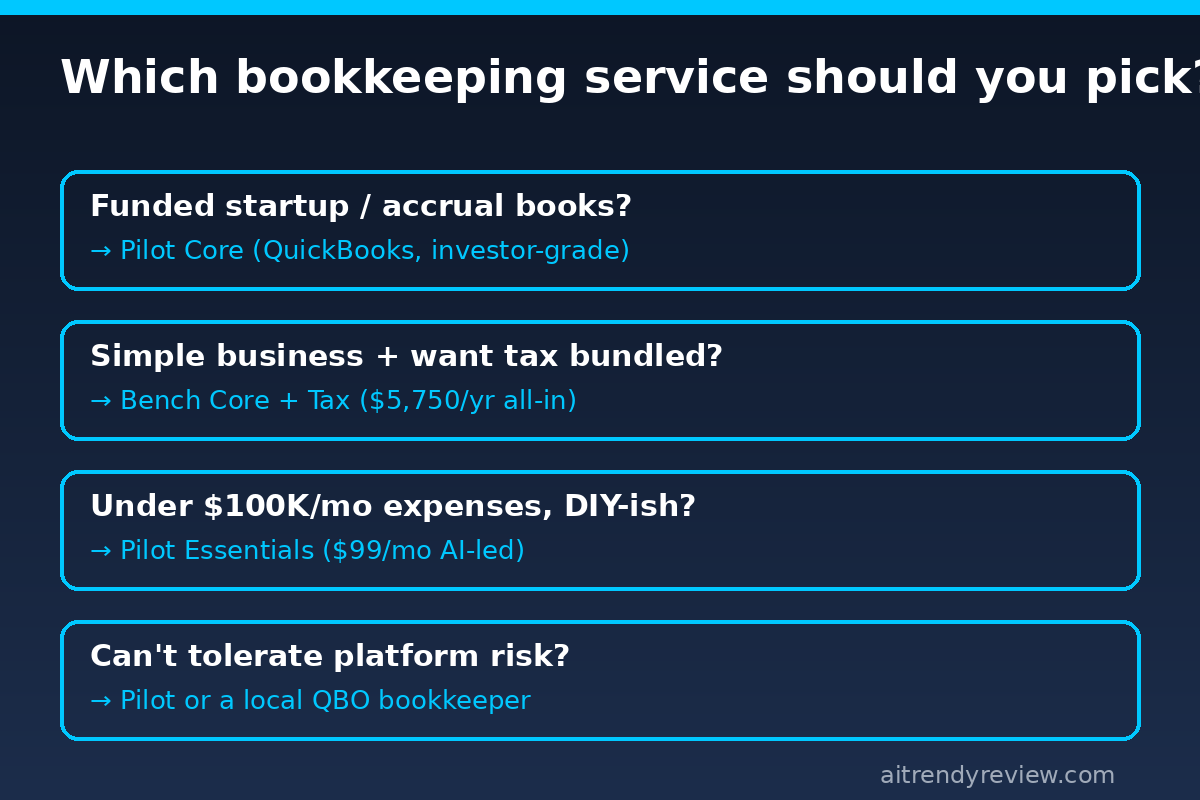
Pilot fits funded startups and growth companies that treat bookkeeping as infrastructure. If you have raised money, sell on contracts, carry deferred revenue, or expect diligence from investors or acquirers, Pilot’s accrual books, QuickBooks portability, and stacked services justify its higher price.
The use-case mapping is fairly clean. If you are a pre-seed or seed-stage startup with real expenses but no finance hire, Pilot Core is the default choice: it produces the accrual financials your next round’s data room will need, and pre-revenue startups get Core discounts. If you are a bootstrapped SaaS or agency doing under $100K/month in expenses and you mainly need clean, reconciled books, Pilot Essentials at $99/month is one of the cheapest credible options anywhere, provided you accept AI-first categorization with no monthly human review. If you claim R&D tax credits, Pilot’s 20%-of-credit service can pay for a chunk of the subscription; on a $200,000 credit, Pilot’s fee is $40,000, so run that math against a flat-fee R&D specialist first.
Who should not pick Pilot? Sole proprietors who need personal tax returns bundled cheaply, businesses that hate QuickBooks, and anyone allergic to quote-based pricing. The disappearance of public Core pricing in 2026 is a genuine downgrade in transparency: the pricing page now shows “contact sales” where a dollar figure used to be, and that always precedes a bigger invoice, not a smaller one. Our full Pilot AI bookkeeping review goes deeper on where the AI layer actually saves money and where it is marketing.
Founders assembling a broader operations stack should note that bookkeeping is the one category where “cheapest tool” thinking backfires hardest. The same buyers comparing Pilot and Bench are usually also weighing AI tools for the rest of the back office — our comparison of Notion AI vs ClickUp AI for workspace automation and our roundup of Devin AI alternatives for startups cover the adjacent decisions.
Who Should Choose Bench in 2026?
Bench fits freelancers, solo consultants, and simple service businesses that want books and tax filing handled in one predictable bill under $600/month. If your business is cash-basis, under a few hundred thousand in revenue, and you would rather never open accounting software, Bench’s bundle is hard to beat on price.
Consider the actual arithmetic for a small S-corp consultancy doing $200,000/year. Bench Core + Tax runs $5,750/year, everything included. The comparable Pilot stack: Core bookkeeping (reported $699+/month = $8,400+/year) plus S-corp tax filing ($2,000+/year): call it $10,400 minimum, nearly double. For that business, Pilot’s extra rigor buys nothing it needs. Bench’s cash-basis books are fine for its tax situation, its “revenue cap” problem does not exist at Core tier, and the dedicated team model works.
The trust question, then, is the whole decision. Reasons for cautious optimism: Employer.com has kept Bench running for over a year and a half since the January 2025 relaunch, the free prior-month trial lets you inspect output before paying, and the new QBO Certified Bookkeeper option ($55/hour + $1,200 onboarding) gives nervous customers a portable-data path that old Bench never offered. Reasons for continued caution: the March 2025 prepaid-services lawsuit, the abruptness of the original shutdown, and the fact that Bench’s classic plans still keep your books in proprietary software.
A practical middle path if you go with Bench in 2026: pay monthly rather than annually for the first six months (the 20% annual discount is not worth prepaying a company with this recent history), export your financial statements quarterly, and keep your own copies of every bank statement. That is cheap insurance against a repeat of December 2024.
What Are the Best Alternatives to Pilot and Bench?
The strongest alternatives in 2026 are QuickBooks Live for existing QBO users, Zeni and indinero for startups wanting Pilot-style service with different pricing, and a fractional bookkeeper for anyone who values a direct human relationship over a platform.
QuickBooks Live is Intuit’s in-house service, sold via consultation with no public pricing in 2026. Its assisted tier coaches you through your own books; its full-service tier does the monthly close for you. It is the lowest-risk brand in the category, since Intuit is not getting acquired over a weekend, but it stops at bookkeeping, with no CFO or R&D credit layer.
Zeni pitches AI-plus-human finance teams for startups and publishes aggressive comparisons against Pilot; indinero bundles bookkeeping, tax, and CFO services in a shape similar to Pilot’s Custom tier. Both are worth quotes if Pilot’s numbers come back high. For e-commerce specifically, Finaloop and doola built tooling around inventory and marketplace reconciliation that neither Pilot nor Bench handles natively.
And the unglamorous option outperforms more often than this industry admits: a good local bookkeeper on QuickBooks or Xero typically charges $300–$600/month for a small business, answers the phone, and never gets shut down by a venture board. The AI-vs-human framing that dominates this category (one we examined across the professional services space in our Harvey AI vs CoCounsel comparison for legal work) applies here too: the AI layer is genuinely good at categorization volume, and genuinely bad at judgment calls like revenue recognition, owner distributions, and “is this deductible?”

Pilot vs Bench: Worth It or Skip It?
Pilot is worth it if: you are a funded or scaling startup that needs accrual books ($699–$1,039/month reported Core pricing buys real rigor); you want your books in portable QuickBooks Online format; you plan to use CFO services or R&D credit capture; or you want a credible $99/month AI-led option and can live without monthly human review.
Skip Pilot if: you are a sole proprietor who mainly needs cheap bundled tax filing; you refuse quote-based sales processes; or your books are simple enough that a $199 Bench plan or a local bookkeeper covers you.
Bench is worth it if: you run a simple, cash-basis service business and the Core + Tax bundle at $599/month ($5,750/year) replaces both a bookkeeper and a tax preparer; you want the free prior-month trial to judge quality before paying; and you are willing to export statements regularly as a hedge.
Skip Bench if: you need accrual-basis books or investor-grade reporting; you cannot tolerate platform-continuity risk after the December 2024 shutdown; your business exceeds the Grow plan’s $250,000 revenue cap and you would land on pricier tiers anyway; or prepaying a year to any recently-bankrupt brand makes your stomach turn. It should.
The bottom line runs against the old conventional wisdom. For years, this matchup was “Bench for cheap simplicity, Pilot for growth” and both were safe defaults. In 2026, only one of them has never locked customers out of their own books. Price Bench’s discount against that fact, and for any business where the books actually matter — fundraising, audits, acquisition — Pilot is the disciplined choice even at twice the cost.
FAQ: Pilot vs Bench Accounting
Is Bench Accounting still in business in 2026?
Yes. Bench shut down abruptly on December 27, 2024, but was acquired by Employer.com on December 30, 2024 for a reported $9 million and relaunched in January 2025. As of August 2026 it operates normally, selling bookkeeping plans from $199/month, though it now runs as an Employer.com subsidiary.
How much does Pilot bookkeeping cost per month?
Pilot’s Essentials plan costs $99/month and uses AI-powered categorization for businesses with up to $100,000 in monthly expenses. The Core plan with a dedicated US-based bookkeeper is quote-based; Fit Small Business’s January 2026 reporting places it between $699 and $1,039/month, billed annually, plus an onboarding fee of about one month’s service.
Which is cheaper, Pilot or Bench?
Bench is cheaper for full-service bookkeeping with human review: $199–$399/month versus Pilot’s reported $699+/month Core plan. But Pilot’s AI-led Essentials plan at $99/month undercuts every Bench tier. For books plus business tax filing, Bench Core + Tax at $5,750/year beats the equivalent Pilot stack, which typically exceeds $10,000.
Does Pilot use QuickBooks?
Yes, exclusively. Pilot performs all bookkeeping in QuickBooks Online, and no other accounting platform is supported. This means your financial data stays in a standard, portable format that any accountant can take over, which became a major selling point after Bench’s 2024 shutdown trapped customer books inside proprietary software.
Does Bench file taxes?
Yes, on its top plan. Bench’s Core + Tax plan ($599/month, or $5,750/year billed annually) includes licensed tax professionals who file annual income tax returns for partnerships, S-corps, and C-corps, plus individual returns for sole proprietors. The Grow ($199/month) and Core ($399/month) plans deliver year-end tax-ready financials but no filing.
What happened to customers who prepaid Bench before the shutdown?
It got contentious. TechCrunch reported in March 2025 that some customers were asked to pay again for services prepaid under old Bench, including completed 2023 tax returns, and one customer, Qorum, sued. Employer.com stated it honors prepaid services, but the dispute is a reason to avoid long prepaid terms with Bench today.
Is Pilot’s $99 Essentials plan good enough for a small business?
For simple businesses, often yes. Essentials includes AI transaction categorization, reconciliation, monthly closes, and covers up to $100,000 in monthly expenses, which is strong value at $99/month. But there is no dedicated human bookkeeper reviewing output monthly, so businesses with tricky revenue recognition, inventory, or heavy manual judgment calls should budget for Core instead.
Can I switch from Bench to Pilot?
Yes. Pilot offers catch-up and cleanup bookkeeping and onboards your history into QuickBooks Online. You will need to export your Bench financial statements and transaction history first, then Pilot rebuilds from bank feeds and statements. Expect an onboarding fee of roughly one month’s Pilot service and plan the switch outside tax season.
Sources
Prices checked August 4, 2026:
- Pilot official pricing page
- Bench official pricing page
- Fit Small Business — Pilot Bookkeeping Review (updated January 13, 2026)
- TechCrunch — Bench billing dispute report (March 14, 2025)
- Wikipedia — Bench Accounting timeline

Naveen Kumar Durai is the founder of Naveen AI Automation and the reviewer behind AITrendyReview. He builds AI automation systems daily and reviews AI tools from official docs, live pricing pages, and verified user reports — updated monthly as tools change.