Anthropic shipped Claude Opus 5 on July 24, 2026, and buried the most interesting fact in the pricing table: it costs exactly what Opus 4.8 cost, $5 per million input tokens and $25 per million output, while posting benchmark numbers that crowd Anthropic’s own twice-as-expensive flagship tier. That pricing decision, more than any single benchmark, is the story. Frontier-adjacent capability just got a 50% price cut.
Is Claude Opus 5 worth it? Yes, for most paid Claude users and API builders. Opus 5 matches or approaches Anthropic’s $10/$25-class Fable 5 on coding and computer-use benchmarks at half the API price ($5 input, $25 output per million tokens), ships as the default on Claude Max, and is the strongest model on the $17-a-month Pro plan.
How we assess: this review is based on official documentation, pricing pages, changelogs, and verified user reports, not hands-on testing.
Key takeaways
- Claude Opus 5 launched July 24, 2026 at $5/$25 per million tokens, unchanged from Opus 4.8 and half the $10/$50 rate of Fable 5 and Mythos 5.
- On CursorBench 3.2 it lands within 0.5% of Fable 5’s peak coding score at half the cost, and it more than doubles Opus 4.8 on Frontier-Bench v0.1.
- Its ARC-AGI 3 score is roughly 3x the next-best model, Anthropic’s strongest published novel-reasoning result to date.
- Fast Mode runs about 2.5x quicker for exactly 2x the price ($10/$50); the Batch API halves costs to $2.50/$12.50.
- It is Anthropic’s best-aligned model on record, with a 2.3 misaligned-behavior score and safety classifiers intervening about 85% less often than on Fable 5.
- Included from the $17/month annual Pro plan up; default model on Max plans starting at $100/month.
What is Claude Opus 5 and what actually changed?
Claude Opus 5 is Anthropic’s new mid-priced frontier model, released July 24, 2026 across Claude.ai, Claude Code, Claude Cowork, the API, AWS Bedrock, Google Cloud, and Microsoft Foundry. It replaces Opus 4.8 at the same price and becomes the default model on Claude Max plans, with headline gains in agentic coding, computer use, and self-verification.
The generational jump is larger than the version number suggests. Per Anthropic’s announcement, Opus 5 more than doubles Opus 4.8’s performance on Frontier-Bench v0.1 while costing less to run per task, and Anthropic describes it as “much stronger at verifying its work and iterating.” That self-checking claim matters more than raw scores for anyone running long agentic sessions, because unverified errors compound across a fifty-step workflow in ways a benchmark table never shows.
Two beta features arrived with the model. Mid-conversation tool switching lets an agent change its toolset without restarting a session, and automatic fallbacks route safety-flagged requests to an alternate model instead of returning a refusal. The second one is quietly a big deal for production apps, where a hard refusal mid-pipeline is an outage, not an inconvenience.
Context window stays at 200,000 tokens per Anthropic’s pricing docs, with no premium for filling it. If you were hoping Opus 5 would inherit the million-token window some other Claude variants list, that did not happen. For most coding and document work 200k is plenty; for whole-codebase ingestion it is the model’s clearest spec-sheet weakness. We reviewed its predecessor in depth in our Claude Opus 4.7 review, and the short version of the delta since then: same price, roughly double the agentic capability, meaningfully better alignment scores.
How much does Claude Opus 5 cost in 2026?
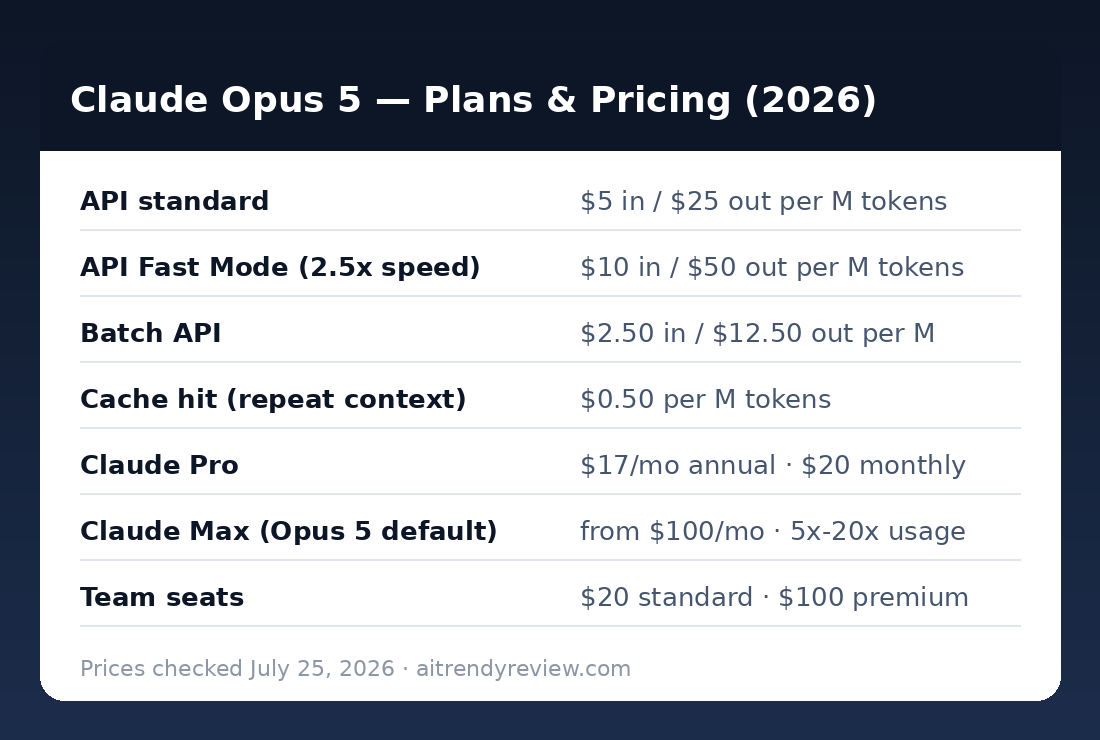
Claude Opus 5 costs $5 per million input tokens and $25 per million output tokens through the API, identical to the Opus 4.x line. Consumer access starts on the Claude Pro plan at $17/month billed annually ($20 monthly), and Opus 5 is the default model on Claude Max plans from $100/month.
The full price stack, from Anthropic’s pricing docs and claude.com/pricing (checked July 25, 2026): Batch API processing halves rates to $2.50/$12.50 for non-urgent jobs. Prompt caching writes cost $6.25 per million (5-minute cache) and cache hits just $0.50, a 90% discount on repeated context. Fast Mode, available only on Opus 5 and 4.8, doubles every rate to $10/$50 for roughly 2.5x speed. Teams pay $20/seat annually for standard seats or $100/seat for premium seats with 5x usage.
| Model | Price (per M tokens) | Free plan | Best for | Key limit |
|---|---|---|---|---|
| Claude Opus 5 | $5 in / $25 out | No (Pro $17/mo+) | Agentic coding, knowledge work | 200k context |
| Claude Opus 4.8 | $5 in / $25 out | No | Fallback / legacy pipelines | Superseded on 8+ benchmarks |
| Claude Fable 5 | $10 in / $50 out | No | Peak coding scores | 2x cost for <0.5% gain |
| Claude Mythos 5 | $10 in / $50 out | No | Frontier research tasks | 2x cost, overkill for most |
| Claude Sonnet 5 | $2 in / $10 out (intro to Aug 31) | Free tier access | High-volume production | $3/$15 after intro ends |
| Claude Haiku 4.5 | $1 in / $5 out | Free tier access | Simple classification, routing | 100k context |
One position worth stating plainly: at these prices there is no remaining reason to default to Fable 5 for coding work. Paying double for a benchmark gap under half a percent is a rounding-error purchase, and Anthropic knows it, which is presumably why Opus 5 is now the default on Max. Fable 5 and Mythos 5 stay relevant only at the frontier edges: offensive-security research and long-horizon autonomous biology work, where Anthropic itself says Mythos 5 still leads.
How good are Claude Opus 5’s benchmarks, really?
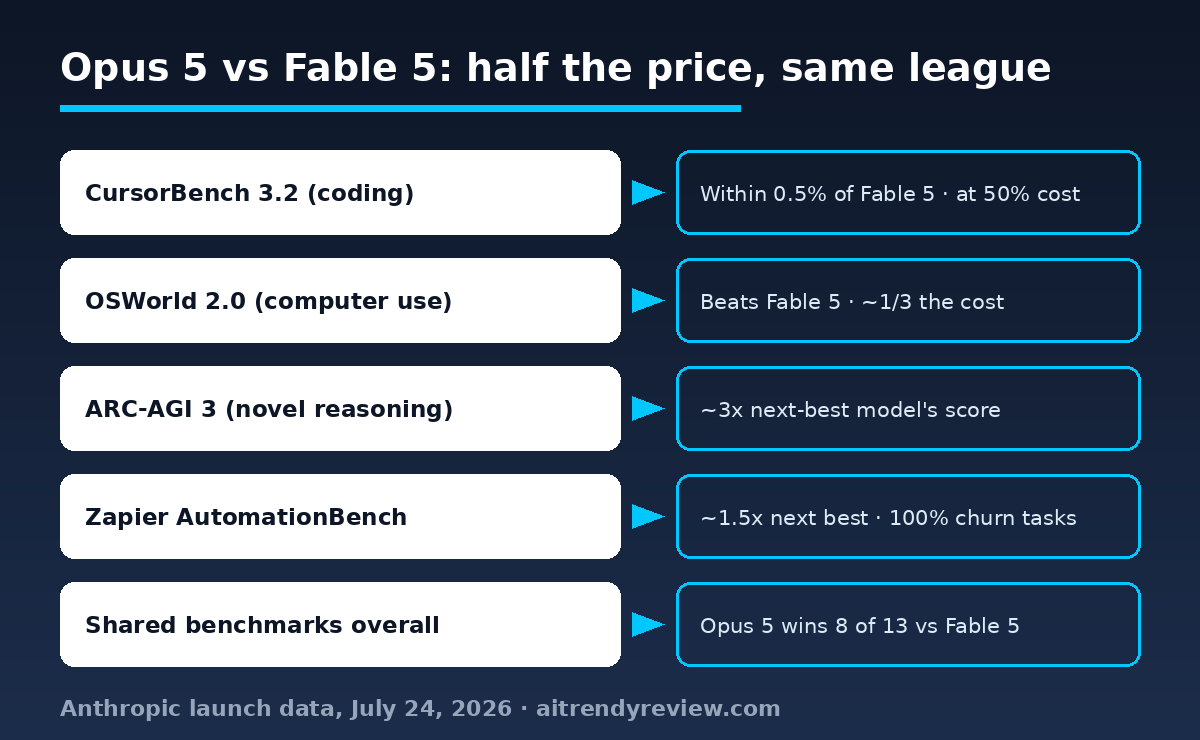
Opus 5 posts state-of-the-art results on Frontier-Bench v0.1 and GDPval-AA v2, lands within 0.5% of Fable 5 on CursorBench 3.2 coding at half the cost, and scores roughly three times the next-best model on ARC-AGI 3. The honest caveat: most of these numbers are Anthropic’s own, published at launch, with independent verification still days or weeks away.
The pattern across the published suite is consistency rather than one spike. Per Anthropic’s launch data and SiliconANGLE’s coverage, Opus 5 beat Fable 5 on 8 of 13 shared benchmarks, took OSWorld 2.0 computer-use at about a third of Fable 5’s per-task cost, and passed Zapier’s AutomationBench at roughly 1.5x the next-best model’s rate, including a 100% pass rate on churn-prevention tasks. Science results moved too: organic chemistry up 10.2 percentage points over Opus 4.8, protein-sequence tasks up 7.7.
The ARC-AGI 3 number deserves both attention and suspicion. Three times the next-best score on a novel-reasoning benchmark is the kind of result that either marks a real capability shift or a benchmark that got absorbed into training-adjacent data. This site’s standing rule, learned from the Willow Atlas-1 episode, applies to Anthropic as much as anyone: vendor-published launch numbers are claims, not facts, until third parties reproduce them. The difference here is that Anthropic publishes methodology and its numbers have historically survived independent testing, which earns provisional trust rather than blind trust.
What the benchmarks cannot tell you is whether the self-verification improvement holds up on your workload. That claim, “much stronger at verifying its work and iterating,” is the one to test on your own tasks first, because it is the one that changes how much babysitting an agent needs.
What are effort settings and Fast Mode on Claude Opus 5?
Effort settings let you trade intelligence for token spend on a per-request basis, so one model serves both quick drafts and hard problems. Fast Mode is separate: it runs Opus 5 about 2.5x faster at exactly double the price, $10 per million input tokens and $50 per million output.
Effort settings are the quieter but more consequential feature. Anthropic’s launch materials note that on Zapier’s AutomationBench, Opus 5 at its lowest effort setting still beat every rival model at their best. If that holds in practice, the cost math changes for API builders: instead of routing easy tasks to Haiku and hard ones to Opus, a single Opus 5 deployment with dynamic effort could cover the whole range with less routing code and fewer model-switching bugs. The counterargument is cost discipline; Haiku at $1/$5 remains 5x cheaper on input than Opus 5 at any effort level, so high-volume trivial tasks still belong on the small model.
Fast Mode’s 2x-for-2.5x trade is fair value in exactly one situation: latency-sensitive interactive products where a human is waiting on the response. For batch pipelines it is money burned; the Batch API runs the same model at a quarter of Fast Mode’s price if you can wait. Note the multipliers stack, so Fast Mode plus a 1-hour cache write compounds, and a careless configuration can quietly quadruple a bill. Anthropic’s own cost-optimization advice, cache aggressively and batch everything non-urgent, is correct and worth taking.
What does Claude Opus 5 actually cost per task?
Sticker rates mislead; per-task cost is what hits the invoice. A typical agentic coding task consuming 50,000 input tokens and 15,000 output tokens costs about $0.63 on Claude Opus 5 at standard rates: $0.25 for input, $0.375 for output. The same task on Fable 5 runs roughly $1.25. Across a team shipping 500 such tasks a month, that is $315 versus $625.
Caching moves those numbers further than most teams expect. With a stable system prompt and codebase context cached, repeat reads bill at $0.50 per million tokens instead of $5, a 90% cut on the input side. A workflow that reuses 40,000 tokens of cached context per call drops its input cost from $0.20 to about $0.02 per task after the first write. Anthropic’s own worked example for its Managed Agents product shows a full one-hour agent session, 50k in and 15k out plus the $0.08 hourly runtime fee, totaling $0.705. Under a dollar for an hour of supervised autonomous work is the number that should worry every outsourcing firm reading this.
Two budget traps to avoid. Fast Mode doubles every rate and stacks with cache-write multipliers, so an interactive product with aggressive 1-hour caching can see input line items at 4x base if configured carelessly. And web search through the API bills $10 per 1,000 searches on top of tokens, regardless of whether the results get used. Neither is hidden; both are missable. Read the pricing docs’ multiplier table before wiring Opus 5 into anything with a budget ceiling.
Where can you run Claude Opus 5?
Claude Opus 5 is available everywhere Anthropic ships: Claude.ai on the web and mobile, Claude Code in the terminal, Claude Cowork, the first-party API, plus AWS Bedrock, Google Cloud Vertex AI, and Microsoft Foundry for teams that need it inside existing cloud contracts.
The deployment details carry real cost differences. First-party API access uses standard global routing by default; pinning inference to US-only data residency applies a 1.1x multiplier on every token category. On AWS and Azure via Claude Platform, billing converts through Claude Consumption Units at $0.01 each, with token math otherwise matching the standard API. Bedrock and Google Cloud set their own rates as partner platforms, and regional or multi-region endpoints there carry a 10% premium over global routing. For a compliance-bound enterprise the premium is the price of admission; for everyone else, the first-party API with global routing is the cheapest path to the same model.
Consumer-side, the notable change is default status. Max subscribers now get Opus 5 without touching a model picker, Pro subscribers can select it manually, and free-tier users do not get it at all. That last gate is worth knowing before recommending Claude to someone as “try the new model for free”; they will be trying Sonnet or Haiku, not this.
Is Claude Opus 5 actually safer, or is that marketing?
The alignment claims come with unusual specificity, which makes them checkable. Anthropic reports a 2.3 misaligned-behavior score on its automated behavioral audit, the lowest it has recorded, alongside reduced deception rates and safety classifiers that intervene about 85% less often than they do for Fable 5.
That last number is the practically important one. Fewer classifier interventions means fewer false-positive refusals, which have been the top complaint from developers running Claude in production since the 4.x era. Combined with the automatic-fallback beta, where a flagged request gets rerouted to an alternate model rather than bounced, Anthropic is clearly engineering against the “my pipeline died on a refusal” failure mode. Good. It was overdue.
The limitations Anthropic admits are worth reading as a map of what the model is not for. Opus 5 stays deliberately behind Mythos 5 on offensive-cybersecurity exploitation and long-running autonomous biology research; the company says capability gains in those areas were incidental rather than trained. It also scored zero on Anthropic’s internal vulnerability-exploitation benchmark, with a new Cyber Verification Program gating legitimate security-research access. Whether you read that as responsible or restrictive depends on your job, but it is disclosed up front rather than discovered in production, and that disclosure habit is part of why Anthropic’s launch claims earn more benefit of the doubt than most.
Which plan should you use Claude Opus 5 on?
Map yourself to a row and stop when you find your situation.
If you are an individual who mostly chats, drafts, and codes casually, the Pro plan at $17/month annual is the entry point and Opus 5 is now the best model on it; our ChatGPT Plus vs Claude Pro comparison covers how that subscription stacks up against OpenAI’s. If you run long agentic coding sessions daily, in Claude Code or Cursor, get Max at $100/month for the usage headroom, and see our Claude Code review for what those sessions look like in practice. If you are an API builder, start Opus 5 at standard effort with batch and caching enabled, and only add Fast Mode where a user is visibly waiting. If you are a team of 5 to 50, standard Team seats at $20 cover most people, with premium seats reserved for whoever runs the longest agent workloads. And if your work is frontier security or biology research, Opus 5 is deliberately not the tool; that is Mythos 5 territory with verification hoops attached.
For rivalry context, our GPT-5.4 vs Claude Opus 4 head-to-head is now a generation stale on the Claude side, which tells you how fast this cycle is moving; an updated matchup is on our list.
Worth it if / Skip it if
Worth it if: you are already paying for any Claude plan, since Opus 5 arrives at no extra cost and is simply better than what you were using. Worth it for API builders currently on Fable 5 for coding, where switching halves your bill for a sub-1% benchmark difference. Worth it if agent reliability, not peak intelligence, is your bottleneck, because the self-verification and fallback features target exactly that.
Skip it if: your workload is high-volume and simple, where Haiku 4.5 at $1/$5 or Sonnet 5 at its $2/$10 introductory rate (through August 31, 2026) remains far cheaper. Skip the Fast Mode premium for anything batchable. Skip upgrading mid-pipeline if your production system is tuned against Opus 4.8’s quirks and you cannot afford regression testing this week; the old model remains available and identically priced. And hold your final verdict until independent benchmark reproductions land, because launch-day numbers, even from Anthropic, are still homework the industry has to grade.
FAQ: Claude Opus 5
What is Claude Opus 5?
Claude Opus 5 is Anthropic’s frontier AI model released July 24, 2026, replacing Opus 4.8 at the same $5/$25 per-million-token API price. It leads or nearly matches Anthropic’s twice-as-expensive Fable 5 on most published coding, computer-use, and knowledge-work benchmarks, and ships across Claude.ai, Claude Code, Cowork, the API, AWS, Google Cloud, and Microsoft Foundry.
How much does Claude Opus 5 cost?
API pricing is $5 per million input tokens and $25 per million output, with Batch API rates of $2.50/$12.50 and cache hits at $0.50 per million. Consumer access starts on Claude Pro at $17/month billed annually ($20 monthly); it is the default model on Max plans from $100/month. Prices checked July 25, 2026.
Is Claude Opus 5 better than Fable 5?
On 8 of 13 shared benchmarks, yes, per Anthropic’s launch data, including OSWorld 2.0 computer use at about a third of the cost. On peak coding (CursorBench 3.2) Fable 5 stays ahead by under 0.5% while costing double. Fable 5’s remaining edge is narrow; for most workloads Opus 5 is the rational default.
What is Fast Mode on Claude Opus 5?
Fast Mode runs Opus 5 roughly 2.5x faster than default for exactly double the token price: $10 per million input and $50 per million output. It is available only on Opus 5 and Opus 4.8, and its multiplier stacks with prompt-caching and data-residency multipliers. It suits interactive products, not batch jobs.
Does Claude Pro include Opus 5?
Yes. Claude Pro at $17/month billed annually ($20 monthly) includes Opus 5 as its strongest available model, along with Claude Code, Cowork, Projects, and Research features. Max plans from $100/month make Opus 5 the default with 5x to 20x Pro’s usage limits. The free tier does not include Opus 5.
What are Claude Opus 5’s effort settings?
Effort settings let you dial the intelligence-versus-token-cost trade per request, so the same model handles quick tasks cheaply and hard tasks at full strength. Anthropic reports that Opus 5’s lowest effort setting still outscored all rival models on Zapier’s AutomationBench, which, if independently confirmed, simplifies model-routing for API builders.
What are Claude Opus 5’s main limitations?
The context window stays at 200,000 tokens, benchmarks are vendor-published and not yet independently reproduced, and Anthropic deliberately keeps it behind Mythos 5 on offensive cybersecurity and autonomous biology research, with a Cyber Verification Program gating security use cases. High-volume simple tasks also remain cheaper on Haiku 4.5 or Sonnet 5.
Sources
- Anthropic: Introducing Claude Opus 5 — launch announcement, benchmarks
- Anthropic API pricing docs — Prices checked July 25, 2026
- Claude plan pricing — Prices checked July 25, 2026
- SiliconANGLE: Anthropic launches Claude Opus 5 — launch coverage

Naveen Kumar Durai is the founder of Naveen AI Automation and the reviewer behind AITrendyReview. He builds AI automation systems daily and reviews AI tools from official docs, live pricing pages, and verified user reports — updated monthly as tools change.