DeepSeek just told every developer on its platform to brace for a bill increase. On August 6, 2026, the company behind the cheapest frontier-class API in the market posted an official notice that it plans to raise prices “significantly” in the near future. No new rates. No effective date. Just a warning shot, and a very loud one, because DeepSeek’s entire pitch since early 2025 has been price.
If you build on the DeepSeek API, or you were about to, this guide covers what was actually announced, what DeepSeek costs today (verified against the official pricing page on August 7, 2026), why the hike is happening, how bad it could plausibly get, and exactly where to go if the new numbers break your unit economics.
How we assess: this review is based on official documentation, pricing pages, changelogs, and verified user reports, not hands-on testing.
Is DeepSeek raising its API prices?
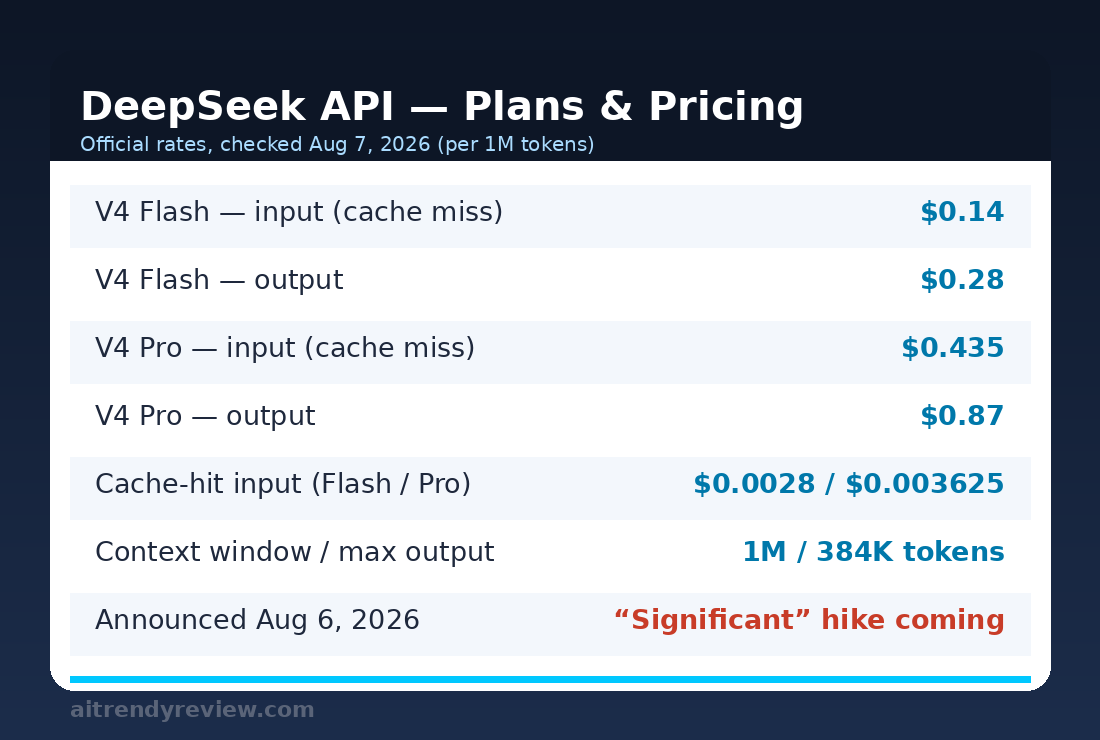
Yes. DeepSeek confirmed on August 6, 2026 that it will raise overall API pricing “significantly” in the near future, with exact rates and dates still unpublished. Current pricing remains live for now: DeepSeek V4 Flash costs $0.14 per million input tokens and $0.28 for output; V4 Pro costs $0.435 and $0.87.
Key takeaways
- DeepSeek’s official notice landed on August 6, 2026: a “significant” increase is coming, but zero new rates or dates have been published.
- Today, V4 Flash costs $0.14 / $0.28 per million tokens (input/output), roughly 70x cheaper on input than Claude Opus 5’s $10 / $50.
- This is DeepSeek’s second pricing change in under a month; peak and off-peak rate tiers arrived in mid-July 2026.
- The closest drop-in fallback on price is GPT-5.6 Luna at $0.20 / $1.20 per million tokens.
- Even a 3x hike would leave V4 Flash output at $0.84 per million tokens, still under every Western flagship tier.
- V4’s weights are open, so self-hosting or third-party inference hosts put a hard ceiling on your downside.
What exactly did DeepSeek announce on August 6?
DeepSeek published a notice stating it plans to raise the overall pricing of its API services in the near future, and that the increase is expected to be significant; the specific plan “will be subject to official notice.” That is the whole announcement. No percentages, no per-model breakdown, no calendar date.
The wording matters. This was not a leak or an analyst guess. It appears on DeepSeek’s own API pricing documentation, which as of August 7, 2026 still lists the current low rates alongside the warning. Bloomberg, TechNode, and Dataconomy all covered the notice within hours, and all three confirm the same gap: nobody outside the company knows the new numbers yet.
One detail most of the news coverage buried: this is the second pricing adjustment in less than a month. In mid-July 2026, DeepSeek quietly introduced peak and off-peak pricing, charging more during high-demand windows. A company that was famous for one flat, absurdly low price sheet has now touched pricing twice in four weeks. That pattern tells you more than the press release does. The era of DeepSeek as a loss-leading price war machine is closing.
What does the DeepSeek API cost right now?
As of August 7, 2026, the DeepSeek API offers two models: deepseek-v4-flash at $0.14 per million input tokens (cache miss) and $0.28 per million output tokens, and deepseek-v4-pro at $0.435 input and $0.87 output. Cache-hit input drops to $0.0028 and $0.003625 respectively.
Both models carry a 1M-token context window and a maximum output of 384K tokens, and both support JSON output and tool calls. The cache-hit discount is the sleeper feature here: a repeated-prefix workload (chatbots with long system prompts, agent loops, RAG pipelines with stable instructions) pays fifty times less on input than a cold request. If your cache-hit ratio is high, your real blended rate is already far below the sticker price, which also means a headline hike will hurt you less than the percentage suggests.
The July 31 refresh (DeepSeek-V4-Flash-0731) kept these rates intact, which briefly reassured people that pricing was stable. Six days later, the increase notice went up. For a deeper look at how these numbers stack up against OpenAI’s flagship, our DeepSeek V4 vs GPT-5.6 cost breakdown runs the per-workload math.
Why is DeepSeek raising prices now?
The short answer: DeepSeek is preparing to be a business rather than a market-share weapon. The company closed a major funding round in June 2026, and analysts quoted by Bloomberg link the pricing shift to preparations for a potential public listing, possibly as early as 2026, plus investor pressure to show a path to profit.
Some history explains why this is such a reversal. In May 2026, DeepSeek made its V4 discount permanent, a move aggressive enough that ByteDance and Tencent cut their own model prices in response. DeepSeek was the floor of the entire market. Every “AI is getting cheaper” chart of the past year leaned on that floor. Pulling it up affects everyone’s assumptions, not just DeepSeek customers.
There is also a plain cost story underneath the IPO story. Serving a 1M-token context window at $0.14 per million input tokens is brutal on GPUs, and DeepSeek’s usage exploded after V4’s launch. The mid-July peak/off-peak split was the first sign that demand was outrunning subsidized capacity. A company confident in its unit costs does not invent congestion pricing. My read: the increase was coming regardless, and the IPO chatter just sets the timing.
How much more expensive could DeepSeek get?
Nobody outside DeepSeek knows, and any article quoting exact new rates before the official notice is guessing. What we can do is bound the problem. “Significant” in Chinese cloud-pricing announcements has historically meant multiples, not single-digit percentages, and DeepSeek has so much headroom that even a 3x increase would leave V4 Flash at roughly $0.42 input / $0.84 output per million tokens, still cheaper than GPT-5.6 Terra ($2 / $12), Gemini 3.6 Flash ($1.50 / $7.50), Qwen3.8 Max ($2 / $6), and Kimi K3 ($3 / $15).
Run the scenarios against a concrete workload. Say your product burns 2 billion input tokens and 400 million output tokens a month on V4 Flash, all cache misses. Today that bill is $392. At 2x it becomes $784; at 3x, $1,176; at 5x, $1,960. Painful, but the same workload on GPT-5.6 Terra costs $8,800 and on Claude Opus 5 it costs $40,000. The realistic risk is not that DeepSeek becomes expensive in absolute terms. It is that DeepSeek stops being 10x cheaper than the nearest good alternative, at which point reliability, latency, and data-residency questions start deciding the contract instead of price.
The wildcard is asymmetry. DeepSeek has not said whether the hike applies evenly to Flash, Pro, cache hits, and off-peak windows. If cache-hit pricing rises faster than the headline rate, agentic and RAG workloads get hit hardest. Watch that line of the new price sheet before anything else.
Who gets hurt most by a DeepSeek price increase?
High-volume, low-margin API products built directly on DeepSeek’s hosted service take the biggest hit; casual users of the free DeepSeek chat app are unlikely to feel anything immediately. The announcement covers API services, and consumer chat apps in China are a competitive battleground DeepSeek will not concede lightly.
The mapping by builder type looks like this. If you run a side project or prototype, do nothing; even a 5x hike keeps your bill in coffee-money territory. If you are a startup reselling AI features at a fixed subscription price, you are the exposed one, because your margin is the spread between your $19/month customer and DeepSeek’s token bill, and that spread was built on $0.28 output. Reprice or diversify before the notice lands, not after. If you are an enterprise with data-governance rules, you probably were not on DeepSeek’s hosted API anyway; a Chinese-hosted endpoint has been a compliance non-starter for most US and EU firms since 2025, and the price hike changes nothing for you.
Indian and Southeast Asian dev shops deserve a special mention because DeepSeek is disproportionately popular there precisely for its pricing. If that is you, the cache-hit and off-peak tactics in the cost-cutting section below are worth implementing this week, whatever DeepSeek decides.
What are the best DeepSeek alternatives if prices spike?
GPT-5.6 Luna is the closest like-for-like fallback at $0.20 input / $1.20 output per million tokens, with the same 1M-class context window. Gemini 3.6 Flash, Qwen3.8 Max, and Kimi K3 all undercut Western flagship tiers while beating DeepSeek on specific strengths like agentic efficiency or open weights.
Here is the field as of August 7, 2026, prices verified against official pages and OpenRouter listings:
| Model / API | Price per 1M tokens (in / out) | Free tier | Best for | Key limit |
|---|---|---|---|---|
| DeepSeek V4 Flash | $0.14 / $0.28 | No (pay-as-you-go) | High-volume, cost-sensitive products | Announced price hike; CN-hosted API |
| DeepSeek V4 Pro | $0.435 / $0.87 | No | Harder reasoning at budget rates | Same hike risk as Flash |
| GPT-5.6 Luna (OpenAI) | $0.20 / $1.20 | No (API credits trial) | Drop-in migration, US hosting | Output 4x DeepSeek’s today |
| Gemini 3.6 Flash (Google) | $1.50 / $7.50 | Yes (AI Studio free quota) | Long-horizon agent workloads | Sticker price well above budget tier |
| Qwen3.8 Max (Alibaba) | $2 / $6 | Limited trial credits | Frontier quality from a CN vendor | Flagship pricing, not a budget swap |
| Kimi K3 (Moonshot) | $3 / $15 | Free chat app | Long-context research tasks | Priciest of the Chinese labs |
A few opinions to go with the numbers. Luna is the boring, correct answer for most migrations: closest price, biggest ecosystem, and OpenAI’s cached-input discount (90% off) mirrors the trick that made DeepSeek cheap in practice. Gemini 3.6 Flash looks expensive per token, but Google’s own benchmarks claim up to 65% fewer tokens burned on long agent tasks, which narrows the real-world gap; our Gemini 3.6 Flash review digs into whether that claim survives contact with real workloads. Qwen3.8 Max is the pick if you want frontier-class output while staying on a Chinese vendor; see our Qwen3.8 Max review for benchmarks. And Kimi K3, covered in our Kimi K3 launch analysis, matters here mostly as proof that Moonshot prices at $3 / $15 and still sells, which is exactly the cover DeepSeek needs to raise.
The alternative nobody hosts for you: V4’s weights are open. Third-party inference providers already serve DeepSeek models, and serious volume users can rent GPUs and pin today’s economics in place permanently. Self-hosting is real work, but its existence caps how far DeepSeek can push managed-API pricing before customers route around it.
Should you migrate off DeepSeek now, or wait for the new prices?
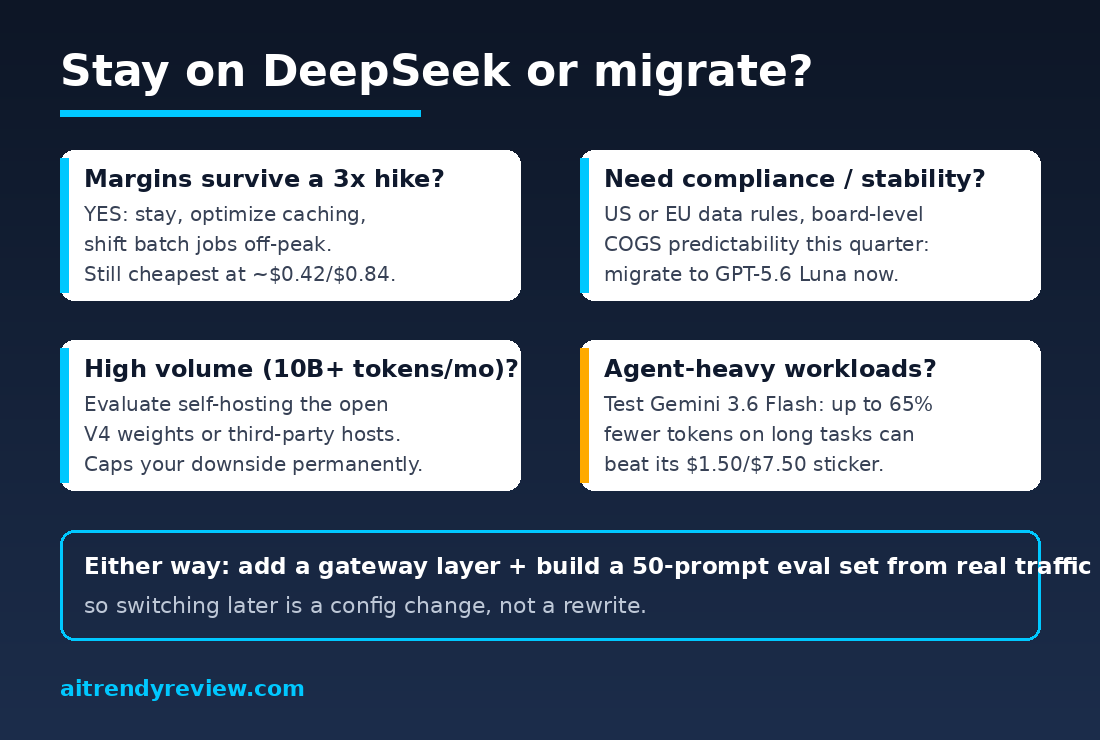
Wait for the numbers, but prepare the exit this week. Migrating an LLM workload costs real engineering time, and jumping before rates are published means paying that cost against an unknown. The right move now is making your stack provider-agnostic so that switching later is a config change, not a rewrite.
Concretely, that means three things. Route every model call through one abstraction layer (a gateway like OpenRouter, or just your own thin wrapper) instead of hard-coding DeepSeek’s SDK in forty places. Build a 50-prompt eval set from your actual production traffic today, while you have no pressure, so you can score Luna or Qwen against your real use case in an afternoon. And benchmark your cache-hit ratio, because it decides whether the hike hits your blended rate at full force or barely at all.
There is one group that should move early: anyone whose contract renewals, investor updates, or pricing pages depend on predictable COGS this quarter. An announced-but-unpriced increase is the worst kind of uncertainty to carry into a board meeting. For everyone else, DeepSeek at 2-3x today’s rates would still be the cheapest serious option on the market, and leaving prematurely could mean paying more for months for no reason.
How do you cut DeepSeek costs before the hike hits?
Maximize cache hits, shift batchable work off-peak, and stop paying for context you do not need. Those three changes routinely cut 40-70% off a DeepSeek bill at today’s rates, and every one of them keeps paying after the increase, whatever the new numbers are.
Cache hits first, because the discount is enormous: $0.0028 versus $0.14 per million input tokens on Flash. You earn hits by keeping prompt prefixes stable, so pin your system prompt, put volatile data (user messages, retrieved chunks) at the end, and never interpolate timestamps or session IDs into the shared prefix. Second, the peak/off-peak structure introduced in July is an arbitrage if you have batch work; overnight summarization, embedding refreshes, and eval runs belong in the cheap window. Third, audit context length. A 1M-token window is an invitation to be lazy, and most products ship 30-50% more context per call than the answer quality requires. Trim retrieval depth, cap history, and measure. If output quality holds, that trim is pure margin.
Worth it if / Skip it if
Worth staying on DeepSeek if: you are cost-driven above all and can absorb a 2-3x hike while staying below every alternative; your workload has a high cache-hit ratio; you can shift batch jobs off-peak; or you retain the option to self-host V4’s open weights if managed pricing goes wrong.
Skip (or leave) DeepSeek if: your customers or regulators cannot accept a China-hosted API; your margins die at 3x and you cannot reprice; you need contractual pricing stability this quarter; or you are starting a new build today, where GPT-5.6 Luna’s $0.20 / $1.20 buys you stability for pennies more. For a sense of the ceiling you would be paying for elsewhere, our Claude Opus 5 review covers what $10 / $50 per million tokens actually buys.
FAQ: DeepSeek API price increase
When will the DeepSeek price increase take effect?
DeepSeek has not announced a date. The August 6, 2026 notice says the increase will come “in the near future” and that specifics will follow in an official notice. As of August 7, 2026, the published rates on the API pricing page are unchanged, so anything you are billed today still uses current pricing.
How much does the DeepSeek API cost right now?
As of August 7, 2026: deepseek-v4-flash costs $0.14 per million input tokens (cache miss) and $0.28 per million output tokens; deepseek-v4-pro costs $0.435 and $0.87. Cache-hit input drops to $0.0028 and $0.003625 respectively. Both models offer a 1M-token context window with up to 384K output tokens.
Why is DeepSeek raising prices after being the cheapest option?
Analysts link the move to DeepSeek’s shift toward profitability ahead of a potential public listing, following a major funding round that closed in June 2026. Serving 1M-token contexts at rock-bottom rates is expensive, and the peak/off-peak pricing introduced in July 2026 already signaled that subsidized capacity was straining under demand.
Will the price increase affect the free DeepSeek chat app?
The announcement covers API services, and DeepSeek has said nothing about the consumer chat app. China’s chatbot market is fiercely competitive, so the free app is likely to stay free. If the situation changes it would come through a separate official notice, not the API pricing page where this warning appeared.
What is the cheapest alternative to the DeepSeek API?
On sticker price, GPT-5.6 Luna at $0.20 input / $1.20 output per million tokens is the closest fallback, with a comparable 1M-class context window and a 90% cached-input discount. Gemini 3.6 Flash ($1.50 / $7.50) can compete on real workloads through token efficiency, and open-weight V4 via third-party hosts can beat everything at volume.
Could DeepSeek still be cheapest after the increase?
Very possibly. Even a 3x hike would put V4 Flash around $0.42 / $0.84 per million tokens, below GPT-5.6 Luna’s output rate and far below Gemini 3.6 Flash, Qwen3.8 Max, or Kimi K3. Coverage of the announcement notes DeepSeek may remain cheaper than leading US alternatives even after the adjustment.
Can I lock in current DeepSeek pricing before the hike?
No. DeepSeek sells pay-as-you-go API access with no published committed-use contracts, so there is nothing to lock. The practical equivalents are maximizing cache hits, shifting batch jobs to off-peak windows, and keeping the option to self-host the open V4 weights, which permanently caps your exposure to managed-API pricing.
Sources
- DeepSeek API Docs: Models & Pricing (official)
- Bloomberg: DeepSeek Plans ‘Significant’ Price Increase for Its AI Services
- TechNode: DeepSeek plans significant API price increases
- Dataconomy: DeepSeek warns developers of significant API price increases
- VentureBeat: Gemini 3.6 Flash cuts agent token costs by up to 65%
Prices checked August 7, 2026.

Naveen Kumar Durai is the founder of Naveen AI Automation and the reviewer behind AITrendyReview. He builds AI automation systems daily and reviews AI tools from official docs, live pricing pages, and verified user reports — updated monthly as tools change.