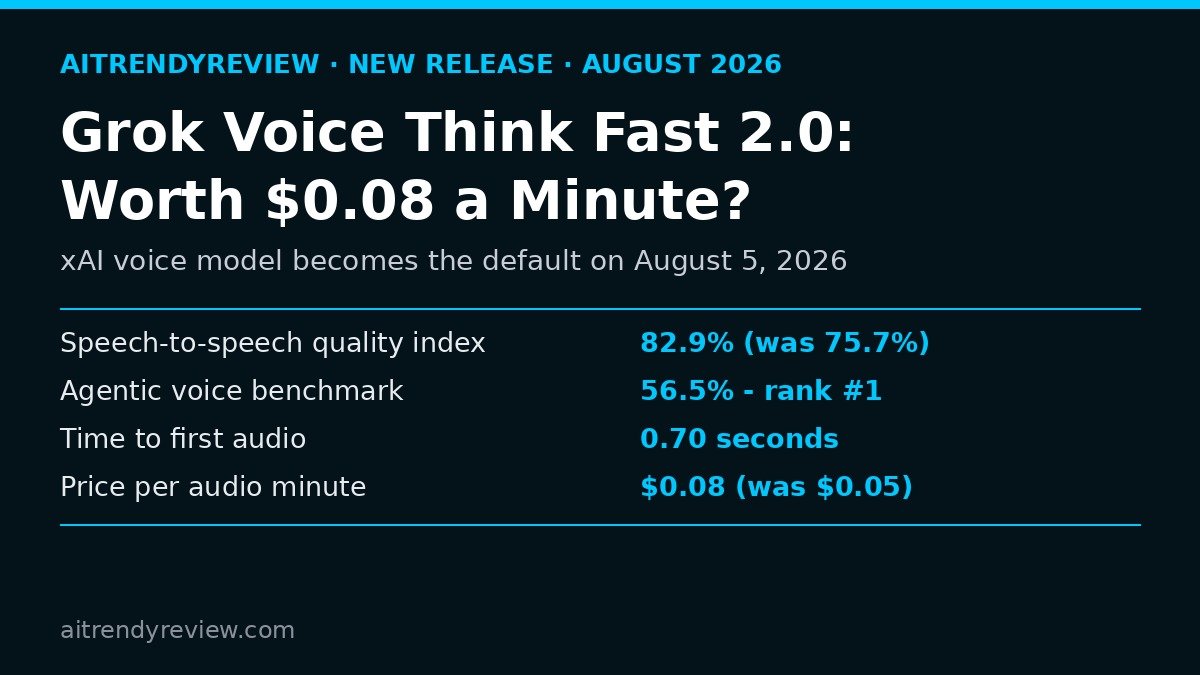
On August 5, 2026, xAI flipped the switch: every developer and every Grok app user pointed at grok-voice-latest got moved to Grok Voice Think Fast 2.0, the speech-to-speech model xAI announced on July 29. The upgrade is automatic, the benchmark gains are real, and so is the bill. Voice minutes jumped 60 percent, from $0.05 to $0.08 per minute of audio. If you run a voice agent, a phone bot, or you just talk to Grok on your commute, this release changes your math this week, not someday.
The launch matters beyond xAI’s own ecosystem because of where the scores landed. On Artificial Analysis’ speech-to-speech evaluations, Think Fast 2.0 posted the top agentic score in the industry, ahead of OpenAI’s GPT-Realtime-2.1 and Google’s Gemini 3.1 Flash voice mode. For the first time, the “best voice agent brain” and the “most expensive mainstream voice API” are the same product, and deciding whether the first fact justifies the second is what this review is for.
How we assess: research/news-based analysis, not hands-on testing.
Is Grok Voice Think Fast 2.0 worth $0.08 per minute? Yes for production voice agents that must reason and call tools mid-conversation: its 56.5% agentic score leads every rival, and 0.70-second first-audio latency is class-competitive. No for simple narration, IVR menus, or text-to-speech work, where ElevenLabs or cheaper realtime APIs deliver similar caller experience for less.
Key takeaways
- 1. Grok Voice Think Fast 2.0 scores 82.9% on Artificial Analysis’ overall speech-to-speech quality index, up from 75.7% for version 1.0.
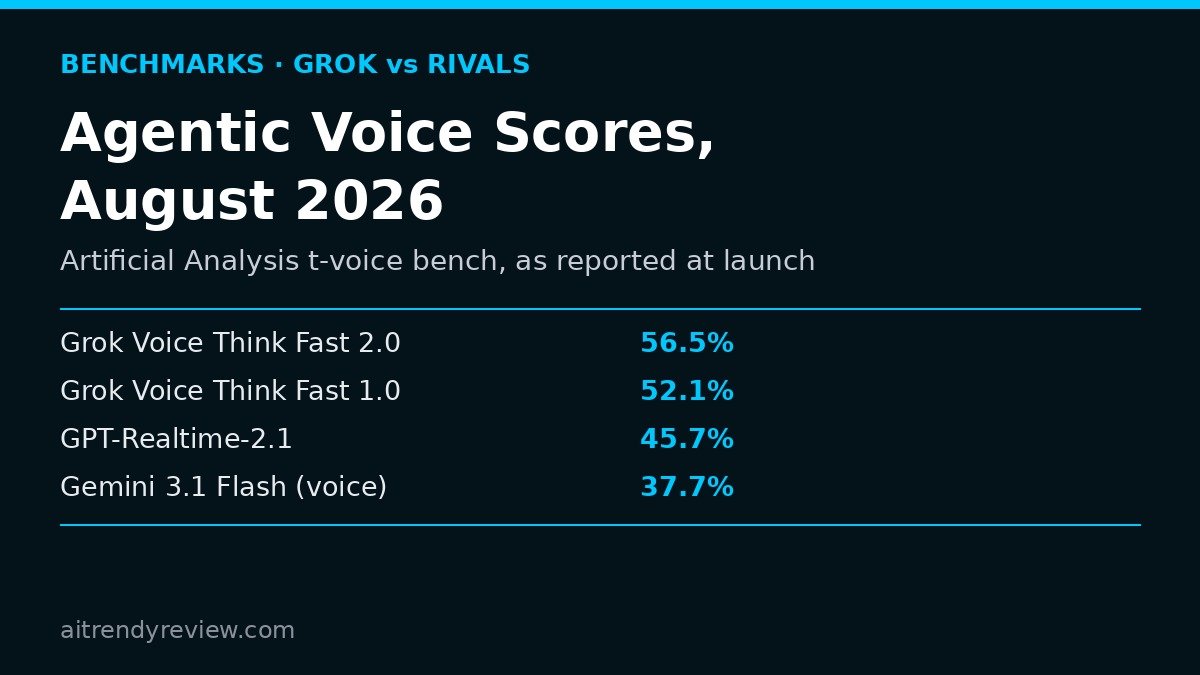
- 2. Its agentic benchmark score of 56.5% beats GPT-Realtime-2.1 (45.7%) and Gemini 3.1 Flash voice (37.7%), the widest lead on any single metric.
- 3. Time to first audio dropped from 1.25 seconds to 0.70 seconds, roughly a 44 percent cut, while the model reasons in parallel as it speaks.
- 4. Pricing rose from $0.05 to $0.08 per audio minute on August 5, 2026. A 10,000-call-minute month now costs $800 instead of $500.
- 5. xAI claims 1.5-2.0x transcription accuracy gains over Deepgram Nova 3 and ElevenLabs Scribe v2 across 24 languages, and about 10x in noisy environments.
- 6. Developers can pin Think Fast 1.0 to keep the old price and behavior; unpinned traffic migrated automatically on August 5.
What exactly is Grok Voice Think Fast 2.0?
It is xAI’s flagship speech-to-speech model: audio in, audio out, with the reasoning happening inside a single system rather than a chain of transcriber, text model, and voice synthesizer. That architecture matters. Pipeline systems (what most call centers still run) lose emotional tone at the transcription step and add latency at every hop. Native speech-to-speech models like Think Fast 2.0, OpenAI’s GPT-Realtime line, and Gemini’s voice modes keep prosody, interruptions, and hesitation inside the model, which is why they can laugh at the right moment or slow down when reading a phone number.
The “Think Fast” branding refers to the model’s trick of reasoning while speaking. Version 2.0 runs a parallel reasoning stream during audio generation, so a complex question (“compare my two insurance quotes and book the cheaper one”) gets actual chain-of-thought treatment without the awkward dead air that made version 1.0 feel like talking to someone doing mental long division. xAI reports median reasoning-token use fell to 0.4x its baseline, meaning the model thinks more efficiently, not just faster. It ships across the API at console.x.ai, the Grok iOS and Android apps, and Grok inside X, and it handles transcription across 24 languages. Full details sit on xAI’s launch announcement.
How fast is it in real conversations?
Latency is the difference between a voice agent that feels like a person and one that feels like a walkie-talkie. Humans notice response gaps beyond about 500-800 milliseconds; beyond a second, callers start talking over the bot. Think Fast 1.0 sat at 1.25 seconds to first audio, on the wrong side of that line. Version 2.0’s 0.70 seconds lands inside the natural-conversation window and roughly matches the fastest realtime modes from OpenAI and Google.
The subtler improvement is that latency now stays flat under reasoning load. In version 1.0, asking anything requiring thought stretched the pause visibly. The parallel reasoning design means version 2.0 starts talking, a acknowledgment, a clarifying phrase, while the heavy computation completes behind the voice. That is a conversational pattern human agents use naturally (“let me pull that up for you…”) and it is the main reason xAI’s reinforcement-learning pass on conversational patterns shows up in the quality index jump from 75.7% to 82.9%. For builders, it means you no longer need to script filler audio or fake typing sounds to cover thinking time, a common workaround in 2025-era voice stacks.
How does it score against GPT-Realtime-2.1 and Gemini 3.1 Flash?
The launch-week numbers from Artificial Analysis’ speech evaluations, as reported by xAI and covered by Testing Catalog, break down like this:
| Model | Agentic voice score | Overall S2S quality | Time to first audio | Price per audio minute |
|---|---|---|---|---|
| Grok Voice Think Fast 2.0 | 56.5% | 82.9% | 0.70s | $0.08 |
| Grok Voice Think Fast 1.0 | 52.1% | 75.7% | 1.25s | $0.05 (pinned) |
| GPT-Realtime-2.1 (OpenAI) | 45.7% | not disclosed at launch | ~0.6-0.8s | usage-based, roughly comparable |
| Gemini 3.1 Flash voice (Google) | 37.7% | not disclosed at launch | ~0.6-0.9s | lowest of the group |
Two honest caveats belong next to that table. First, the comparative scores come from xAI’s launch materials citing Artificial Analysis’ t-voice bench; independent replication takes weeks, and vendors always publish their best-look numbers. Second, agentic scoring measures multi-step task completion by voice (booking, lookup, tool calls, policy compliance), not voice beauty. A 56.5% leader still fails four in ten complex tasks. The gap over rivals is large and consistent with version 1.0’s already-strong showing, but nobody should read 56.5% as “solved.”
Where the claim has outside support is transcription. xAI cites 1.5-2.0x word-error improvements over Deepgram Nova 3 and ElevenLabs Scribe v2 across its 24 supported languages, stretching to roughly 10x in noisy conditions, and noisy-environment accuracy is exactly what phone-channel deployments live and die on. Our Atlas-1 vs Deepgram comparison covers how fast this transcription tier has been moving in 2026.
What does the price jump actually cost you?
The move from $0.05 to $0.08 per audio minute is a 60 percent increase, and because billing is per minute of audio rather than per token, it is brutally easy to forecast. Run the numbers on three typical deployments. A hobbyist talking to Grok 20 minutes a day through the API pays about $48 a month, up from $30. A small business voice agent handling 5,000 support minutes a month pays $400, up from $250. A mid-size operation running 50,000 minutes, roughly seventeen concurrent lines during business hours, pays $4,000 a month, up from $2,500. Consumer app users are unaffected; this is API pricing.
Against the market, $0.08 sits at the premium end but not alone: OpenAI’s realtime audio pricing has hovered in a similar effective range depending on session structure, and a human agent costs $0.50-$1.00 per minute in US contact centers, which is the comparison enterprise buyers actually make. The awkward middle case is anyone whose calls do not need reasoning. If your agent reads order status and takes messages, you are paying for a chess engine to play tic-tac-toe. xAI left one escape hatch: pin Think Fast 1.0 explicitly and keep the old model and price for now. Unpinned traffic moved on August 5, and xAI’s A/B test on Starlink’s phone lines, which reported higher sales conversion and support containment on 2.0, tells you which way xAI expects that decision to go.
Is it better than ElevenLabs for voice work?
They are converging from opposite directions, and the answer depends on which half of “voice work” you mean. ElevenLabs built its reputation on voice quality: cloning, emotional range, 70-plus languages, and a production toolkit that our ElevenLabs review still rates as the best in class for narration, audiobooks, dubbing, and character work. Its Conversational AI product bolts those voices onto your choice of text model. Grok comes from the other side: the intelligence is native, the voice is good but not the headline, and there is no voice cloning at all.
The practical split for August 2026 looks like this. Content creation, one distinct voice, emotional reads, dubbing: ElevenLabs, no contest. Autonomous phone agents that must decide, look things up, and complete transactions: Grok’s 56.5% agentic score versus ElevenLabs’ dependence on an external brain makes Think Fast 2.0 the stronger default. High-volume transcription feeding analytics: Grok’s claimed accuracy edge over Scribe v2 makes it a serious new option, though Deepgram and ElevenLabs price transcription separately and often cheaper. Teams already comparing voice stacks after Microsoft’s MAI push should note the same pattern we found in our MAI Voice 2 Flash vs ElevenLabs analysis: the agentic layer, not raw voice quality, is where 2026’s real differentiation happens.
Who should switch, and who should pin version 1.0?
If you’re building outbound or inbound phone agents that sell, schedule, or troubleshoot, switch. The Starlink A/B result (better conversion and containment) is exactly the metric your CFO cares about, and 60 percent higher model cost disappears inside a single percentage point of improved containment against human-agent rates.
If you’re running simple flows, order status, message-taking, FAQ answers, pin Think Fast 1.0 at $0.05 and bank the savings, or evaluate cheaper realtime tiers like Gemini 3.1 Flash voice, whose 37.7% agentic score is irrelevant when the task needs no agency.
If you’re a Grok app subscriber, do nothing; you already have 2.0 and the improvement costs you nothing extra.
If you’re an accessibility or dictation user in a loud environment, a workshop, a car, a kitchen, the noisy-audio transcription gains are the single biggest quality-of-life jump in this release. Switch.
If you’re mid-contract on an ElevenLabs Conversational AI deployment, run a two-week parallel pilot before moving anything. Voice migrations break on edge cases (accents, barge-in behavior, DTMF handling), not on benchmarks.
If you’re privacy-sensitive, read xAI’s data-retention terms for voice before deploying; conversational audio is subject to different retention defaults by plan tier, and regulated industries will want the enterprise controls.
If you’re an agency building voice agents for clients, the timing question is contract structure. Per-minute costs just moved 60 percent on the default model, and the vendor landscape is repricing monthly, so quote clients with a pass-through model cost line rather than a fixed all-in rate. Agencies that locked flat pricing on version 1.0 economics are the ones eating this increase today. A pass-through line item plus a small margin keeps the next migration, and there will be a next one, from becoming a renegotiation.
If you’re evaluating the whole 2026 voice field from scratch, shortlist three: Grok Voice Think Fast 2.0 for agentic phone work, ElevenLabs for voice quality and cloning, and Gemini 3.1 Flash voice for cost-sensitive simple flows. Benchmarks age in weeks in this market, so run the pilot on your own traffic before committing an annual budget to any of them.
What changed under the hood compared with version 1.0?
xAI describes three engineering changes, and each maps to a measurable claim. The first is the parallel reasoning stream: version 1.0 alternated between thinking and speaking, which is why its first-audio time was 1.25 seconds and why long pauses appeared mid-call whenever tool use kicked in. Version 2.0 generates speech and reasoning tokens concurrently, cutting first audio to 0.70 seconds and holding conversational rhythm during lookups. The second is a reinforcement-learning pass focused specifically on conversational patterns, turn-taking, interruption recovery, acknowledgments, graceful topic shifts, which is the kind of training that moves a quality index the way 75.7% moved to 82.9%. The third is a rebuilt audio front end responsible for the transcription gains, trained heavily on degraded audio: traffic noise, kitchen clatter, speakerphone echo, overlapping speakers.
The efficiency line in the release deserves more attention than it got. Median relative reasoning-token use dropped to 0.4x baseline, meaning the model reaches conclusions using less than half the internal computation of its predecessor on typical queries. That is presumably how xAI holds 0.70-second latency while doing more thinking, and it hints at margin room behind the $0.08 price. For developers, lower internal token burn also tends to mean more consistent latency at the p95 tail, not just a better median, though tail numbers were not published at launch and deserve independent measurement before you promise SLAs to a client.
How reliable is it for tool calls and real agent work?
The t-voice bench that produced the 56.5% score evaluates the unglamorous plumbing of agent work: calling APIs with correct parameters while mid-sentence, respecting policy constraints (“never quote a price without checking inventory”), recovering when a tool errors out, and completing multi-step tasks like a reschedule-plus-refund across systems. Version 1.0 already led this benchmark at 52.1%, and xAI credits the 2.0 gains to improved tool-use reliability rather than raw model intelligence. In deployment terms, that is the difference between an agent that books the appointment and one that confidently says it did.
The Starlink phone-service A/B test is the closest thing to production evidence in the launch materials: higher sales conversion and higher support containment (calls resolved without human transfer) on 2.0 versus 1.0. Containment is the metric that decides voice-AI budgets, because every contained call is a human-agent call that did not happen at ten times the cost. The honest limits: xAI has not published the effect sizes, Starlink is a sibling company with every incentive to cooperate, and one deployment is one data point. Treat it as a promising signal that matches the benchmark direction, then run your own containment numbers during a pilot. Any voice platform worth production traffic will show its gains in your call logs within two weeks.
How do you get started, and what should a pilot measure?
Access is through console.x.ai with standard API keys; the model streams over WebRTC or WebSocket sessions, and the Grok app versions on iOS and Android already run 2.0 for subscribers. Bring-up for a basic voice loop is a day of work for a developer who has built on any realtime voice API before, and the request shape will feel familiar to anyone coming from OpenAI’s realtime endpoints. Budget guardrails matter more than usual because billing is per audio minute: set hard session caps, log minutes per conversation, and alert on outliers, since a hung session that keeps the audio channel open bills exactly like a talkative customer.
A useful two-week pilot measures five things against your current stack: first-audio latency at median and p95, barge-in recovery (callers interrupting the bot), task completion rate on your top three call intents, transcription accuracy on your real call audio rather than clean samples, and containment rate. Route ten percent of traffic, compare against version 1.0 or your incumbent, and make the pinning decision with data. If the agentic gains show up in your intents the 60 percent price delta will look cheap; if they do not, your calls did not need the reasoning and version 1.0 at $0.05, or a budget rival, was always the right tool.
How does this fit xAI’s bigger 2026 picture?
Voice is becoming xAI’s clearest commercial lane. The company threaded Grok Voice through the X platform, the standalone apps, and Tesla’s in-car assistant work, and the Starlink customer-service deployment shows xAI eating its own cooking at telecom scale. Meanwhile the competitive field keeps reshuffling: Google answered two days after this launch by shipping Gemini 3.6 Flash on August 5 with aggressive $1.50-per-million input pricing, our Gemini 3.6 Flash review covers that release, and OpenAI is heading toward a September IPO with an S-1 expected within weeks, which puts public-market pressure on realtime API margins for the first time. Voice pricing across the industry is likely to stay volatile through Q4. Locking architecture decisions to any single vendor’s minute rate is riskier than usual right now, which is one more argument for keeping your agent logic portable behind an abstraction layer.
FAQ
What is Grok Voice Think Fast 2.0?
It is xAI’s speech-to-speech AI model, announced July 29, 2026, that listens and speaks natively while reasoning in parallel. It became the default Grok voice model on August 5, 2026 across the API, Grok apps, and Grok on X.
How much does Grok Voice Think Fast 2.0 cost?
API pricing is $0.08 per minute of audio, up from $0.05 for version 1.0. Consumer Grok app usage is covered by existing subscriptions. Developers can pin version 1.0 to keep the old rate for now.
Is Grok Voice better than ChatGPT’s voice mode?
On agentic tasks, launch benchmarks say yes: 56.5% versus 45.7% for GPT-Realtime-2.1 on the t-voice bench. For casual conversation quality the gap is narrower, and OpenAI’s ecosystem advantages remain.
Does Grok Voice support voice cloning?
No. xAI offers a set of built-in voices only. Creators who need custom or cloned voices should use ElevenLabs or a comparable voice-generation platform for that layer.
What languages does it support?
xAI cites transcription improvements across 24 languages, with the largest gains in noisy environments. English remains the most polished experience for full conversational agents.
How do I avoid the automatic upgrade?
Pin the explicit Think Fast 1.0 model identifier in your API calls instead of using grok-voice-latest. Unpinned traffic was migrated automatically on August 5, 2026.
Is the 56.5% agentic benchmark score good?
It is the best published score in the industry right now, and also means complex multi-step voice tasks still fail roughly four times in ten. Production deployments should keep human fallback paths.
Where can I try it?
Through the Grok iOS or Android app, Grok on X, or the API at console.x.ai with per-minute billing. The launch post at x.ai/news has model details.
Verdict: the best voice agent brain, at a price that filters casual use
Grok Voice Think Fast 2.0 is the most convincing release yet in the 2026 voice race. The agentic lead is wide, the latency finally feels human, and the transcription claims target the exact conditions where phone-channel AI actually struggles. The 60 percent price increase is the honest cost of that lead, and xAI clearly believes production buyers will pay it; the Starlink conversion data suggests they are right. Builders of real voice agents should test it this month. Everyone doing simpler voice work should pin 1.0 or shop the budget tier, because paying reasoning prices for non-reasoning calls is how AI budgets quietly bleed. Rating: 4.4/5.
Sources
- xAI: Introducing Grok Voice Think Fast 2.0 (July 29, 2026) — Verified August 7, 2026
- Testing Catalog: launch coverage with benchmark comparisons (July 29, 2026) — Verified August 7, 2026
- Tech Research Online: Grok Voice Think Fast 2.0 benchmark reporting — Verified August 7, 2026
- LLM Stats: August 2026 model release tracker (migration and pricing timeline) — Verified August 7, 2026

Naveen Kumar Durai is the founder of Naveen AI Automation and the reviewer behind AITrendyReview. He builds AI automation systems daily and reviews AI tools from official docs, live pricing pages, and verified user reports — updated monthly as tools change.