Affiliate disclosure: This post contains affiliate links. If you buy through them, we may earn a small commission at no extra cost to you. Read our full disclosure.
How we assess: this review is based on official documentation/manufacturer specs, pricing pages, and verified user/owner reports, not hands-on testing.
Willow AI spent the spring of 2026 telling everyone that its Atlas-1 speech-to-text model beat Deepgram “by a wide margin.” Deepgram, meanwhile, kept quietly processing billions of minutes of audio for companies like Spotify and NASA without responding at all. So which one should actually handle your transcription in 2026? The answer turns out to be stranger than the marketing fight suggests, because one of these two models no longer exists. This comparison is based on official pricing pages, engineering blogs, the Artificial Analysis benchmark leaderboard, and verified user reports rather than hands-on lab testing, and every price was checked on July 21, 2026. If you want the full background on Willow first, our Willow AI Atlas-1 review covers the company’s whole story in depth.
Should you pick Atlas-1 or Deepgram for transcription in 2026?
Pick by what you are building. Atlas-1 was Willow’s dictation model; it was retired on July 7, 2026, replaced by Frontier Pro and Frontier Mini inside Willow’s free app, and never offered an API. Deepgram Nova-3 is a developer API from $0.0043 per minute. For dictating messages, use Willow. For building software, use Deepgram.
Key takeaways
- Atlas-1 lived exactly 97 days: launched April 1, 2026, retired July 7, 2026, when Willow replaced it with Frontier Pro and Frontier Mini.
- Willow now includes unlimited dictation for $0 on its Basic plan; the Pro plan costs $15/month, or $12/month billed annually.
- Deepgram Nova-3 costs $0.0043/minute for batch transcription and gives every new account $200 in free credit, roughly 775 hours of batch audio.
- Willow claimed a 1.2% word error rate for Atlas-1, but the model never appeared on the independent Artificial Analysis leaderboard, where Deepgram Nova-3 measures 5.3%.
- Deepgram supports 10+ languages in real time with a public API; Willow runs only inside its own apps on Mac, Windows, and iPhone.
- Transcribing 100 hours of recorded audio costs about $25.80 on Deepgram batch pricing; Willow cannot do it at any price, because it has no file-upload transcription.
What Is Willow’s Atlas-1, and Can You Still Use It?
Atlas-1 was Willow AI’s in-house speech-to-text model, launched April 1, 2026, and no, you cannot use it anymore: Willow retired Atlas-1 on July 7, 2026 and replaced it with two successors, Frontier Pro and Frontier Mini, across all of its apps.
That retirement is the single most important fact in this comparison, and most coverage still misses it. When Willow announced Atlas-1, the pitch was aggressive: a frontier dictation model that “outperforms ElevenLabs, Deepgram, OpenAI, and more by a wide margin,” built on what Willow called the first scalable, human-powered transcription infrastructure for real-time dictation. The company behind it is young. Willow was founded in March 2025 by Allan Guo and Lawrence Liu, went through Y Combinator, and has raised $4.2 million from BoxGroup, Y Combinator, and Burst Capital.
The “human-powered” part deserves a closer look. Instead of training only on public audio datasets the way most Whisper-derived models do, Willow built a pipeline of human transcribers correcting real dictation output, then fed those corrections back into training. Real people mumbling half-formed Slack messages are very different training material from audiobook narrators, and that corpus is Willow’s actual moat.
Here is what Atlas-1 never was: an API. There was no endpoint, no per-minute pricing, no SDK. Atlas-1 existed only inside Willow’s dictation apps for Mac, Windows, and iPhone, where you hold a hotkey, talk, and formatted text appears in whatever text field you’re using. That single design decision shapes every honest comparison with Deepgram. Willow sells a finished product to people who talk instead of type. Deepgram sells raw transcription infrastructure to people who build software. When Willow’s successor models shipped on July 7, the headline change was commercial rather than technical: Frontier-class dictation became free with no credit card, which repositioned the entire product around growth instead of subscription revenue.
What Does Deepgram Nova-3 Offer for Transcription?
Deepgram Nova-3 is a speech-to-text API for developers: you send audio, you get JSON back, and you pay $0.0043 per minute for batch files or from $0.0048 per minute for real-time streaming, with $200 in free credit when you sign up.
Nova-3 is the workhorse of Deepgram’s lineup and has been since its early-2025 release. Deepgram’s own published benchmarks put it at a 5.26% word error rate for batch transcription, and the company claims a 54% streaming latency advantage over competitors. It handles real-time multilingual transcription across 10+ languages, offers keyterm prompting so you can teach it your product names without training a custom model, and ships a medical variant, Nova-3 Medical, fine-tuned for clinical vocabulary.
The 2026 lineup goes further than Nova-3 itself. Deepgram’s Flux model adds model-integrated end-of-turn detection, which matters enormously if you’re building voice agents: Flux knows when a speaker has finished a thought, not just when audio goes quiet, at $0.0065 per streaming minute. There’s a Voice Agent API at $0.075 per minute of connection time, Aura-2 text-to-speech at $0.030 per 1,000 characters, and add-ons like speaker diarization and redaction at $0.0020 per minute each. Deployment options run from cloud to on-premises, which is why regulated industries show up in Deepgram’s customer list.
What Deepgram does not sell is a consumer product. There is no Deepgram dictation app, no hotkey, no formatting layer that turns your rambling into a sendable email. If you want Nova-3 inside your daily writing workflow, someone has to build that wrapper, and plenty of dictation startups have done exactly that on Deepgram’s API. The buyer is a developer, the unit is a minute of audio, and the free $200 credit is generous enough to run a real pilot: at batch rates it covers roughly 775 hours before you pay a cent.
How Do Atlas-1 and Deepgram Compare on Accuracy?
Willow claimed a 1.2% word error rate for Atlas-1; Deepgram Nova-3 measures 5.3% on the independent Artificial Analysis leaderboard. But Willow’s number was self-reported on its own test set, and Atlas-1 was retired before any third party ever verified it.
Sit with that asymmetry for a moment. The Artificial Analysis Word Error Rate Index, checked July 21, 2026, ranks ElevenLabs Scribe v2 at 2.2% WER, AssemblyAI Universal-3 Pro at 3.3%, OpenAI’s GPT-4o Transcribe at 4.1%, and Deepgram Nova-3 at 5.3%. Willow does not appear anywhere on the index, which evaluates 51 models. A vendor claiming 1.2% against a field where the best independently measured model scores 2.2%, without ever submitting to third-party testing, has published a marketing number. Treat it that way.
And yet the raw WER comparison undersells what Willow was actually good at. Word error rate is a blunt instrument for dictation. A transcript can be 98% word-accurate and still unusable if punctuation is wrong, filler words survive, and “Nova-3” comes out as “nover three.” Willow’s July 2026 engineering post argues the company should be measured on “edit rate” instead, the amount of correction you do before hitting send, and pairs its recognition model with a reinforcement-learning-trained edit model for punctuation, capitalization, and personal vocabulary. Their framing: the user doesn’t ask whether the transcript was mostly correct, they ask whether they can send it. That is the right metric for dictation, and it’s one Deepgram’s raw API output doesn’t even try to win, because formatting is the wrapper developer’s job.
My position: for verifiable accuracy on recorded audio, Deepgram’s 5.3% is a real, benchmarked number and Willow’s 1.2% is a claim. For dictation usability, Willow’s pipeline plausibly beat raw Nova-3 output. Both things are true at once.
How Much Do Willow and Deepgram Cost in 2026?
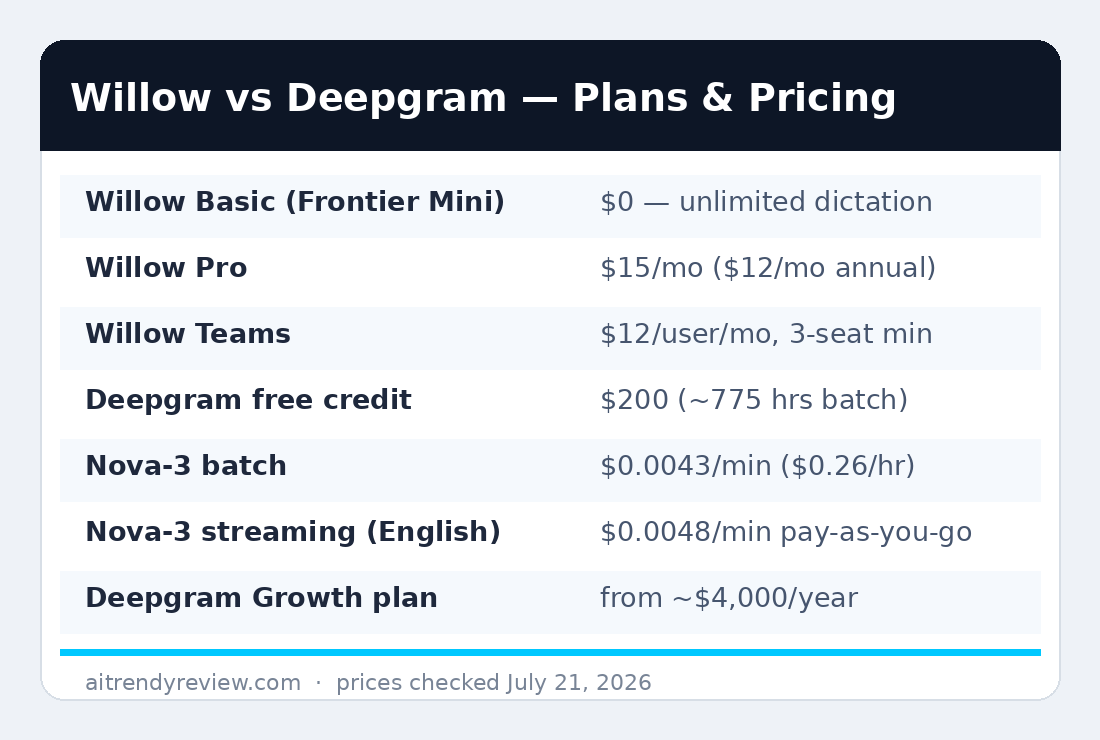
Willow is subscription-priced for individuals: $0 for unlimited Basic dictation, $15/month for Pro, and $12/user/month for Teams. Deepgram is usage-priced for developers: $0.0043/minute batch, from $0.0048/minute streaming, with volume discounts on a Growth plan starting around $4,000 per year.
The two pricing models are so different that a single number comparison misleads, so here is the full picture. Willow’s free Basic plan, introduced with the July 7 Frontier update, includes unlimited dictation on the Frontier Mini model with no credit card required. That replaced the old free tier that MakerStack’s March 2026 review measured at 2,000 words per week, a cap it called “very tight for daily use.” Pro at $15/month (or $12/month billed annually) gets you the Frontier Pro model, and Teams runs $12/user/month with a three-seat minimum. Enterprise is custom.
Deepgram’s pricing page starts everyone with $200 in credit. After that, Nova-3 batch transcription costs $0.0043 per minute, or about $0.26 per hour. Streaming runs $0.0048 per minute for monolingual English and $0.0058 for multilingual on pay-as-you-go terms, per June 2026 pricing snapshots; some Deepgram materials still list the older $0.0077 streaming rate, so verify against the live page before budgeting. The Growth tier, which starts at roughly $4,000 per year in prepaid credit, cuts the monolingual streaming rate to $0.0042.
| Tool | Price | Free plan | Best for | Key limit |
|---|---|---|---|---|
| Willow (Frontier Pro/Mini, ex-Atlas-1) | $0–$15/mo | Unlimited dictation, no card | Dictating email, Slack, docs | No API, no file transcription |
| Deepgram Nova-3 | $0.0043/min batch | $200 credit (~775 hrs) | Building transcription into apps | No consumer app; raw output |
| ElevenLabs Scribe v2 | ~$6.67/1,000 min | Limited free tier | Highest verified accuracy (2.2% WER) | Costs ~1.5x Deepgram batch |
| AssemblyAI Universal-3 Pro | ~$3.50/1,000 min | Free credit at signup | Cheap accurate batch at scale | Weaker real-time story |
| OpenAI GPT-4o Transcribe | $6.00/1,000 min | None (API billing) | Teams already on OpenAI | 4.1% WER, mid-pack price |
Run the arithmetic on a concrete workload and the gap gets vivid. Transcribing a 100-hour podcast archive costs about $25.80 on Deepgram batch pricing and simply cannot be done on Willow, which has no file-upload transcription at all. Meanwhile a writer who dictates 20,000 words a week pays Willow $0 on the Basic plan, while wiring up Deepgram for the same workflow would mean building or buying an app around the API first.
Which Should You Pick for Your Use Case?
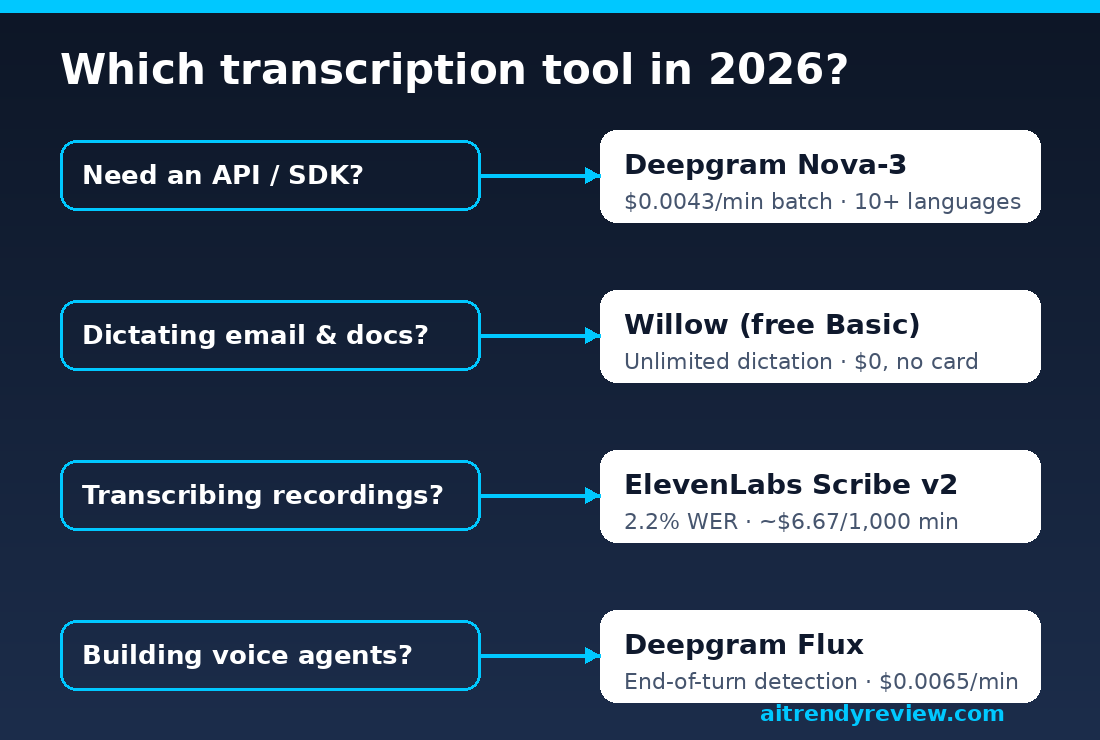
Match the tool to the job. If you talk instead of type, get Willow. If you build software that needs transcription, get Deepgram. If you transcribe recorded files for a living, get neither, and read the alternatives section below.
Here is the mapping in more detail. If you’re a solo founder answering 80 emails a day, Willow’s free Basic plan is the obvious pick: it types into Gmail, Slack, Notion, and even Cursor’s AI code editor, and the formatting layer means what appears is sendable. If you’re a developer adding call transcription to a support product, Deepgram Nova-3 is the pick, and the $200 credit funds your entire prototype phase. If you’re a voice-agent startup, Deepgram’s Flux with end-of-turn detection at $0.0065/minute is built for exactly your problem, and nothing in Willow’s catalog is relevant to you at all.
Two harder cases. A 50-person team standardizing on dictation should price Willow Teams at $12/user/month against just giving everyone the free Basic plan first; start free, upgrade the heavy users. A medical practice should look at Deepgram’s Nova-3 Medical through a HIPAA-compliant wrapper vendor rather than either consumer product, because clinical vocabulary breaks general models fast.
One warning for anyone still searching for Atlas-1 specifically: any product page or listing still selling “Atlas-1 access” in late 2026 is out of date. The model is gone from Willow’s apps, and its successors are what you actually get. Willow’s own official site now leads with the free unlimited offer.
Is Deepgram or Willow Better for Real-Time Speech?
Deepgram wins real-time transcription for software; Willow wins real-time dictation for humans. Deepgram Nova-3 streams at $0.0048 per minute with roughly 300ms responsiveness, while Willow’s apps turn live speech into formatted, sendable text with about 200ms latency but no programmatic access.
The word “real-time” hides two different problems. Problem one is streaming transcription: a live caption feed, a sales-call analyzer, a voice bot that must respond before the caller gets bored. That is Deepgram territory, and its 2026 lineup is built around it. Nova-3 streaming handles the transcription itself, Flux adds end-of-turn detection so an agent knows when to speak, and Deepgram’s own benchmarks claim a 54% latency edge on streaming against competing APIs. Whether that exact figure survives your workload, the architecture is real: this is infrastructure designed to sit inside a phone call.
Problem two is live dictation, and it is harder than it sounds. A dictation tool cannot show you a rough draft and clean it up later; whatever appears in the text field is what you send. Willow’s whole pipeline exists for this moment. Independent reviews measured its output at roughly 200 milliseconds, against 700ms or more for typical competitors, and the formatting model handles capitalization, paragraph breaks, and your personal vocabulary before text ever lands. MakerStack’s review put the accuracy gain at 40%+ over built-in OS dictation. One caveat cuts against Willow here: it requires an internet connection, with no offline mode, so a flaky hotel Wi-Fi day turns your dictation tool into a paperweight. Deepgram offers on-premises deployment for exactly that class of concern, though at enterprise contract prices rather than $15 a month.
If your definition of real-time involves an SDK, there is no contest, because Willow doesn’t ship one. If it involves your own voice and a send button, the contest flips the same way.
How Do Willow and Deepgram Handle Privacy and Confidential Audio?
Deepgram is the stronger choice for regulated or confidential audio because it offers on-premises and private-cloud deployment, plus redaction at $0.0020 per minute. Willow processes all dictation on its servers, offers no offline mode, and publishes fewer compliance specifics.
Think about what transcription actually touches: patient notes, legal strategy, unreleased financials, customer phone calls. Deepgram built for that buyer. Audio can stay inside your own infrastructure with a self-hosted deployment, the redaction add-on strips PII from transcripts automatically, and Nova-3 Medical exists specifically because clinical vocabulary and compliance requirements travel together. None of this is free; self-hosting means an enterprise contract, not the $200-credit tier. But the path exists, which is why Deepgram shows up in call centers and healthcare stacks.
Willow is a different risk profile. Every word you dictate transits Willow’s servers, the company is a six-person startup barely a year past founding, and its early growth was fueled by consumer convenience rather than compliance paperwork. The main user complaint on record is milder but telling: unwanted translation of non-English speech, the kind of rough edge young products carry. For dictating marketing copy and Slack messages, none of this matters much. For a lawyer dictating privileged memos, it should give real pause, and our Harvey AI review covers what legal-grade AI vendors do differently on data handling. A small team shipping fast is great for features and unproven for custody of sensitive audio. Choose accordingly.
Are There Better Alternatives Than Either One?
For transcribing recorded audio files, yes: ElevenLabs Scribe v2 leads all independently benchmarked models at 2.2% WER, and AssemblyAI Universal-3 Pro at 3.3% WER costs less than Deepgram per thousand minutes. Neither replaces Willow for live dictation, though.
The transcription market splits into three lanes, and the Atlas-1 vs Deepgram framing only covers two of them. The third lane is high-accuracy batch transcription of recorded audio: interviews, podcasts, meetings, depositions. There, ElevenLabs Scribe v2 is the current accuracy king at 2.2% WER for roughly $6.67 per 1,000 minutes, which is about 1.5 times Deepgram’s batch price for meaningfully better output. We covered the company’s broader platform in our ElevenLabs review; transcription has quietly become one of its strongest products. AssemblyAI Universal-3 Pro at $3.50 per 1,000 minutes undercuts everyone in the accuracy top tier and is the value pick for bulk archives.
OpenAI sits in an awkward middle. GPT-4o Transcribe measures 4.1% WER at $6.00 per 1,000 minutes: better accuracy than Nova-3, worse than Scribe v2, priced near the top. It makes sense mainly for teams already deep in OpenAI’s stack, the same crowd weighing the flagship models in our GPT-5.4 review. Mistral’s Voxtral Small at 2.9% WER and $4.00 per 1,000 minutes is the sleeper option almost nobody talks about.
Notice who is absent from every one of these benchmark rows: Willow. That is not an insult; it’s a category boundary. Dictation apps and transcription APIs get measured on different things, and the lesson of Atlas-1’s 97-day life is that even Willow decided benchmark warfare wasn’t its game. The company pivoted to free-unlimited distribution instead of fighting Deepgram on WER charts.
Worth It If / Skip It If
Willow (Atlas-1’s successors) is worth it if you dictate messages, emails, or docs daily and want formatting handled for you; you work on Mac, Windows, or iPhone; you’d rather pay $0 than configure anything. Skip it if you need an API, file transcription, offline mode, or independently verified accuracy numbers, none of which Willow offers as of July 2026.
Deepgram is worth it if you’re building transcription into software, need real-time streaming in 10+ languages, want voice-agent turn detection via Flux, or have 100+ hours of audio to batch-process at $0.26/hour. Skip it if you just want to talk and see text appear, or if maximum verified accuracy matters more than cost, where ElevenLabs Scribe v2’s 2.2% WER wins.
Frequently Asked Questions
Is Atlas-1 still available in 2026?
No. Willow retired Atlas-1 on July 7, 2026, exactly 97 days after its April 1 launch, and replaced it with Frontier Pro and Frontier Mini across all Willow apps. You cannot select Atlas-1 anymore, but Frontier Mini is free with unlimited dictation, so the successor costs less than the original did.
Does Willow AI have an API like Deepgram?
No. Willow has never offered a public API, per-minute pricing, or developer SDK, and that did not change with the July 2026 Frontier update. Atlas-1 and its successors only run inside Willow’s own dictation apps for Mac, Windows, and iPhone. Developers who need programmatic transcription should use Deepgram, AssemblyAI, or ElevenLabs instead.
How much does Deepgram Nova-3 cost per minute?
Deepgram Nova-3 costs $0.0043 per minute for batch (pre-recorded) transcription on pay-as-you-go terms, about $0.26 per hour. Streaming runs $0.0048 per minute for monolingual English and $0.0058 for multilingual, per June 2026 pricing snapshots. New accounts get $200 in free credit, and Growth-plan customers pay discounted rates from about $4,000 per year.
Was Atlas-1 more accurate than Deepgram Nova-3?
Unproven. Willow’s launch materials cited a 1.2% word error rate, which would beat every independently tested model, but Atlas-1 never appeared on the Artificial Analysis leaderboard and was retired before third-party verification. Deepgram Nova-3’s 5.3% WER is independently measured. For dictation-specific quality like punctuation and formatting, Willow’s pipeline was plausibly better; for verifiable accuracy, Deepgram holds the receipts.
Can Deepgram be used for dictation like Willow?
Not directly. Deepgram sells an API, not an end-user app, so there is no built-in hotkey dictation, formatting, or personal vocabulary layer. Several dictation products are built on top of Deepgram’s API, and a developer could wire Nova-3 streaming at $0.0048 per minute into a custom dictation tool, but out of the box it types nothing anywhere.
What replaced Atlas-1 in Willow’s apps?
Frontier Pro and Frontier Mini, announced by Willow CTO Lawrence Liu on July 7, 2026. Frontier Mini powers the free Basic plan with unlimited dictation and no credit card required, while Frontier Pro serves the $15/month Pro plan. The change made Frontier-class dictation free and ended the old 2,000-word-per-week free cap.
Which is cheaper for transcribing 100 hours of audio?
Deepgram, and it is not close, because Willow cannot transcribe audio files at all; it only does live dictation. One hundred hours of batch audio costs about $25.80 on Deepgram Nova-3 at $0.0043 per minute. If accuracy matters more than price, ElevenLabs Scribe v2 does the same job for roughly $40 at a verified 2.2% word error rate.
Sources
Prices checked July 21, 2026.
- Willow official site and pricing
- Deepgram pricing page
- Artificial Analysis Speech-to-Text Leaderboard
- Willow’s Atlas-1 launch announcement
- Deepgram: Best Speech-to-Text APIs 2026

Naveen Kumar Durai is the founder of Naveen AI Automation and the reviewer behind AITrendyReview. He builds AI automation systems daily and reviews AI tools from official docs, live pricing pages, and verified user reports — updated monthly as tools change.
Read our Editorial Policy →