Meta just walked into the AI coding wars carrying a price gun. On August 5, 2026, the company released Muse Code, a terminal-based coding agent powered by its Muse Spark 1.2 model, aimed squarely at Anthropic’s Claude Code and OpenAI’s Codex. The pitch is blunt: Mark Zuckerberg claims it can complete “software engineering tasks across large repos,” and Meta’s AI chief Alexandr Wang framed it as “an incredibly good option, especially from a cost perspective.” That cost angle is real. On Meta’s contributor tier, Muse Code charges $0.10 per million input tokens, roughly 20 times cheaper than its own standard tier, if you let Meta train on your code. So the question developers are asking this week is simple: is a day-old agent with a discount that big actually a threat to Claude Code, or is the fine print the whole story? This breakdown covers the benchmarks, the two-tier pricing, the crash-recovery architecture, and exactly who should switch, based on what Meta and independent outlets have published in the launch window.
How we assess: research/news-based analysis, not hands-on testing.
Should you switch from Claude Code to Meta’s Muse Code? Not for quality: Claude Opus 5 beats Muse Spark 1.2 on every published benchmark, including Terminal-Bench 2.1 (86.7% vs 82.9%). Switch, or at least experiment, if cost dominates your decision and your code is not sensitive, because the $0.10-per-million contributor tier is the cheapest agentic coding on the market.
Key takeaways
- Muse Code launched in beta on August 5, 2026 for macOS and Linux, terminal-only, installed with a single curl command. No Windows build and no GUI at launch.
- Two prices: the standard tier costs $1.25 per million input tokens and $4.50 per million output tokens with no training on your code; the contributor tier costs $0.10/$0.20 but grants Meta permission to train future models on your prompts and completions.
- On benchmarks, Muse Spark 1.2 trails Claude Opus 5: 82.9% vs 86.7% on Terminal-Bench 2.1, 59.3% vs 65.0% on DeepSWE 1.1, and 70.6% vs 79.4% on Meta’s own internal coding benchmark.
- Its standout engineering feature is crash-safe persistence: an append-only local event log records every model call, tool run, approval, and edit, so interrupted sessions resume without losing work.
- It runs parallel sub-agents in isolated worktrees; Zuckerberg says it built six game features simultaneously without collisions.
- Timing matters: Claude Sonnet 5’s introductory $2-per-million input price rises to $3 on September 1, 2026, which is exactly the cost pressure Meta is exploiting.
What exactly is Meta Muse Code?
Muse Code is a command-line coding agent: you type a goal in your terminal, and it plans the change, edits files across your repository, runs your tools and tests, and validates the result. It is Meta’s first direct competitor to Claude Code and Codex, and it arrived on August 5, 2026 as a beta for macOS and Linux, installed with one command (curl -fsSL https://dev.meta.ai/install.sh | bash). There is no graphical interface and no Windows support at launch, which tells you who Meta is courting first: the same terminal-native developers who made Claude Code a fixture.
Under the hood it runs Muse Spark 1.2, the coding-focused update to the model family that replaced Llama inside Meta’s products this spring. The agent architecture is the interesting part. Muse Code distributes big jobs across multiple sub-agents working in parallel, each inside an isolated worktree so their edits cannot collide with your main branch or each other. Zuckerberg’s launch demo claim was that it “built six features for a game simultaneously with no collisions.” It also leans on multimodal input; Meta demonstrated converting a video walkthrough of a home into a functional booking web app. Beyond code generation, it keeps persistent background agents running for long tasks, a design choice VentureBeat flagged as its clearest differentiation from the current Claude Code workflow. For context on how the incumbent works, our Claude Code review covers the tool Meta is explicitly gunning for.
How does the two-tier pricing actually work, and what’s the catch?
The pricing is the launch’s real headline, and the catch is written into the tier names. The standard tier costs $1.25 per million input tokens and $4.50 per million output tokens, allows 3,000 requests per minute with 4 million tokens per minute, and Meta commits to not training on your code. The contributor tier drops the price to $0.10 per million input and $0.20 per million output, about 20 times cheaper, with tighter limits (60 requests and 2.1 million tokens per minute). In exchange, per MacRumors’ reading of the terms, you “give the company permission to use their prompts and completions to train future AI models.” Your code becomes training data. That is the deal.
Compare the raw numbers. Claude Sonnet 5, the default engine many Claude Code users run, costs $2 per million input and $10 per million output on its introductory pricing, and Anthropic has said the input price rises to $3 on September 1, 2026. Claude Opus 5, the benchmark leader, costs more still. So Muse’s standard tier undercuts Sonnet 5 meaningfully, and its contributor tier undercuts everything in the market by an order of magnitude. Two cautions before you rebuild your budget around those numbers. First, agentic coding burns output tokens fast, and $4.50 output is where standard-tier costs will actually accumulate. Second, early coverage noted Meta’s official documentation on pricing remains thin, with outlets reconstructing exact figures from the developer portal, so confirm current rates at dev.meta.ai before committing a team. For employer-owned or client code, assume the contributor tier is off-limits until your legal team says otherwise.
Is Muse Code actually as good as Claude Code?
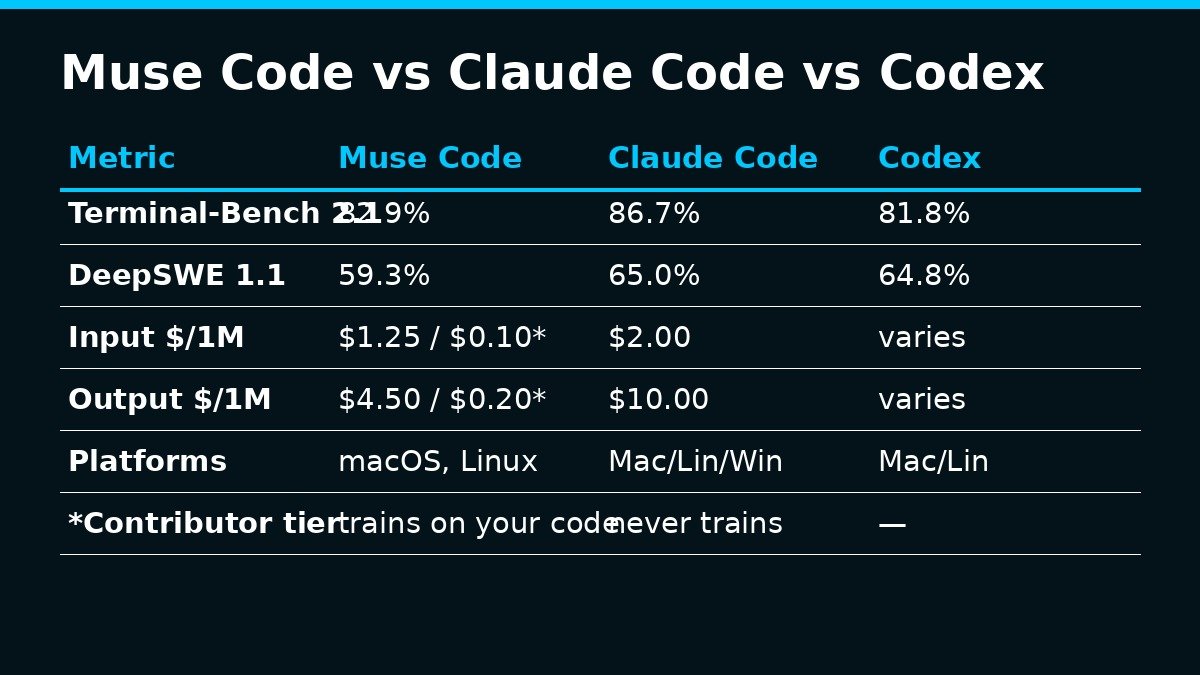
On published benchmarks, no. Decrypt compiled the launch-day comparison and Claude Opus 5 leads every table. On Terminal-Bench 2.1, which measures real terminal-based engineering tasks, Claude Code with Opus 5 scores 86.7%, Muse Spark 1.2 scores 82.9%, and OpenAI’s GPT-5.6 Terra Codex sits at 81.8%. On DeepSWE 1.1, the gap widens: Opus 5 at 65.0%, Codex at 64.8%, and Muse at 59.3%, a five-point deficit on the hardest repository-level tasks. Most telling, on Meta’s own internal coding benchmark, Opus 5 scores 79.4% against Muse’s 70.6%. When your competitor wins your home-field benchmark by nine points, publishing that number is at least honest.
Benchmarks are not the whole product, though. Muse Code’s append-only event log, which records every model call, tool run, approval, and edit locally, means a crashed terminal, a dropped SSH session, or a machine reboot does not vaporize an hour of agent work. You resume from the log. Anyone who has lost a long Claude Code session mid-refactor understands why Meta led with this. The multimodal angle is also further along than rivals: video input to working web app was the launch demo. So the honest summary for week one: Muse is the price-performance play with two clever engineering ideas, not the quality leader. Where it slots against the current leader is covered in our Claude Opus 5 review, and the broader field in Cursor vs GitHub Copilot vs Claude Code.
How do Muse Code, Claude Code, and Codex compare head to head?
Here is the launch-week picture, using published benchmark figures and current pricing.
| Factor | Meta Muse Code | Claude Code | OpenAI Codex |
|---|---|---|---|
| Released | Aug 5, 2026 (beta) | Established, mature | Established |
| Model | Muse Spark 1.2 | Claude Opus 5 / Sonnet 5 | GPT-5.6 Terra Codex |
| Terminal-Bench 2.1 | 82.9% | 86.7% (Opus 5) | 81.8% |
| DeepSWE 1.1 | 59.3% | 65.0% (Opus 5) | 64.8% |
| Input price /1M | $1.25 std / $0.10 contributor | $2 (Sonnet 5, rises to $3 Sept 1) | Varies by plan |
| Output price /1M | $4.50 std / $0.20 contributor | $10 (Sonnet 5) | Varies by plan |
| Trains on your code | Contributor tier: yes. Standard: no | No | No (API default) |
| Platforms | macOS, Linux, terminal only | macOS, Linux, Windows | macOS, Linux, cloud |
| Signature feature | Crash-safe event log, parallel worktree sub-agents | Ecosystem, MCP, agent quality | Cloud task delegation |
What does the contributor tier mean for your code’s privacy?
It means exactly what it says: your prompts and the agent’s completions become Meta training data, and you should treat that as a hard boundary rather than a nuance. On the contributor tier, the code the agent reads into context and the code it writes back can inform future Muse models. For a solo developer hacking on side projects, an open-source maintainer whose code is already public, or a student learning to ship, that trade can be rational; you are converting privacy you may not need into a 95% discount. For anyone touching employer IP, client work under NDA, proprietary algorithms, or anything with regulated data in the repo, the contributor tier is a compliance incident waiting for a signature. Use the standard tier or stay away.
Three practical guardrails if you experiment this week. First, keep contributor-tier work in dedicated repositories with nothing sensitive in the tree, including .env files and API keys, since the agent reads what it needs. Second, remember tiers are account-level pricing decisions; confirm which tier a given project bills against before pointing the agent at it. Third, reread the terms at dev.meta.ai rather than relying on week-one journalism, because beta terms shift. The wider pattern is worth naming too: Meta ran the same data-for-access playbook two days earlier with Muse Spark 1.2’s discounted API pricing, and it mirrors how free consumer AI products have always worked. The difference is that here the data is your codebase. This trade is new to the coding-agent market, and how many developers accept it will tell every vendor whether privacy is a feature or a price lever.
Who should actually switch, and who should stay put?
Map yourself to the closest profile.
If you’re a hobbyist or indie developer with public or non-sensitive code, try the contributor tier now. At $0.10/$0.20 per million tokens, an evening of agentic coding costs pennies, and the quality gap to Opus 5, while real, does not matter much for side projects.
If you’re a professional running Claude Code on client or employer code, stay put for now. Opus 5 leads every benchmark, your workflows already exist, and Muse’s standard tier saves money only if your output-token mix cooperates. Revisit after the beta matures and Windows support lands.
If you’re cost-optimizing an AI-heavy startup, run a two-week bake-off: Muse standard tier against Sonnet 5, same tasks, measure completion rate and total spend, especially with Sonnet 5’s input price rising September 1. The numbers will decide for you.
If you’re on long-running agent tasks that keep dying mid-session, Muse’s event-log recovery is the one feature no competitor matches today, and it may be worth the benchmark discount alone.
If you’re all-in on autonomous agents, note that Muse’s parallel worktree sub-agents echo what we found in our Devin review: parallelism impresses in demos and needs supervision in practice.
If you’re on Windows, this launch is not for you yet. Claude Code and the editor-based tools in our comparison guides remain the field.
How do you install Muse Code and what should you try first?
Installation is one line in a macOS or Linux terminal: curl -fsSL https://dev.meta.ai/install.sh | bash, followed by signing in with a Meta developer account and choosing a tier. From there the workflow will feel familiar to anyone who has run Claude Code: open a terminal inside a repository, describe the change you want, and approve or reject the agent’s proposed actions as it plans, edits, and runs your tests. The tier decision is the one thing to get right before your first prompt, because it is the difference between Meta training on your session and not.
A sensible first-week evaluation looks like this. Start with a throwaway project or a public repo, on the contributor tier if the code is genuinely non-sensitive, and give it a bounded task: add a feature with tests, upgrade a dependency across the codebase, or fix a reproducible bug. Watch how it plans before it edits; the sub-agent parallelism only shows up on multi-part tasks, so ask for something with several independent pieces. Then deliberately kill the terminal mid-task and restart, because the event-log resume is the feature you are actually auditioning. If it survives that, graduate to the standard tier on a real project and compare spend against your current tool for the same work. Budget note: agentic sessions are output-heavy, and at $4.50 per million output tokens the standard tier is cheap but not free; a long refactor session can still cost real money, so check the usage dashboard early rather than at month’s end. Keep expectations calibrated to a day-old beta: reviewers have already noted rough edges around documentation, and beta terms and prices can move without much notice.
Where does Muse Code fit in Meta’s larger AI push?
Muse Code is the fourth beat in a year-long pivot that has seen Meta rebuild its AI stack around the Muse brand. In April 2026 the company replaced Llama with Muse Spark as its flagship model family, a decisive break from the open-weight strategy that defined Meta AI for three years. May brought expanded Muse-powered features across Meta’s consumer apps, July added image generation, and now August delivers the developer play: Muse Spark 1.2 through the Model API and Muse Code as its agentic front end. The through-line is vertical integration. Meta wants the model, the agent, the data flywheel, and the developer relationship, and the contributor tier is the flywheel’s intake valve: every discounted session feeds training data for the next Muse model.
The competitive framing is not subtle either. Meta launched Muse Code two days after news broke that Microsoft booked $24.1 billion in OpenAI-related revenue for its fiscal year, and priced it to make Anthropic’s September 1 Sonnet 5 increase look ill-timed. Meta can afford to lose money on coding agents indefinitely; advertising pays the bills, and code data may be worth more to its model roadmap than the API revenue it forgoes. For developers, that subsidy is genuinely useful as long as you understand you are the product on the cheap tier. For the market, it puts a clock on premium pricing: if Muse Spark 2.0 closes the benchmark gap while holding contributor-tier prices, the coding-agent business turns into a knife fight. Our Cursor vs Claude Code comparison shows how fast leadership in this category has already changed hands twice.
Does Muse Code change the AI coding market even if you never use it?
Yes, because it resets the price floor and forces an answer on training data. Anthropic and OpenAI now compete against a rival willing to price agentic coding at $0.10 per million input tokens, subsidized by training-data collection and Meta’s ad-funded balance sheet. That pressure lands at an awkward moment for Anthropic, which is walking Sonnet 5’s input price up 50% on September 1 while a Microsoft filing just revealed $24.1 billion in OpenAI-related revenue flowing through its fiscal year, a reminder of how much money now rides on developer AI spend. Cheap capable agents also expand who codes at all; the same week Meta shipped Muse Code, it shipped video-to-app generation, which is a no-code pitch wearing a terminal costume.
The counterweight: quality still commands loyalty, and Claude Code’s lead is not just benchmarks but a mature ecosystem of integrations, MCP tooling, and two years of developer trust. DeepSeek proved in January that shock pricing alone does not dethrone an incumbent, as we covered in DeepSeek V4 vs GPT-5.6. What Muse Code really tests is whether a 20x discount can buy market share faster than a 4-to-6-point benchmark gap loses it. Watch three signals through fall 2026: whether Anthropic blinks on the September 1 price step, whether Meta ships Windows and a GUI, and whether any enterprise publicly adopts the contributor tier. Those will tell you if this launch was a price war or a price stunt.
FAQ: Meta Muse Code vs Claude Code
Is Meta Muse Code free?
No. There is no free tier at launch. The cheapest access is the contributor tier at $0.10 per million input tokens and $0.20 per million output, which requires letting Meta train on your prompts and completions. The standard tier costs $1.25/$4.50 with no training.
What platforms does Muse Code run on?
macOS and Linux only, as a terminal application installed via a curl script. There is no Windows build and no graphical interface at launch on August 5, 2026.
Is Muse Code better than Claude Code?
Not on published benchmarks. Claude Opus 5 scores 86.7% on Terminal-Bench 2.1 versus Muse Spark 1.2’s 82.9%, and leads on DeepSWE 1.1 (65.0% vs 59.3%) and Meta’s own internal benchmark (79.4% vs 70.6%).
What model powers Muse Code?
Muse Spark 1.2, Meta’s coding-focused model update. It is also available directly through the Meta Model API, separate from the Muse Code agent.
Does Meta train on my code if I use Muse Code?
Only on the contributor tier, where the discount exists precisely because you grant that permission. The standard tier ($1.25/$4.50 per million tokens) does not train on your code, per Meta’s launch terms.
What is Muse Code’s crash recovery feature?
An append-only local event log records every model call, tool run, approval, and file edit. If your session crashes or disconnects, the agent resumes from the log instead of restarting the task from zero.
How does Claude Sonnet 5’s price change affect this comparison?
Sonnet 5’s introductory $2 per million input price rises to $3 on September 1, 2026. That widens Muse’s standard-tier price advantage on input tokens, though Sonnet 5 retains the benchmark and ecosystem edge.
Can Muse Code build apps from video?
Meta demonstrated converting a video flythrough of a home into a working booking web app, and multimodal input is a launch feature. Treat demo-grade capability as a starting point, not a production guarantee.
Sources
All pricing, benchmark, and launch details verified August 6, 2026.
- TechCrunch: Meta launches Muse Code (Aug 5, 2026)
- MacRumors: Muse Code costs up to 20x less if you let Meta train on your data
- 9to5Mac: Muse Code for macOS and Linux
- Decrypt: How Muse compares to Claude Code and Codex
- CNBC: Meta debuts first AI coding agent
- OpenRouter: Claude Sonnet 5 pricing
- AI Tools Recap: August 2026 AI news (Sonnet 5 price change)
Muse Code is available now at dev.meta.ai; Claude Code documentation lives at docs.claude.com.

Naveen Kumar Durai is the founder of Naveen AI Automation and the reviewer behind AITrendyReview. He builds AI automation systems daily and reviews AI tools from official docs, live pricing pages, and verified user reports — updated monthly as tools change.