A New York federal judge decided in February 2026 that anything a client types into a consumer AI chatbot can be read out loud in court. Five months later, Anthropic shipped Claude Opus 5 and claimed it “gets to the redline in less time” on NDAs. Those two events, taken together, changed the answer to a question thousands of lawyers are asking: should legal document work run through Claude or ChatGPT? The honest answer depends less on benchmarks than on which plan you buy, and most comparisons skip that part entirely.
How we assess: this review is based on official documentation, pricing pages, changelogs, and verified user reports, not hands-on testing.
Is Claude or ChatGPT better for legal documents? Claude is the stronger pick for long-contract review and drafting prose, thanks to a 1M-token context window and Opus 5’s redlining gains. ChatGPT scored higher on one independent legal benchmark (79.8% vs 68.4%, GC AI, May 2026) and wins on structured drafting. Neither is confidential on a $20 consumer plan.

Key takeaways
- Claude Opus 5 (released July 24, 2026) scored 11.7% all-pass on Harvey’s Legal Agent Benchmark (the highest of any Opus model) while using 26% fewer tokens than Opus 4.8.
- ChatGPT beat Claude 79.8% to 68.4% on GC AI’s 100-task In-House Legal Bench in May 2026, though that test predates Opus 5.
- Both tools cost $20/month at the entry paid tier, and both scale to $100 and $200 individual plans; team plans start at $25/seat (Claude) and $20-25/seat (ChatGPT Business).
- The Heppner ruling (SDNY, February 17, 2026) stripped attorney-client privilege from consumer-tier AI chats on both platforms.
- Courts have logged roughly 1,490 AI-hallucination cases worldwide as of May 2026, with sanctions reaching $15,000 per attorney in March 2026.
- ChatGPT Free and Plus train on your inputs by default; Claude’s consumer training is opt-in, with a 5-year retention period if you accept.
Which is better for legal documents: Claude or ChatGPT?
Claude is better for reviewing and drafting long legal documents; ChatGPT is better for structured, template-driven output and legal research workflows. Claude’s 1M-token context window reads an entire deal binder in one pass, while GPT-5.6’s strongest verified legal gain is “structured drafting” per Legora’s evaluation. Buy based on your document type, not the logo.
The split is real, and it shows up in the two most credible third-party evaluations published this year. Harvey, the legal AI platform our Harvey AI vs CoCounsel comparison covers in depth, reported that Claude Opus 5 hit 11.7% all-pass on its Legal Agent Benchmark in July 2026, calling it “a meaningful step up relative to prior Opus models,” with particular strength in transactional and disclosure-heavy work: corporate governance, M&A, energy, real estate. That number sounds low until you understand LAB grades complete multi-step agent runs, where a single missed clause fails the whole task.
Point the other direction and the picture flips. GC AI’s In-House Legal Bench, run in May 2026 across 100 in-house tasks, put ChatGPT at 79.8% and Claude Opus 4.7 at 68.4%. One caveat matters: that test ran two months before Opus 5 existed. The honest read is that neither model dominates. Claude drafts better prose and holds more context; ChatGPT executes structured tasks more reliably. Anyone telling you one of them “wins at legal” flatly hasn’t read both benchmarks.
What did Claude Opus 5 actually change for legal work?
Claude Opus 5, released July 24, 2026, improved contract redlining speed and multi-step legal reasoning. Anthropic says that on NDAs it “gets to the redline in less time and with fewer passes, with accuracy maintained or better.” Harvey measured comparable accuracy to Opus 4.8 while generating 26% fewer tokens, meaning faster, cheaper document runs.
The redlining claim is the one lawyers should care about. Redlines are where general-purpose chatbots historically embarrass themselves: they rewrite clauses nobody asked about, or miss the one indemnity carve-out that mattered. Anthropic putting NDA redlining in the launch announcement, and Harvey rolling Opus 5 out to US legal customers the same week, signals where this model was tuned.
Pricing stayed put. Opus 5 costs $5 per million input tokens and $25 per million output on the API, identical to Opus 4.8, with a fast mode at double the price that runs roughly 2.5x quicker. On subscriptions, Opus 5 is the default model on Claude Max and the strongest model available on Claude Pro at $20/month. A 300-page contract stack that once needed chunking now fits in one context window, and the model that reads it costs the same as the one it replaced. That is quiet, unglamorous progress of the kind that actually shifts buying decisions. Our full Claude Opus 5 review covers the benchmarks and limits beyond legal work.
GPT-5.6 arrived two weeks earlier, on July 9, 2026, in three variants: Sol (flagship, $5 input / $30 output per million tokens), Terra (mid-tier, $2.50/$15), and Luna (budget, $1/$6). OpenAI’s own launch page cites an evaluation by legal AI company Legora: GPT-5.6 “improved or held steady in 5 of 7 tasks, with the strongest gains in structured drafting.” Note what that phrasing concedes: it regressed or flatlined on two of seven legal tasks. Launch pages rarely admit that much, which makes the admission useful.
Is ChatGPT safe for confidential legal documents?
Not on Free or Plus plans. ChatGPT’s consumer tiers train on your inputs by default, and the Heppner ruling (SDNY, February 2026) held that consumer AI chats carry no attorney-client privilege. ChatGPT Business and Enterprise offer zero-data-retention and contractual confidentiality, which changes the analysis. The $20 plan is for public documents only.
Here is the case every comparison should lead with and almost none do. In United States v. Heppner, decided February 17, 2026, Judge Jed Rakoff applied a three-part test and found that communications with consumer-grade AI platforms get no privilege protection: the AI is not an attorney, the platform’s terms permit training on user inputs, and the user operated outside counsel’s direction. Consumer tiers of both ChatGPT and Claude fail that test. Whatever a client pasted into a $20 chatbot plan is potentially discoverable.
The two companies’ data postures differ in a way that matters for anything short of privileged work. OpenAI trains on Free and Plus inputs by default; you must go turn it off. Anthropic flipped to an opt-in model on August 28, 2025: consumer chats train Claude only if you agree, though agreeing brings a five-year retention period. Default settings decide real outcomes because most users never open the settings page. Claude’s default is the safer one; on this axis, that’s the entire argument.
For genuinely confidential material the plan tier is the whole game. ChatGPT Business ($20-25/seat/month) and Enterprise offer zero data retention and contractual confidentiality. Claude for Work and the Anthropic API likewise exclude training and run on commercial terms. GC AI’s analysis of Heppner notes the ruling left one door open: counsel-directed use on a platform with enforceable confidentiality may preserve privilege under the Kovel doctrine. That door only exists on business tiers.
How do Claude and ChatGPT compare on contract review and drafting?
Claude leads on long-context contract review: its 1M-token window holds full discovery productions, and reviewers consistently rate its drafting prose closer to senior-associate quality. ChatGPT leads on structured drafting and scored 11 points higher on GC AI’s in-house benchmark. For redlines, early evidence favors Opus 5; for templates and forms, GPT-5.6.
Context capacity is Claude’s clearest structural edge. Opus-class models hold 1M tokens, roughly 750,000 words, enough for a full deal binder or discovery production in a single conversation. When a model can see every exhibit at once, cross-document questions (“which of these 40 vendor contracts deviate from our standard indemnity clause?”) stop being a chunking-and-praying exercise.
Claude’s weakness is subtler, and GC AI documented a sharp example: asked about termination rights, Claude missed a termination-at-will provision because contracts rarely use that exact phrase; the model pattern-matched keywords instead of reasoning through the clause’s effect. That failure mode is precisely why 68.4% of in-house tasks passed and 31.6% didn’t. ChatGPT’s corresponding weakness is prose. Its drafts read competent and flat; Claude’s read like they were written by someone who bills by the hour. For client-facing letters, memos, and negotiated agreements where tone carries weight, that gap is visible in one paragraph.
Hallucinated citations remain the shared, career-ending failure mode. Damien Charlotin’s tracker counted roughly 1,490 AI-hallucination court filings worldwide by May 2026, up from a single famous case ($5,000, Mata v. Avianca) in 2023. By March 2026, Whiting v. City of Athens reached $15,000 per attorney plus opposing fees; April 2026 brought an indefinite bar suspension in Nebraska. Most logged cases involve ChatGPT, partly market share and partly lawyers treating a language model as a case-law database. Neither model should ever produce a citation that goes into a filing unverified. Not once.
Claude vs ChatGPT for legal documents: head to head
| Tool | Price | Free plan | Best for | Key limit |
|---|---|---|---|---|
| Claude (Opus 5) | $20/mo Pro; $100-200 Max; Team $25/seat | Yes (daily caps, weaker models) | Long-contract review, redlines, drafting prose | Keyword-style misses on implied clauses |
| ChatGPT (GPT-5.6) | $20/mo Plus; $100-200 Pro; Business $20-25/seat | Yes (Terra variant only) | Structured drafting, templates, research workflows | Trains on Free/Plus inputs by default |
| Harvey AI | ~$500/seat/mo (quoted) | No | Law firms needing workflow-grade legal AI | Price; overkill for solo practices |
What do Claude and ChatGPT cost for legal teams in 2026?
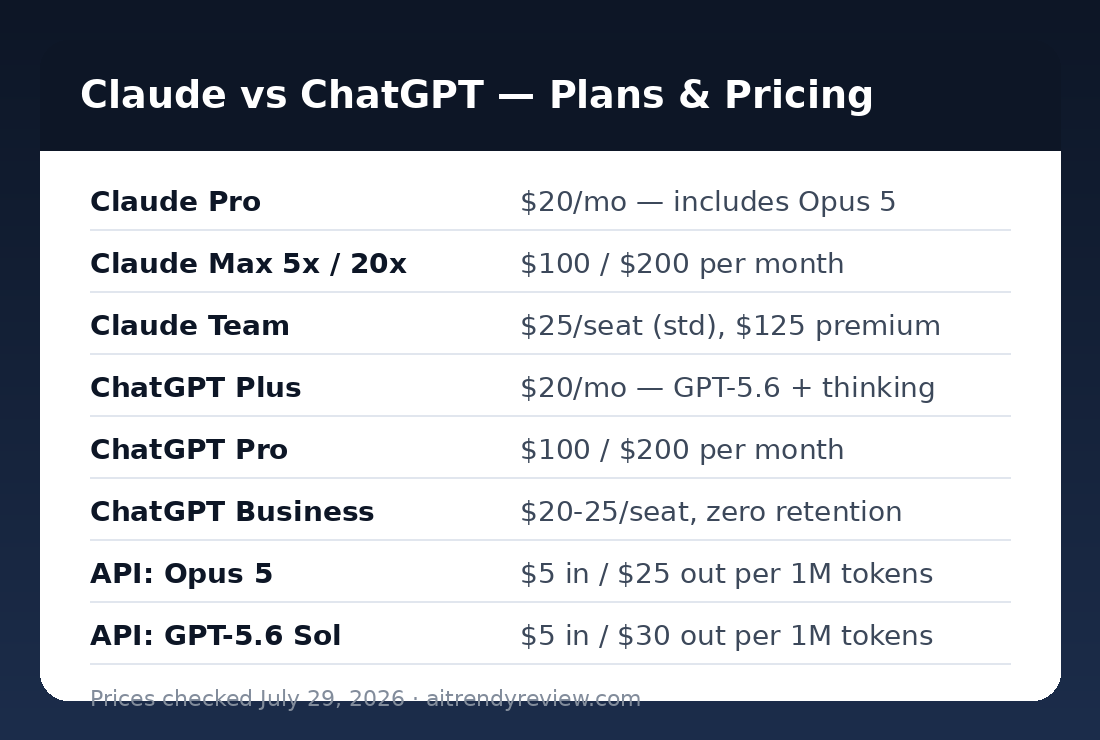
Both start at $20/month for individuals (Claude Pro, ChatGPT Plus) and both sell $100 and $200 tiers with 5x and 20x higher limits. Claude Team runs $25/seat standard or $125/seat premium; ChatGPT Business runs $20-25/seat. Confidential work requires the business tiers on either platform; budget from there, not from $20.
The pricing symmetry is almost suspicious. Claude: Free, Pro at $20/month ($17 on annual billing), Max 5x at $100, Max 20x at $200, Team from $25/seat. ChatGPT: Free, Go at $8, Plus at $20, Pro at $100 or $200, Business at $20-25/seat. The $8 ChatGPT Go tier has no Claude equivalent, but it serves Terra only, not the flagship, so it’s irrelevant for document work that matters.
What the sticker prices hide is model access. ChatGPT Plus at $20 gets GPT-5.6 and its thinking mode, but the Sol flagship variant sits behind the $100+ Pro tiers. Claude Pro at $20 includes Opus 5 outright: the same frontier model Max subscribers get, with lower usage limits. A solo lawyer paying $20 gets Anthropic’s best model or OpenAI’s second-best. For a fuller consumer-plan breakdown, see our ChatGPT Plus vs Claude Pro comparison; for API-side economics, our DeepSeek V4 vs GPT-5.6 pricing analysis shows how far frontier prices have stretched.
Can Claude or ChatGPT replace dedicated legal AI like Harvey?
No. They replace the model layer, not the workflow layer. Harvey, CoCounsel, and Spellbook wrap frontier models (Harvey now runs Opus 5) in citation checking, matter management, and firm-grade confidentiality. A general chatbot gives you the same brain without the guardrails. Solos can bridge the gap with discipline; firms mostly can’t.
The revealing detail is that Harvey itself adopted Opus 5 within days of launch, rolling it out to US customers in July 2026. The $500-per-seat legal platforms are, at the model layer, selling you Claude and GPT with legal plumbing around them. What you pay for is the plumbing: verified citation pipelines, privilege-aware data handling, practice-area workflows, the things that keep associates out of sanctions trackers. Our Harvey AI review examines whether that wrapper justifies roughly 25x the price of a Claude Pro seat.
Anthropic is compressing that gap from below. Claude for Legal launched May 12, 2026 with 12 practice-area plugins and 90+ workflow agents, a clear signal that the general-purpose platforms intend to eat the workflow layer too. It hasn’t happened yet. In mid-2026, a chatbot subscription plus a lawyer who verifies everything is a workflow; a chatbot subscription alone is a liability.
Which should you choose: solo lawyer, small firm, or legal department?
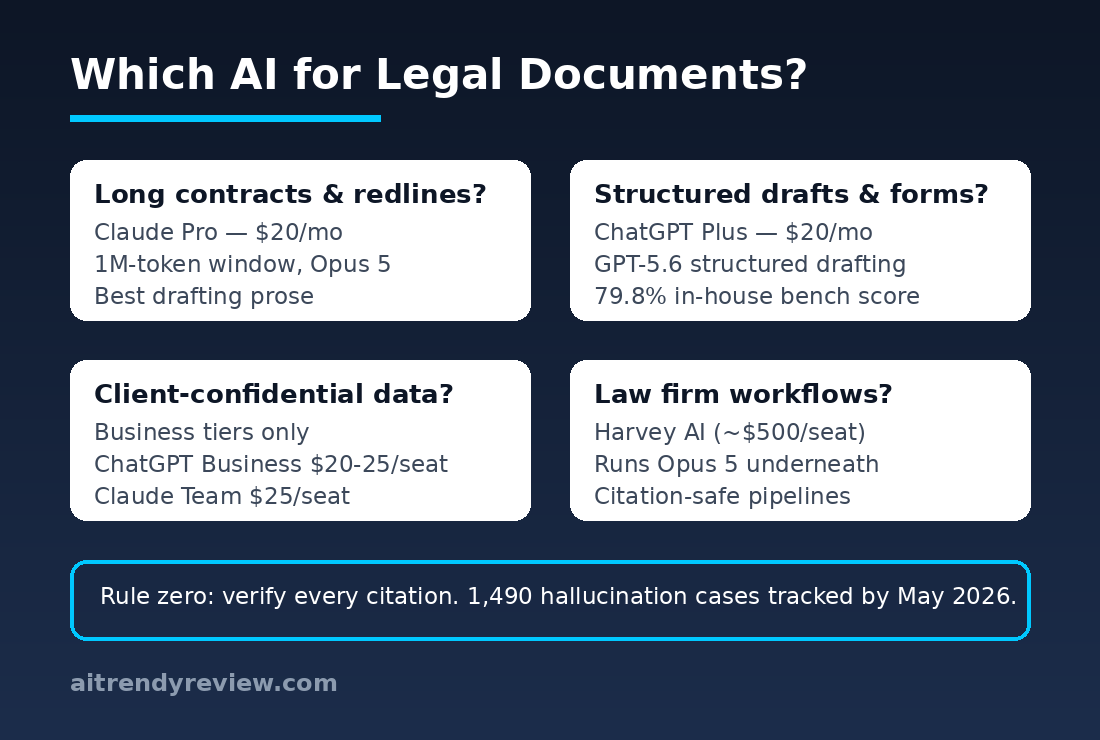
If you’re a solo lawyer, get Claude Pro at $20/month for Opus 5 access, opt-in-only training, and the best drafting prose. If you run a 5-50 person firm, get ChatGPT Business or Claude Team for zero-retention terms. If you’re a legal department with regulated data, skip consumer tools entirely: enterprise deployment or a wrapped platform like Harvey.
The reasoning, case by case. A solo practitioner lives on drafting and review, rarely has enterprise procurement, and needs the best model per dollar: Claude Pro delivers Opus 5 (the model Harvey picked for transactional work) at $20, with training off unless you opt in. Keep client identities out of prompts and verify every citation, and it is a defensible setup for non-privileged work.
A small firm’s calculus changes because Heppner makes consumer plans a malpractice question. ChatGPT Business at $20-25/seat with zero data retention is the cheapest path to contractual confidentiality; Claude Team standard costs about the same. Pick by document mix: transactional shops reviewing long agreements lean Claude, litigation-support and research-heavy practices lean ChatGPT’s structured-task strength. Legal departments at regulated companies should treat both chatbots as engines, not products, and buy the wrapper: Harvey, CoCounsel, or an enterprise deployment with counsel-directed use that can survive a privilege challenge.
How do you use Claude or ChatGPT for legal documents without getting sanctioned?
Never file an unverified citation, never paste client-identifying data into a consumer plan, and never let the model perform legal judgment, only legal labor. Treat Claude and ChatGPT as fast first-draft associates whose every factual claim gets checked. The 1,490 sanction-tracker cases share one root cause: output that skipped human verification.
The workflow that keeps lawyers out of that tracker has four parts. First, separate drafting from research. Both Claude Opus 5 and GPT-5.6 are strong writers and unreliable case-law databases; asking either to “find supporting authority” is how Mata v. Avianca happened. Draft with the model, research in Westlaw or Lexis, then hand the verified authorities back to the model to weave in. Second, redline against a source of truth. When Claude reviews a contract, feed it your firm’s standard positions or playbook in the same prompt; the 1M-token window exists precisely so the model can compare against something rather than improvise. Third, strip identifiers before anything touches a consumer tier: party names, deal values, dates that make a matter recognizable. On business tiers with zero retention this is belt-and-suspenders; on a $20 plan it is the whole belt.
Fourth, and this is the step firms skip: write the AI policy down. Heppner‘s privilege analysis turned partly on whether use was counsel-directed. A one-page policy stating which tools, which tiers, which document classes, and who verifies output converts ad-hoc chatbot use into exactly the kind of directed, documented process that both the ethics rules and the Kovel workaround reward. Courts in several districts now ask filers to certify AI involvement; a firm that can point to its policy answers that question in one sentence.
One more habit pays off across both platforms: ask the model to argue against its own redline. Opus 5’s launch materials emphasize verification and iterative reasoning; GPT-5.6’s thinking mode exists for the same purpose. A prompt as simple as “list the three weakest changes you just proposed and why opposing counsel would reject them” surfaces more real issues than a second read-through, and costs thirty seconds. The lawyers getting value from these tools in 2026 aren’t the ones with secret prompts; they’re the ones who built verification into the loop and never let the model’s confidence substitute for their own.
Worth it if / Skip it if
Claude is worth it if: you review contracts longer than 100 pages, you care how drafts read, you want frontier-model access at $20, or your data posture demands training-off-by-default. Skip Claude if: your work is template-heavy structured drafting, or you need the ecosystem of plugins and custom GPTs that OpenAI’s platform carries.
ChatGPT is worth it if: you draft structured documents from templates, you want the stronger showing on in-house-task benchmarks, or your firm already runs ChatGPT Business with zero retention. Skip ChatGPT if: you’d be pasting client material into a Free or Plus plan; the training default and Heppner make that combination indefensible in 2026.
FAQ
Can lawyers legally use ChatGPT or Claude for client work?
Yes. No US jurisdiction bans it, but ethics rules on competence and confidentiality apply fully. After Heppner (February 2026), consumer-tier chats carry no privilege, so client-identifying or privileged material belongs only on business tiers with contractual confidentiality, used under counsel direction. Several courts also require disclosure of AI-assisted filings.
Does ChatGPT train on my legal documents?
On Free and Plus plans, yes: training on inputs is the default unless you disable it in settings. ChatGPT Business and Enterprise contractually exclude training and offer zero data retention. Claude is opt-in on consumer plans: nothing trains unless you agree, though opting in extends retention to five years.
Is Claude Opus 5 better than GPT-5.6 for contracts?
For long-contract review and redlining, the evidence leans Claude: Harvey benchmarked Opus 5 as its best Opus yet for transactional work, and Anthropic claims faster NDA redlines. For structured, template-driven drafting, Legora’s evaluation found GPT-5.6’s strongest gains. Match the model to the document type rather than picking one outright.
How much does Claude cost for a small law firm?
Claude Team costs $25 per seat monthly on the standard tier, or $125 per seat premium, with pooled usage and admin controls. A five-lawyer firm pays about $125/month standard. Individual Claude Pro is $20/month but lacks the commercial data terms; firms handling client data should price from the Team tier up.
Can Claude or ChatGPT cite case law reliably?
No. Roughly 1,490 court filings with AI-hallucinated citations had been tracked worldwide by May 2026, and 2026 sanctions reached $15,000 per attorney. Both models fabricate plausible-looking citations under uncertainty. Use them for drafting and analysis; verify every citation in Westlaw, Lexis, or a citator before anything reaches a court.
What is the safest way to use AI for privileged documents?
Use a business or enterprise tier with zero data retention and contractual confidentiality (ChatGPT Business, Claude for Work, or a legal platform like Harvey) and have counsel direct the use. Heppner suggests counsel-directed use on confidential platforms may preserve privilege under the Kovel doctrine; consumer plans preserve nothing.
Do I still need Harvey or CoCounsel if I have Claude?
For a solo practice, often not: Claude Pro plus disciplined citation checking covers drafting and review at $20/month. Firms above roughly ten lawyers usually justify a wrapped platform: verified-citation pipelines, matter management, and privilege-aware infrastructure are what $500/seat buys, since Harvey itself runs Claude Opus 5 underneath.
Sources
- Anthropic — Introducing Claude Opus 5 (July 24, 2026)
- OpenAI — GPT-5.6 announcement (July 9, 2026)
- Harvey — Claude Opus 5, Now Live in Harvey (July 2026)
- GC AI — AI Hallucination Legal Cases: A Sanctions Tracker
- GC AI — ChatGPT for Lawyers in 2026 and the Heppner ruling
Prices checked July 29, 2026. AI-tool pricing changes frequently; confirm on the official Claude pricing page and ChatGPT pricing page before buying.

Naveen Kumar Durai is the founder of Naveen AI Automation and the reviewer behind AITrendyReview. He builds AI automation systems daily and reviews AI tools from official docs, live pricing pages, and verified user reports — updated monthly as tools change.