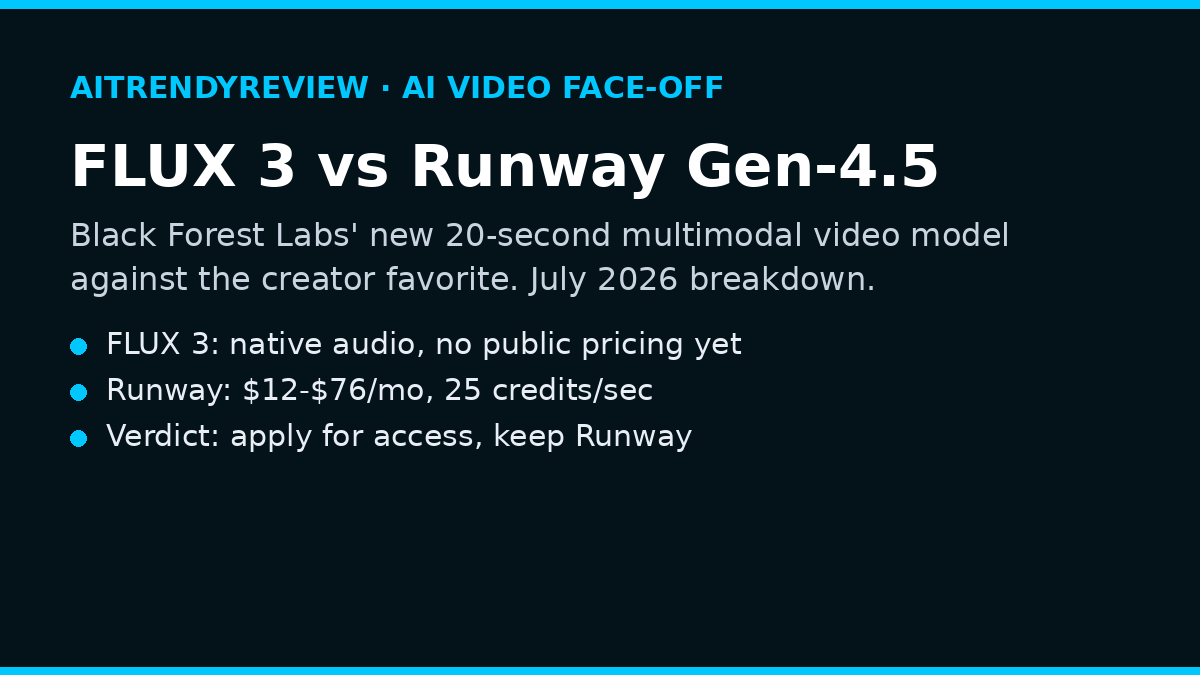
Black Forest Labs just crashed the AI video party. On July 23, 2026, the Freiburg-based lab behind the FLUX image models announced FLUX 3, a single multimodal model that generates up to 20-second video clips with native synchronized audio, and opened a gated early-access program the next day. Its vendor-run preference tests claim a 77% win rate against Runway Gen-4.5, the model many working creators currently pay for every month.
That sets up the question this post answers: if you’re paying Runway $12 to $76 a month right now, should you apply for FLUX 3 access, wait for its public launch, or stay put? We break down what’s confirmed versus what’s marketing, price both paths with real numbers, and map the decision to specific creator workflows.
How we assess: research/news-based analysis, not hands-on testing.
Should you switch from Runway Gen-4.5 to FLUX 3 today? No. Not yet. FLUX 3 has no public pricing, no public API, and application-gated access, while Runway ships reliable Gen-4.5 output today from $12 per month. Apply for FLUX 3 early access now, keep your Runway plan, and reassess when FLUX 3 pricing and independent benchmarks land.
Key Takeaways
- July 23, 2026: FLUX 3 announced as one unified model spanning video, image, audio, and action prediction; video early access opened July 24.
- 20 seconds of video with native audio per generation: dialogue, sound effects, and ambient sound in one pass. Runway Gen-4.5 output remains shorter per generation.
- 77% preference win over Runway Gen-4.5 in BFL’s own preliminary tests of 10-second 720p clips, vendor-measured, no independent benchmarks yet.
- $0 pricing information: BFL has announced no pricing for any FLUX 3 tier. Its previous top model, FLUX.2 Max, ran a premium $70 per 1,000 image generations.
- Runway today: $12/mo Standard (625 credits), $28/mo Pro (2,250), $76/mo Max (9,500), with Gen-4.5 costing 25 credits per second of output.
- Open weights are coming: FLUX 3 Dev, a multimodal open-weight release, is promised for later in 2026, the wildcard that could reset video-AI pricing entirely.
- $3.25B: BFL’s valuation after its December 2025 $300M Series B; partners already testing include Canva, Krea, Magnific, and Picsart.
What Exactly Did Black Forest Labs Launch on July 23?
Black Forest Labs announced FLUX 3, a single foundation model trained jointly across image, video, audio, and robotic action prediction, and it opened gated early access for the video and action capabilities on July 24, 2026. This is not four models behind one brand name. BFL says its “Self-Flow” training approach produces one unified backbone that treats video frames, sound, and physical actions as views of the same world model.
The confirmed video capabilities: clips up to 20 seconds per generation with synchronized native audio, including multilingual dialogue. It accepts text-to-video, image-to-video, video-to-video, and keyframe-to-video inputs, and it chains multi-shot sequences agentically for longer narratives rather than stretching a single pass. Evaluations so far were run at 720p on 10-second clips.
The rollout order matters as much as the tech. Video and Action shipped to early access first, image synthesis follows “in the coming weeks,” and the open-weight FLUX 3 Dev arrives last, later in 2026. There is no public API today, and BFL approves each early-access applicant individually. Anyone telling you FLUX 3 is “available” is overstating it — what’s available is an application form.
One more confirmed detail worth registering: this launch is also a robotics play. BFL co-developed FLUX-mimic with Zurich-based mimic robotics, and the system is in a production pilot handling flexible door seals on an Audi manufacturing line, with a company-stated ~101 ms reaction time. That tells you BFL is chasing bigger markets than social clips, which has implications for how hard it will fight on creator pricing.
How Good Is FLUX 3 Compared to Runway Gen-4.5, Really?
On BFL’s own numbers, FLUX 3 beat Runway Gen-4.5 in 77% of human preference comparisons, but every caveat attached to that figure matters. The tests were run by the vendor, on a pre-release FLUX 3 checkpoint, using 10-second 720p clips, and BFL itself labels the results “preliminary evaluation.” No independent benchmark of FLUX 3 exists as of July 29, 2026.
The full preference table BFL published: 93% versus Luma Ray 3.2, 77% versus Runway Gen-4.5, 60% versus Kling v3 Pro, and effective ties at 52% versus both Google’s Gemini Omni Flash and ByteDance’s Seedance 2.0. Read as a pattern rather than gospel, it suggests FLUX 3 sits in the top tier of video models but is not running away from Google, whose model is already generally available through a live API.
Runway’s counterargument is operational, not statistical. Gen-4.5 is shipping, today, at known prices, with known render times, inside a mature editor with lip-sync, camera controls, and an asset pipeline creators already use. Runway won a 2025 technical Emmy and its tools have been used on Hollywood productions: distribution and workflow maturity that a preference percentage doesn’t capture. Our full Runway Gen-4 review covers that ecosystem in depth, and our Runway vs Sora comparison shows how it stacks against OpenAI’s approach.
The honest read: FLUX 3’s native 20-second audio-synced generation is a real capability gap: Runway generates shorter silent-first clips and layers audio in post. If BFL’s quality claims survive independent testing, the 77% number will matter. Until then it’s a strong signal, not a verdict.
What Does Each Option Actually Cost in July 2026?
Runway’s costs are public and FLUX 3’s are not; that asymmetry is the core of the switching decision. Runway’s current plans: Free (125 one-time credits), Standard at $12/user/month annual (625 credits/month), Pro at $28 (2,250 credits), and Max at $76 (9,500 credits). Gen-4.5 burns 25 credits per second of output, so Standard buys about 25 seconds of Gen-4.5 video a month, Pro about 90 seconds, and Max about 380 seconds, roughly $0.48, $0.31, and $0.20 per second respectively.
FLUX 3 has announced no pricing for any tier. The only anchor we have is history: BFL priced FLUX.2 Max at $70 per 1,000 text-to-image generations, at the premium end of its category. A 20-second audio-synced video generation is computationally far heavier than an image, so expect FLUX 3 API pricing, whenever it lands, to start premium, not cheap. Early access itself costs nothing but an application today.
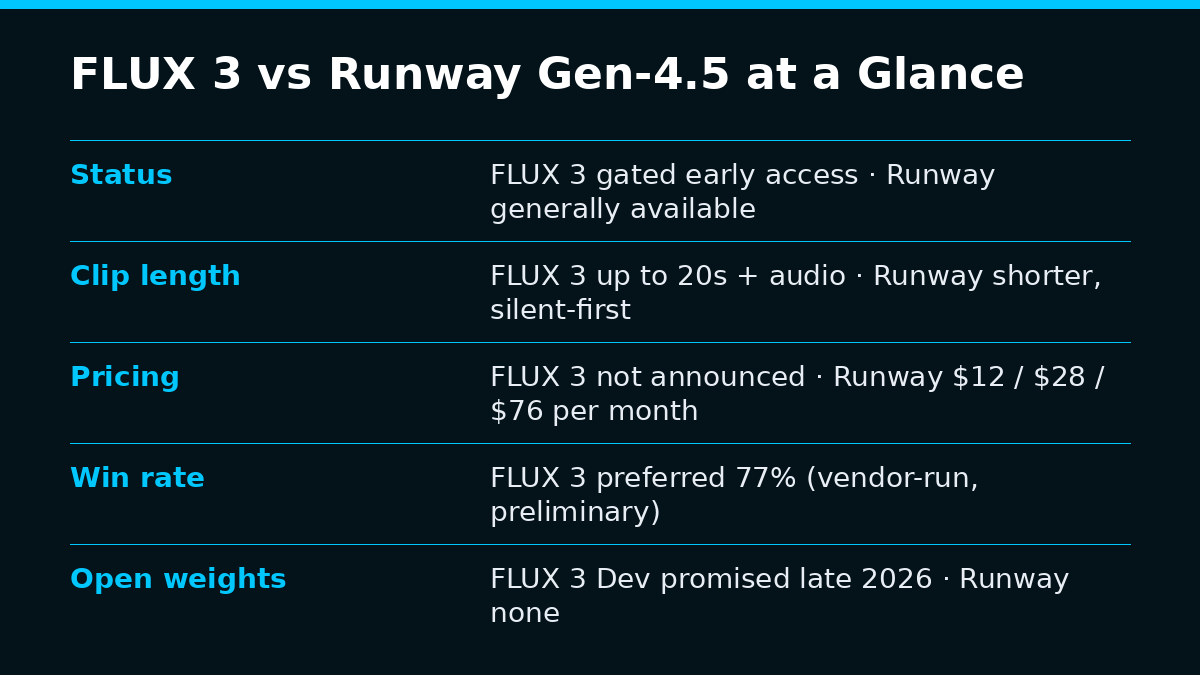
| FLUX 3 (BFL) | Runway Gen-4.5 | |
|---|---|---|
| Status (July 29, 2026) | Gated early access, application required | Generally available |
| Max clip length | 20 s per generation, chainable | Shorter per generation |
| Native audio | Yes: dialogue, SFX, ambient | No (audio added separately) |
| Input modes | Text, image, video, keyframe | Text, image, video |
| Pricing | Not announced | $12 / $28 / $76 per month |
| Cost per second (Gen-4.5) | Unknown | $0.20–$0.48 depending on plan |
| Public API | No | Yes |
| Open weights | FLUX 3 Dev, later 2026 | No |
| Independent benchmarks | None yet | Extensive real-world track record |
| Editor/workflow tools | Minimal (model access) | Mature editing suite |
The budget takeaway: a creator producing 60–90 seconds of finished AI video a month is well served by Runway Pro at $28. There is no FLUX 3 price to compare against, and committing your pipeline to an unpriced product is how agencies end up with surprise invoices.
Who Is Black Forest Labs, and Can You Trust Them With Your Pipeline?
BFL is the strongest independent European AI lab in visual generation, and its staying power looks better than most startups whose model you might build on. Founded in August 2024 by researchers behind Stable Diffusion, the company closed a $300 million Series B in December 2025 led by AMP and Salesforce Ventures at a $3.25 billion post-money valuation, taking total funding past $450 million. It remains independent, with no Big Tech parent, and Martin Scorsese serves as an advisor, a signal of its ambitions in serious filmmaking.
Its distribution is already broad: FLUX models power features inside Adobe Photoshop and Picsart, and Canva, Burda, Magnific, Krea, and Picsart are named FLUX 3 integration partners. That means many creators will touch FLUX 3 through tools they already pay for before BFL ever sells them a subscription, the same dynamic we track in our Midjourney v7 review, where platform lock-in shapes the buying decision as much as image quality.
The open-weight angle deserves its own paragraph. BFL built its reputation on releasing capable FLUX Dev weights that the community could self-host and fine-tune. FLUX 3 Dev is promised as a full multimodal backbone (video, audio, image, and action), which would be the most capable open-weight video release ever if it ships as described. The hedge: BFL has pushed Dev to the end of the rollout queue this time and hasn’t disclosed license terms, a posture shift from its earlier releases. If you’re a developer betting on self-hosting, that license is the document to wait for.
For audio-adjacent creators, note that FLUX 3’s native soundtrack generation will collide with dedicated tools; see our Suno v5 review and ElevenLabs review for what best-in-class standalone audio looks like today.
Which Choice Fits Your Workflow Right Now?
Match your situation to a lane rather than chasing launch-week hype. Here’s the mapping we’d use:
If you’re a YouTuber or short-form creator shipping weekly, stay on Runway. Your bottleneck is iteration speed and predictable cost, both of which an application-gated preview can’t offer. Apply for FLUX 3 access in parallel; it costs nothing.
If you’re an agency producing client video, stay on Runway Pro or Max for delivery work, and put FLUX 3 in your R&D column. Pitching clients on 20-second audio-synced generations is compelling, but promising deadlines on an unpriced early-access model is malpractice.
If you’re a filmmaker or narrative creator, apply for early access today. Keyframe-to-video plus multi-shot chaining plus native multilingual dialogue is the most director-shaped feature set any lab has announced, and early access is where you learn its grammar before competitors do.
If you’re a developer or product team, wait for the API and the FLUX 3 Dev license. Nothing is buildable today. Meanwhile, prototype against Runway’s live API so you have a working baseline to benchmark FLUX 3 against the week it opens.
If you’re budget-constrained, do nothing. Runway’s free tier (125 one-time credits) plus FLUX 3’s free application covers your exploration. The worst move at this stage of a hype cycle is paying for expectations.
If audio is your differentiator (dialogue scenes, sound design, dubbed content), FLUX 3 is the one to watch most closely. Native synchronized audio in the same generation pass is the feature Runway doesn’t have an announced answer to.
What Does Runway Gen-4.5 Offer That FLUX 3 Doesn’t?
Runway’s real moat isn’t the model — it’s everything wrapped around it, and none of that shows up in a preference test. Gen-4.5 lives inside a full production environment: a timeline editor, camera and motion controls, lip-sync tooling, style references, asset management, and team workspaces. A working creator doesn’t ship a raw generation; they ship an edit, and Runway collapses the distance between the two. FLUX 3 early access, by contrast, is model access: you bring your own pipeline.
The maturity gap extends to the practical layers agencies bill against. Runway publishes prices, so you can quote a client. It has a public API, so your tools can automate it. Render behavior and content moderation are known quantities after years of production use, including on broadcast and film work that earned the company a technical Emmy in 2025. And its credit system, whatever its annoyances, makes cost per deliverable predictable to the cent: at 25 credits per second, a 30-second spot costs 750 credits, under $10 of a Pro plan, before iteration.
There’s also a stability argument for incumbency during a model-release frenzy. July 2026 alone saw at least seven notable video or multimodal model announcements, and creators who re-platform every launch week spend more time migrating than making. The rational posture, which we’ve recommended across categories from AI coding tools to image generators, is to run your production stack one generation behind the bleeding edge and evaluate the new thing with money you’ve already budgeted for R&D.
None of this makes Runway unbeatable. It makes Runway the thing FLUX 3 has to beat on workflow, not just win-rate — and that contest hasn’t started yet, because FLUX 3 doesn’t have a public product.
What Could FLUX 3 Pricing Look Like When It Ships?
Nobody outside Freiburg knows, but the available signals point premium-first, with the open-weight release as the long-term price anchor. Signal one: BFL’s own history. FLUX.2 Max launched at $70 per 1,000 image generations, deliberately at the top of its market. A 20-second, audio-synced, 720p-plus video generation involves orders of magnitude more compute than a single image, so a launch API price in the dollars-per-generation range would surprise no one who has watched this category.
Signal two: the partner-first rollout. Canva, Krea, Magnific, and Picsart integrations mean BFL can monetize through platform deals before setting a retail price, the same way it distributed FLUX models through Adobe Photoshop. For most casual users, the first affordable taste of FLUX 3 will likely arrive inside a subscription they already pay for, at those platforms’ price points rather than BFL’s.
Signal three: FLUX 3 Dev. If BFL ships genuinely capable open weights later in 2026, self-hosting becomes the ceiling on what anyone can charge, a dynamic that already reshaped image-generation pricing after earlier FLUX Dev releases. The counterweight: BFL moved Dev to the end of the queue and hasn’t published license terms, and a restrictive license (non-commercial, or gated by revenue) would blunt that effect considerably.
Planning guidance: if FLUX 3 API pricing lands below roughly $0.30 per second of finished video (Runway Pro territory), switching economics get interesting for volume producers. Above that, FLUX 3 competes on capability (length, native audio) rather than price, and Runway’s workflow advantage keeps most subscribers where they are. Set a calendar reminder for the pricing announcement; don’t set your budget by the hype.
What’s Confirmed vs. Hype at This Point?
Confirmed, per BFL’s announcement and launch coverage: the July 23 announcement date; one unified multimodal architecture; 20-second video with native synchronized audio; text/image/video/keyframe input modes; gated early access for Video and Action open now; image access “in the coming weeks”; FLUX 3 Dev open weights later in 2026; the Canva/Krea/Magnific/Picsart/Burda partner list; the mimic robotics collaboration with an Audi production pilot; and the $3.25B valuation behind it all.
Unconfirmed or vendor-only, as of July 29: every preference-test percentage (BFL-run, pre-release checkpoint, no third-party replication); all pricing for every tier; API timing; the FLUX 3 Dev license terms and exactly which capabilities its weights will include; image-model quality (no benchmarks published at all); and any production SLA. Treat each of these as a question mark in your planning, not a line item.
Also unknown: how competitors respond. Google’s Gemini Omni Flash already ties FLUX 3 in BFL’s own tests while being publicly available, and OpenAI, Kuaishou (Kling), and Luma all ship on faster public cycles than BFL’s staged rollout. The video-model leaderboard in December will not look like July’s. That churn is itself an argument against switching tools every launch week, a pattern we’ve flagged before in fast-moving categories like DeepSeek V4 vs GPT-5.6.
You can apply for FLUX 3 early access at Black Forest Labs’ official site: bfl.ai.
The Bottom Line for July 2026
FLUX 3 is the most interesting video-AI announcement of the summer, and it is still not a reason to cancel anything this week. The capability story is real: one model producing 20-second clips with synchronized dialogue and sound effects is a step nobody else has shipped in a single pass, and BFL’s $450 million war chest plus its Canva-to-Photoshop distribution network means this launch will not quietly disappear the way smaller lab demos do. If the open-weight FLUX 3 Dev lands with a workable license, the economics of the whole category shift within months.
But a working creator’s stack runs on three things FLUX 3 cannot offer yet: a price, an API, and a track record. Runway Gen-4.5 has all three, from $12 a month, inside an editor built for finishing work rather than generating clips. So run the two-track play. Keep Runway as your production floor, file the free FLUX 3 application today, and let the early-access build answer the quality question with your own prompts instead of BFL’s benchmark slides. Switching is a decision for the month pricing drops, not for launch week. We’ll update this comparison when it does.
Frequently Asked Questions
Is FLUX 3 available to the public?
No. As of July 29, 2026, FLUX 3 video and action capabilities are in a gated early-access program with individually approved applications. There is no public API, and image generation hasn’t opened yet.
How much does FLUX 3 cost?
Black Forest Labs has announced no pricing for any FLUX 3 tier. The early-access application is free. BFL’s previous flagship, FLUX.2 Max, was priced at a premium $70 per 1,000 image generations, which hints at positioning.
Is FLUX 3 better than Runway Gen-4.5?
Unproven. BFL’s own preliminary tests show FLUX 3 preferred 77% of the time over Gen-4.5 on 10-second 720p clips, but those tests are vendor-run on a pre-release checkpoint with no independent verification yet.
How long are FLUX 3 videos?
Up to 20 seconds per generation with native synchronized audio, and multi-shot sequences can be chained agentically for longer narratives.
Does FLUX 3 generate sound and dialogue?
Yes. Native audio, including multilingual dialogue, sound effects, and ambient noise, is generated with every video output in the same pass, a capability Runway Gen-4.5 does not offer natively.
Will FLUX 3 have open weights?
BFL has promised FLUX 3 Dev, an open-weight multimodal backbone covering video, audio, image, and action prediction, for later in 2026. License terms haven’t been disclosed.
Should I cancel my Runway subscription?
No. Runway remains the reliable, priced, generally available option with a mature editor. The sensible play is keeping Runway for production work while applying for FLUX 3 early access to evaluate it firsthand.
Who owns FLUX 3?
Black Forest Labs, an independent AI lab in Freiburg, Germany, founded in August 2024 by Stable Diffusion alumni and valued at $3.25 billion after its December 2025 Series B.
Sources
- Black Forest Labs: FLUX 3 announcement. Verified July 29, 2026
- Digital Applied: FLUX 3 — Black Forest Labs Goes Multimodal Frontier. Verified July 29, 2026
- Novalogiq: Black Forest Labs launches FLUX 3 in limited release. Verified July 29, 2026
- eesel: Runway AI pricing in 2026. Verified July 29, 2026

Naveen Kumar Durai is the founder of Naveen AI Automation and the reviewer behind AITrendyReview. He builds AI automation systems daily and reviews AI tools from official docs, live pricing pages, and verified user reports — updated monthly as tools change.