Every YouTube creator flirting with AI video in 2026 ends up at the same fork: Runway Gen-4 or Sora. One is a professional editing suite with surgical camera control. The other is a $20 add-on to a chatbot subscription that happens to generate sound, dialogue, and physics-aware motion in a single pass. They are not interchangeable, and picking wrong costs you real money in credits, re-renders, and disclosure headaches.
Which is better for YouTube videos, Runway Gen-4 or Sora? Sora 2 is the better pick for most YouTube creators in 2026 because it generates synchronized audio and dialogue natively and costs $20/month inside ChatGPT Plus. Runway Gen-4 wins for creators who need precise shot control, 4K upscaling, and brand-safe consistency across long-form projects, starting at $15/month.
How we assess: this review is based on official documentation, pricing pages, changelogs, and verified user reports, not hands-on testing.
Key Takeaways
- Price gap is real: Sora 2 comes bundled with ChatGPT Plus at $20/month; Runway’s comparable Pro plan runs $35/month ($28 billed annually), per each company’s official pricing pages as of July 22, 2026.
- Credit math favors Sora for volume: Runway’s Gen-4.5 burns 12 credits per second, so a single 60-second sequence eats 720 credits, more than the entire 625-credit monthly allowance on Runway’s $15 Standard plan.
- Audio is the dividing line: Sora 2 generates synchronized dialogue and sound effects natively; Runway Gen-4 outputs silent clips, so you budget separately for voiceover and music.
- Clip length differs 2x: Runway Gen-4 caps clips at 10 seconds; Sora 2’s API supports 16- and 20-second generations, per OpenAI’s developer documentation.
- YouTube rules apply to both: Since January 2026, realistic synthetic content requires the “altered or synthetic content” disclosure toggle, with a three-strike enforcement system reported by policy trackers.
- Free tiers are nearly gone: Runway’s free plan gives 125 one-time credits (about 25 seconds of Gen-4 Turbo); free ChatGPT users lost Sora access entirely on January 10, 2026, per third-party tracking.
What Is Runway Gen-4, and Why Do YouTube Creators Use It?
Runway Gen-4 is the flagship video generation model inside Runway’s browser-based creative suite, and it remains the tool of choice for creators who treat AI video like footage rather than a slot machine. Gen-4 generates clips up to 10 seconds from text or image prompts, and the surrounding platform is where it earns its keep: keyframe-style image-to-video control, character and scene consistency across shots, a full timeline editor, and Topaz-powered 4K upscaling on the Pro plan and above.
Runway’s model lineup moved fast this year. Gen-4 Turbo handles cheap, quick drafts at roughly 5 credits per second, while the newer Gen-4.5 (listed on Runway’s credits documentation at 12 credits per second) delivers the highest fidelity. The pricing page now also bundles third-party models like Kling 3.0, which turns Runway into something closer to an aggregator with an editor attached.
For YouTube specifically, Runway’s pitch is control. You can lock a character’s face across an eight-shot sequence, regenerate just one shot, upscale the final cut to 4K, and export without a watermark on any paid plan. That workflow maps cleanly onto faceless channel production, B-roll replacement, and intro sequences. We covered the base model in depth in our full Runway Gen-4 review; this comparison focuses on how it stacks up against Sora when the destination is a YouTube upload.
What Is Sora 2, and What Makes It Different?
Sora 2 is OpenAI’s second-generation video model, launched in late 2025 and folded into ChatGPT Plus and Pro subscriptions in 2026. Two things separate it from Runway Gen-4. First, audio: OpenAI states Sora 2 produces “synchronized dialogue and sound effects” in the same generation pass, including background soundscapes and speech, per the official Sora 2 announcement. No other mainstream generator ships lip-synced dialogue at this price. Second, physics: OpenAI’s launch post highlights that a missed basketball shot now “rebounds off the backboard” instead of teleporting to the hoop, a small detail that matters enormously for believable action footage.
Sora 2 lives in three places: the ChatGPT interface, the standalone Sora social app (iOS, launched in the U.S. and Canada first), and the API, where the models are named sora-2 and sora-2-pro. Per OpenAI’s video generation guide, both API models support 16- and 20-second generations, and sora-2-pro outputs 1920×1080 landscape or 1080×1920 portrait, which is the exact vertical format YouTube Shorts wants.
The catch is access economics. Free ChatGPT users lost Sora video generation on January 10, 2026, according to credit-tracking site AI Free API, and OpenAI began selling top-up credit packs (reported at $4) once demand outran compute. Sora is no longer the free toy it was at launch. It is a metered feature of a $20 subscription, and heavy users hit the ceiling faster than they expect.
Runway Gen-4 vs Sora: How Do Prices Actually Compare for YouTube Creators?
For a creator producing four to eight minutes of AI footage per month, Sora via ChatGPT Plus is the cheaper path at $20/month flat; Runway’s credit system means a comparable volume of Gen-4.5 footage pushes you into the $35 Pro or $95 Max plan. Here is the full picture, with prices pulled from official pricing pages on July 22, 2026.
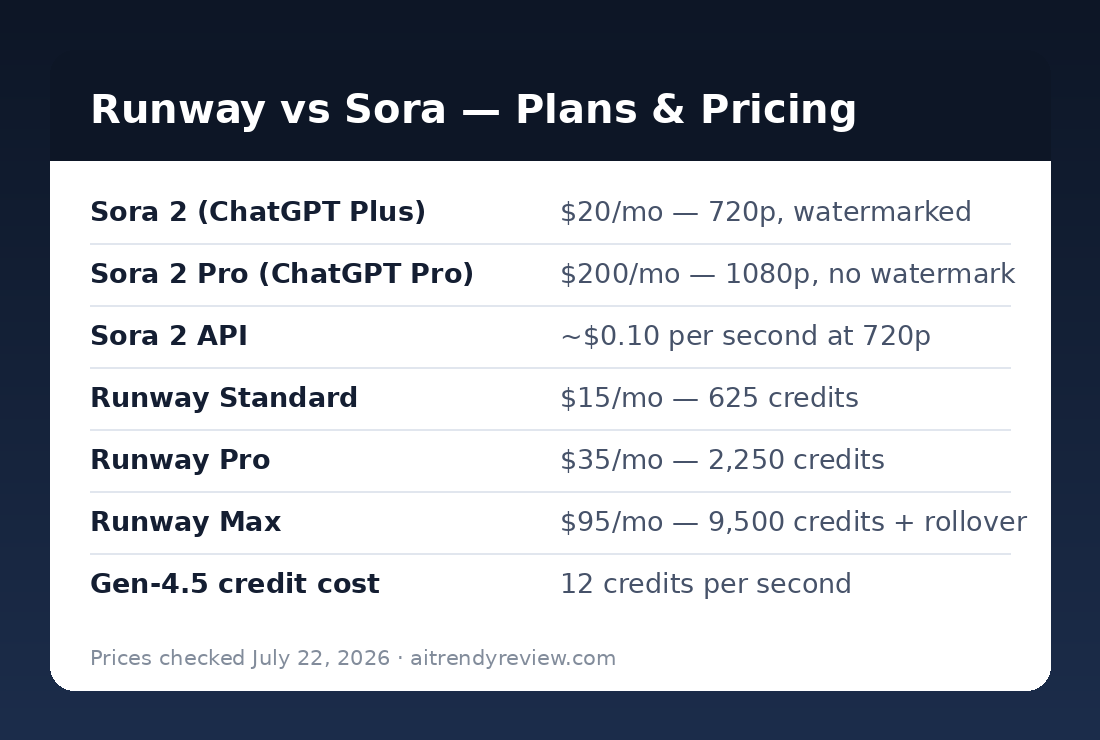
| Tool | Price | Free plan | Best for | Key limit |
|---|---|---|---|---|
| Sora 2 (ChatGPT Plus) | $20/mo | None since Jan 10, 2026 | Shorts, dialogue scenes, volume drafting | 720p cap, watermarked, ~1,000 credits/mo (reported) |
| Sora 2 Pro (ChatGPT Pro) | $200/mo | None | 1080p finals, priority queue, relaxed mode | Price jump is 10x Plus |
| Runway Standard | $15/mo ($12 annual) | 125 one-time credits | Light editing + occasional clips | 625 credits ≈ 52 sec of Gen-4.5/mo |
| Runway Pro | $35/mo ($28 annual) | — | Regular B-roll, 4K upscales | 2,250 credits ≈ 187 sec of Gen-4.5/mo |
| Runway Max | $95/mo ($76 annual) | — | Faceless channels at scale | 9,500 credits, rollover 1 month |
| Sora 2 API | ~$0.10/sec (720p) | — | Automated pipelines | sora-2-pro reported near $0.30+/sec |
Run the math on a typical faceless-channel workload: 10 minutes of finished AI footage monthly, with a 3:1 generation-to-keeper ratio. That is roughly 1,800 seconds of raw generation. On Runway Gen-4.5 at 12 credits per second, you would need 21,600 credits, which is more than two Max plans. Drop to Gen-4 Turbo at 5 credits per second and it is 9,000 credits, still a full $95 Max subscription. The same volume through the Sora 2 API at $0.10 per second costs about $180, and inside a ChatGPT Plus plan you would simply hit the monthly ceiling and wait. Nobody publishes this arithmetic on their pricing page, but it decides which tool you can afford to iterate with, and iteration is where AI video quality actually comes from.
One more cost trap worth flagging: multiple user reports, including reviews collected on Trustpilot, complain that Runway deducts credits for failed or error generations. When a fifth of your renders come back unusable, your effective per-second price rises by the same fraction.
Which Produces Better Video Quality for YouTube?
Sora 2 generally wins on realism and motion coherence; Runway Gen-4 wins on control and finishing. That split has held across most independent side-by-side tests published since late 2025, including comparisons by CrePal and BuildMVPFast, and it matches what each company optimizes for.
Sora 2’s physics modeling is the headline. OpenAI built the model to respect failure states: objects drop, rebound, and splash in ways prior models fudged. For YouTube content where a human might appear on screen (skits, POV footage, product-style shots), that believability gap is visible to viewers within seconds. The weakness is steerability. Sora gives you a prompt box, not a director’s chair, and re-rolling until the shot matches your storyboard burns through daily limits fast.
Runway Gen-4 produces a slightly more “rendered” look in complex scenes, and its 10-second clip ceiling forces you to think in cuts. What it offers instead is repeatability. Character reference locking keeps the same face across an entire episode. Image-to-video means your Midjourney V7 stills become motion sources, so your channel’s art direction survives the transition to video. And Topaz 4K upscaling on Pro and above means your final export does not look soft next to real 4K footage on a living-room TV, where a growing share of YouTube watch time happens.
The honest summary: if a clip needs to fool a viewer, Sora 2. If a clip needs to match the last one you published, Runway Gen-4.
What About Audio? Sora Talks, Runway Stays Silent
Sora 2 generates dialogue, sound effects, and ambient audio in the same pass as the video. Runway Gen-4 generates silent footage. For YouTube production budgets, this is not a minor feature difference; it restructures your entire toolchain.
A Runway-based pipeline for a narrated video typically needs three subscriptions: Runway for footage, a voice generator for narration, and a music tool for the bed. If you go that route, our ElevenLabs review covers the current voice pricing tiers, and Suno V5 remains the strongest option for commercial-safe background music. Realistically that stack runs $40 to $70 per month on top of Runway itself.
Sora 2 collapses part of that stack. Lip-synced character dialogue, footsteps, room tone, and crowd noise arrive baked into the clip. The quality is not broadcast-mix clean, and most serious creators still replace or sweeten the audio in post. But for Shorts, where a 15-second clip lives or dies on immediacy, native audio means you can go from prompt to publishable draft without opening an audio editor. Runway has nothing equivalent shipping in Gen-4 today.
One caveat cuts the other way: Sora’s generated dialogue is only as good as its voice consistency, and it cannot clone your specific narrator voice the way a dedicated voice tool can. Channels built around a signature narrator still need the separate voice subscription regardless of which video generator they pick.
Can You Monetize Runway and Sora Videos on YouTube in 2026?
Yes. AI-generated footage from both Runway Gen-4 and Sora 2 is eligible for the YouTube Partner Program, provided you disclose realistic synthetic content and the video offers original value. YouTube’s enforcement targets what it now calls “inauthentic content” (mass-produced, formulaic uploads), not AI tools themselves.
The policy timeline matters here. In mid-2025 YouTube renamed its “repetitious content” monetization guideline to “inauthentic content,” and in January 2026 it tightened disclosure: creators must toggle the “altered or synthetic content” checkbox in YouTube Studio for AI-generated visuals, synthetic voices, and realistic alterations, per YouTube’s disclosure help documentation. Policy trackers report a three-strike system for non-disclosure: a warning first, then a 90-day monetization suspension, then removal from the Partner Program.
What this means in practice differs by tool. Sora 2 footage is more photorealistic, so it trips the “could a viewer mistake this for real?” test more often, which means you should be toggling the disclosure on nearly every Sora-heavy upload. Runway Gen-4 footage used as stylized B-roll under narration sits in grayer territory, but the January 2026 rules name AI-generated visuals explicitly, so the safe play is disclosing on both. Disclosure itself carries no algorithmic penalty; properly labeled AI content earns comparable RPM to conventional content in the same niche, according to policy analyses published this year.
Commercial rights are the easier half of the question. Runway grants commercial usage rights on all paid plans. OpenAI’s terms assign output ownership to the user, and Sora videos can be used commercially, though OpenAI’s usage policies prohibit misleading deepfakes and unauthorized likenesses, and the Sora app adds consent controls around real people’s faces. Monetization risk on YouTube comes almost entirely from disclosure failures and low-effort mass production, not from the tools’ licenses.
How Do Watermarks and Disclosure Rules Affect Your Channel?
Watermarks are where the $20 Sora tier shows its limits. Videos generated through the Sora app and ChatGPT Plus carry a visible moving watermark on download, and the cottage industry of “Sora watermark removers” that sprang up in response is a compliance trap: stripping provenance marks from a realistic AI video and uploading it undisclosed is precisely the pattern YouTube’s three-strike system exists to catch. ChatGPT Pro and the API are the sanctioned watermark-free paths, per OpenAI’s own tiering and multiple 2026 tracking reports.
Runway is cleaner here: every paid plan from $15 Standard upward exports without watermarks, and the free plan’s watermarked 720p exports are only for testing. That makes Runway the lower-friction choice for creators who refuse to show a vendor logo on screen but will not pay $200/month for ChatGPT Pro.
Both companies embed C2PA-style provenance metadata in outputs. YouTube reads content credentials and may apply its own “altered or synthetic” label automatically when it detects them. Trying to outrun that detection is a losing game; building disclosure into your upload checklist takes five seconds and removes the channel-level risk entirely.
Which Is Better for YouTube Shorts vs Long-Form Videos?
For Shorts, Sora 2. For long-form, Runway Gen-4. The format split follows directly from each tool’s technical shape.
Shorts favor Sora because the deliverable is a single vertical clip under 60 seconds where sound drives retention. Sora 2’s API generates native 1080×1920 portrait video with synchronized audio in 16- or 20-second segments, so two or three generations stitch into a complete Short. The visible watermark on Plus-tier downloads matters less in a format viewers already associate with AI experiments, though disclosure rules still apply.
Long-form flips the calculus. A 10-minute video needs dozens of clips that match in style, lighting, and character identity, plus an edit. Runway’s reference-locking keeps shot 34 consistent with shot 2, its timeline editor lives in the same browser tab, and 4K upscaling keeps quality up on big screens. Sora offers no comparable project structure; you would be managing 40 disconnected generations in a downloads folder.
The hybrid pattern many channels have settled on: Sora 2 for hook clips and dialogue moments, Runway for the connective B-roll and anything requiring a consistent character, then a conventional editor to bind it. At $20 plus $15, the two-tool stack costs less than Runway Pro alone, which is a quietly strong argument for not choosing at all.
What Do Real Users Complain About?
Runway’s loudest complaints cluster around the credit system. Trustpilot reviews of runwayml.com repeatedly describe credits burning through failed generations, prompts being ignored (“it does not follow very clear prompts when you tell it not to include something,” one reviewer wrote), and subscribers on ~$100/month tiers reporting they get “only a few videos” they can use. The company’s own documentation confirms credits do not roll over on Standard and Pro, only on Max, and eesel’s June 2026 pricing analysis documented that failed generations still deduct credits. If you evaluate Runway, do it assuming a meaningful failure-rate tax.
Sora’s complaint profile is different: capacity, not quality. Free access was withdrawn on January 10, 2026. Plus users report daily rolling caps (around 30 credits per 24 hours, per AI Free API’s tracking) that stall batch production, and OpenAI selling $4 top-up packs confirmed that “generous limits” from the launch announcement did not survive contact with demand. The other recurring gripe is steering: Sora produces gorgeous clips that are 80% right and resists the last 20%, which is exactly the failure mode you would expect from a prompt-only interface.
Neither complaint set is disqualifying. They point to the same practical advice: budget for waste. Whichever tool you pick, assume one usable clip per three generations until your prompting stabilizes, and price your subscription tier around that ratio rather than the marketing math.
If You’re This Kind of Creator, Get This Tool
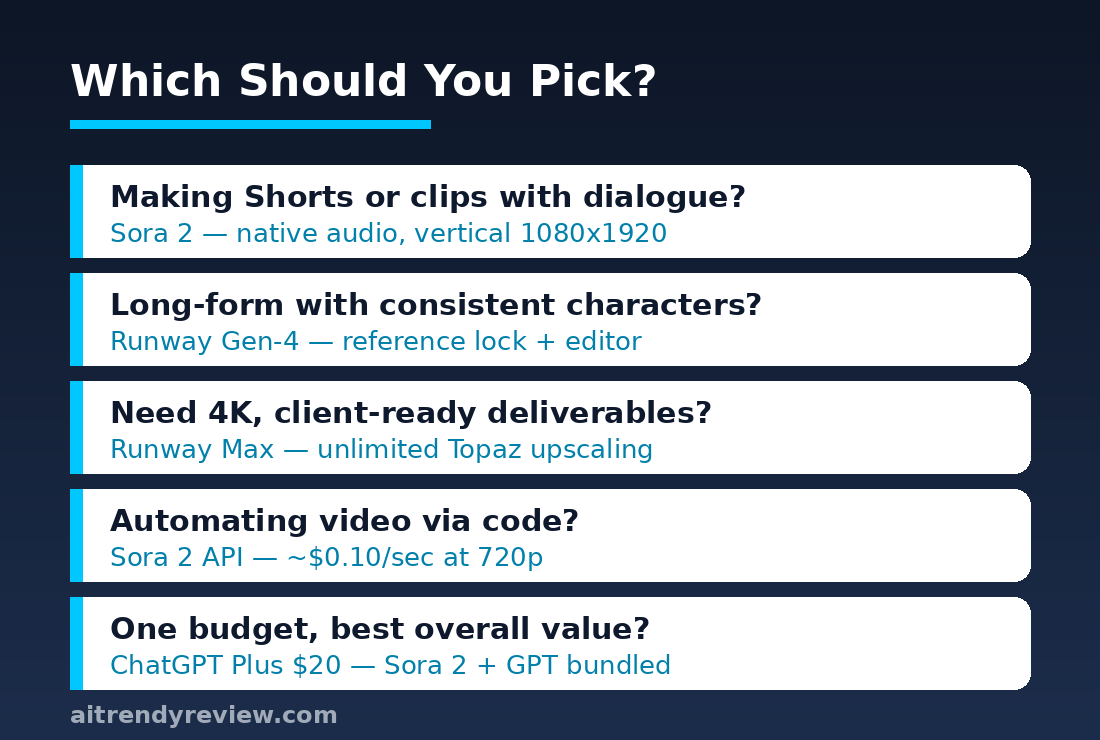
If you run a Shorts-first channel or make dialogue-driven skits, get Sora 2 via ChatGPT Plus at $20/month. Native audio and portrait output cover 90% of the format’s needs.
If you run a faceless long-form channel with a consistent visual identity, get Runway Pro at $35/month ($28 annual). Reference locking and the built-in editor are the features that actually save you hours.
If you produce client work or need 4K deliverables, Runway Max at $95/month is the only option here with unlimited Topaz upscaling and credit rollover.
If you are a developer automating video at scale, the Sora 2 API at roughly $0.10 per 720p second undercuts Runway’s per-second credit cost by a wide margin.
If you are budget-capped at one subscription and do general content, ChatGPT Plus is the higher-value $20: you get Sora 2 plus the entire GPT toolset, where Runway Standard’s 625 credits buy under a minute of Gen-4.5 footage monthly.
Runway Gen-4: Worth It If / Skip It If
Worth it if you publish long-form video weekly, need the same character or product across dozens of shots, upscale to 4K, or want one browser tab that goes from generation to finished edit. The $28/month annual Pro price is defensible for a monetized channel.
Skip it if your output is Shorts, your clips need sound, or your monthly footage need exceeds about three minutes of finals on a sub-$40 budget. The credit math stops working, and failed-generation deductions make it worse.
Sora 2: Worth It If / Skip It If
Worth it if you already pay for ChatGPT Plus, you make Shorts or dialogue content, or you want the most realistic motion available at $20/month. The bundled price is the best value in AI video right now.
Skip it if you need watermark-free downloads without paying $200/month for Pro, need clips longer than 20 seconds in one take, or your workflow depends on precise shot-to-shot continuity. Sora does not do project consistency, and re-roll costs pile up against daily caps.
Final Verdict: Sora 2 for Most YouTube Creators, Runway for Producers
Sora 2 wins this comparison for the majority of YouTube creators on price, audio, and realism: $20/month inside a subscription many creators already carry, against a Runway credit system where one minute of top-model footage can exceed the $15 plan’s entire monthly allowance. Runway Gen-4 keeps a clear lane for producer-style channels that need consistency, 4K, and editing in one place, and it earns its cost there. The two-tool stack at $35 combined remains the sharpest setup of all. Prices in this niche move monthly; both pricing pages are linked below, and every figure above was checked on July 22, 2026.
Frequently Asked Questions
Can I monetize Sora videos on YouTube?
Yes. Sora-generated videos are eligible for the YouTube Partner Program if you toggle the “altered or synthetic content” disclosure and add original value through editing, narration, or commentary. YouTube’s 2026 rules penalize undisclosed synthetic media and mass-produced “inauthentic content,” not the use of AI tools themselves.
Does Runway Gen-4 have a watermark?
No, not on paid plans. Every Runway paid tier from Standard ($15/month) upward exports without watermarks. Only the free plan, which includes 125 one-time credits, applies a watermark to its 720p exports. Commercial usage rights are included on all paid Runway plans, per Runway’s published terms.
How much does one minute of Runway Gen-4.5 video cost?
About 720 credits, since Runway’s documentation lists Gen-4.5 at 12 credits per second. That exceeds the Standard plan’s entire 625-credit monthly allowance, so realistic Gen-4.5 usage starts at the Pro plan ($35/month, 2,250 credits), which covers roughly three minutes of raw generation.
Is Sora free to use in 2026?
No. Free ChatGPT users lost Sora video generation on January 10, 2026, according to third-party tracking. Sora 2 now requires ChatGPT Plus ($20/month) or Pro ($200/month), and OpenAI sells additional credit packs, reported at $4, when subscribers exhaust their monthly allocation.
Which is better for YouTube Shorts, Runway or Sora?
Sora 2. It generates native 1080×1920 portrait video with synchronized dialogue and sound effects, and its 16- to 20-second generations stitch cleanly into a sub-60-second Short. Runway Gen-4 caps clips at 10 silent seconds, so a Short requires more generations plus separate audio work.
Does Sora 2 generate audio and dialogue?
Yes. OpenAI states Sora 2 creates synchronized dialogue, sound effects, and background soundscapes in the same generation pass as the video. Runway Gen-4 produces silent footage, so Runway users typically add voiceover and music with separate tools like ElevenLabs and Suno.
Can I use Runway videos commercially?
Yes. All paid Runway plans include commercial usage rights for generated content, covering monetized YouTube videos, client work, and ads. The free plan is intended for evaluation. You remain responsible for disclosure obligations on platforms like YouTube and for avoiding third-party likenesses or trademarks in prompts.
Will YouTube demonetize AI-generated videos?
Not for using AI. YouTube demonetizes undisclosed realistic synthetic media (a reported three-strike system began in January 2026) and “inauthentic content” that is mass-produced or repetitive with no original value. Disclosed, edited, original AI content earns RPM comparable to conventional videos in the same niche.
Sources
Prices checked July 22, 2026.
- Runway official pricing page
- Runway Help Center: How do credits work?
- OpenAI: Sora 2 announcement
- OpenAI developer docs: Video generation with Sora
- YouTube Help: Disclosing altered or synthetic content

Naveen Kumar Durai is the founder of Naveen AI Automation and the reviewer behind AITrendyReview. He builds AI automation systems daily and reviews AI tools from official docs, live pricing pages, and verified user reports — updated monthly as tools change.