Indian English is the second-largest English variant on the planet, spoken by roughly 130 million people. Yet most AI transcription tools still treat it as an edge case. Upload a Bangalore standup meeting to a tool trained mostly on American podcast audio and you will watch “prepone the sprint review” become “prepone the spring review” or worse. The accuracy gap is real, it is measurable, and it decides which tool deserves your money.
What is the best AI transcription for Indian accents in 2026? For API users, Deepgram Nova-3 Multilingual (from $0.0058/min) and AssemblyAI Universal-3 Pro ($0.21/hour) handle Indian English most reliably. For Hinglish and code-switched audio, Sarvam AI’s Saarika model (₹30/hour, about $0.35) is purpose-built for it. For meetings without code, Otter.ai Business works well enough.
How we assess: this review is based on official documentation, pricing pages, changelogs, and verified user reports, not hands-on testing.
Key takeaways
- Sarvam AI Saarika is the only major model built specifically for Indian speech, at ₹30/hour (roughly $0.35) with ₹100 in free credits.
- AssemblyAI Universal-2 posts a 7.9% word error rate on noisy real-world audio versus 11.4% for Whisper large-v3, and noisy audio is where accent handling actually gets exposed.
- Deepgram Nova-3 Multilingual costs $0.0058 to $0.0092 per minute pay-as-you-go, with $200 in free credit and no card required.
- OpenAI’s gpt-4o-mini-transcribe is the cheapest big-lab option at $0.003/minute, or $0.18 per audio hour.
- Otter.ai’s free plan caps you at 300 minutes per month and 30 minutes per conversation; the Pro plan lifts that to 1,200 minutes for $8.33/month billed annually.
- Willow’s Atlas-1, briefly a contender, was retired on July 7, 2026, just 97 days after launch.
Why do most transcription tools struggle with Indian accents?
Most speech models are trained predominantly on American and British English, so the phonetic patterns of Indian English are underrepresented in their training data. Retroflex consonants, syllable-timed rhythm, and vocabulary like “prepone” or “do the needful” trip up models that have barely seen them. Code-switching between Hindi and English makes things worse.
A 2026 analysis by Oravo lays out the mechanics. English spoken in India is syllable-timed rather than stress-timed, meaning each syllable gets roughly equal duration. American English swallows unstressed syllables. A model tuned to expect swallowed syllables mis-segments Indian speech at the word-boundary level, which is why errors cluster in strange places: names, numbers, and compound phrases rather than random words.
Then there is vocabulary. Indian English is not American English with different pronunciation; it is its own dialect with its own lexicon. “Revert back,” “prepone,” “lakh,” “crore,” and dozens of other terms appear nowhere in a LibriSpeech training run. General-purpose models either substitute a phonetically similar American word or produce gibberish. Neither is acceptable in a legal deposition or a client call summary.
The practical takeaway: clean-speech benchmark numbers are nearly useless for this decision. Every major model scores between 2.1% and 2.8% word error rate on LibriSpeech clean audio, per CodeSOTA’s 2026 speech recognition guide. The spread only appears on hard audio. On noisy real-world recordings, AssemblyAI Universal-2 holds 7.9% WER while Whisper large-v3 degrades to 11.4%. That 3.5-point gap is the difference between a transcript you skim and one you retype.
Which AI transcription tool is most accurate for Indian accents?
Based on published benchmarks and vendor documentation, AssemblyAI and Deepgram lead for Indian-accented English through APIs, while Sarvam AI leads for Hinglish and Indian-language audio. No third-party benchmark isolates Indian-accent WER across all vendors, so noisy-audio accuracy is the best available proxy, and those three win it.
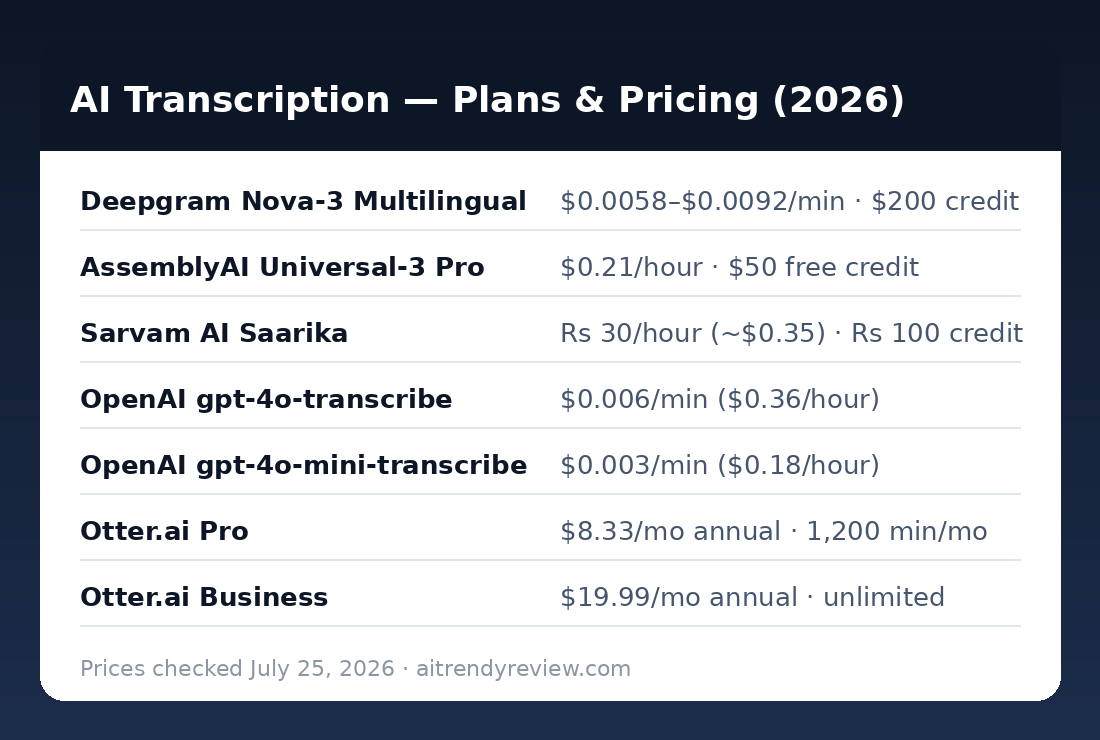
Here is the field for 2026, compared on the numbers that matter:
| Tool | Price | Free plan | Best for | Key limit |
|---|---|---|---|---|
| Deepgram Nova-3 Multilingual | $0.0058–$0.0092/min | $200 credit, no card | Developers, call centers | API only, no consumer app |
| AssemblyAI Universal-3 Pro | $0.21/hour | $50 credit (~185 hrs on Universal) | Accuracy-critical workloads | Add-ons billed separately |
| Sarvam AI Saarika | ₹30/hour (~$0.35) | ₹100 credit | Hinglish, Indian languages | India-focused, smaller ecosystem |
| OpenAI gpt-4o-transcribe | $0.006/min ($0.36/hr) | None (API pay-as-you-go) | Whisper upgraders | No diarization built in |
| OpenAI gpt-4o-mini-transcribe | $0.003/min ($0.18/hr) | None | Budget batch jobs | Lower accuracy than full model |
| Otter.ai Pro | $8.33/mo annual, $16.99 monthly | 300 min/mo, 30 min/convo | Meetings, no-code users | 1,200 min/mo cap, accent errors on names |
| Otter.ai Business | $19.99/mo annual, $30 monthly | — | Teams, unlimited meetings | 4-hour per-conversation cap |
One opinion up front: if you can write ten lines of Python, skip the consumer apps entirely. The API tools cost a tenth as much per hour and let you swap models when a better one ships. The consumer-app premium buys you a calendar integration, and that is about it.
Deepgram Nova-3: the developer default for accented English
Deepgram’s Nova-3 is the model this site recommended over Willow’s Atlas-1 back when that comparison mattered, and the reasoning holds. Nova-3 Multilingual is trained across 45+ languages with automatic language detection, which matters for Indian audio because meetings in India rarely stay in one language for a full hour. Per Deepgram’s pricing page (checked July 25, 2026), Nova-3 Multilingual runs $0.0058 to $0.0092 per minute pay-as-you-go, and the monolingual English model is cheaper still at $0.0048 to $0.0077. Speaker diarization adds about $0.002/minute.
The $200 free credit, with no credit card required, is the most generous trial in the category. At batch rates that is over 500 hours of audio, enough to test against your own recordings rather than trusting anyone’s benchmark, including ours.
Where Deepgram fits Indian-accent work specifically: its independently measured 5.3% WER on Willow’s own comparison corpus and 8.2% on CodeSOTA’s noisy set put it a hair behind AssemblyAI on raw accuracy, but its streaming latency is best in class. For a Mumbai call center doing live agent-assist, that trade is correct. For offline batch transcription of interviews, AssemblyAI’s slightly better accuracy wins. We covered the full head-to-head in our Atlas-1 vs Deepgram comparison.
The limit is obvious: Deepgram is an API. There is no app, no meeting bot, no editor. You are expected to build. If that sentence made you tired, skip ahead to Otter.
AssemblyAI Universal-3 Pro: the accuracy pick
AssemblyAI’s Universal models top the published accuracy tables that exist for 2026. Universal-2 posted 2.1% WER on LibriSpeech clean and, more importantly, 7.9% on noisy real-world audio, the best figure in CodeSOTA’s comparison. The newer Universal-3 Pro runs $0.21 per hour ($0.0035/min), with the older Universal-2 still available at $0.15 per hour, per AssemblyAI’s pricing (rates verified May–July 2026). New accounts get $50 in free credits, which stretches to roughly 185 hours on Universal-2. No credit card required.
AssemblyAI markets “top-tier English accuracy across accents,” and while the company does not publish an Indian-English-specific WER, its noisy-audio lead is the strongest signal available. Models that stay accurate through background noise, crosstalk, and compression artifacts are the same models that stay accurate through unfamiliar phonetics, because both depend on how much diverse real-world audio went into training.
Watch the add-on billing. Speaker diarization adds $0.02/hour, entity detection $0.08/hour, topic detection $0.15/hour, summarization $0.03/hour. Stack every feature and your effective rate can double. For plain transcripts of Indian-accented interviews, podcasts, and research calls, the base rate is all you need, and at $0.21/hour a 100-hour monthly workload costs $21. A human transcription service quotes that per hour.
Sarvam AI Saarika: built in India, for Indian speech
Sarvam AI is the outlier on this list because it is the only vendor whose model was trained primarily on Indian speech rather than adapted to it. Saarika, Sarvam’s speech-to-text model, handles Indian English alongside Hindi, Tamil, Telugu, and twenty-plus other Indian languages, and it is the only model here that treats Hinglish code-switching as a first-class input rather than a failure mode.
Pricing is refreshingly simple. Per Sarvam’s API pricing docs (checked July 25, 2026), standard speech-to-text costs ₹30 per hour of audio, about $0.35, billed per second. Adding speaker diarization raises it to ₹45/hour. Translation-to-English during transcription costs the same ₹30/hour, which is quietly one of the best deals in the market: transcribe a Hindi meeting and get English text out for $0.35 an hour. New accounts get ₹100 in free credits.
The honest caveats: Sarvam is a young company, the ecosystem of SDKs and integrations is thinner than Deepgram’s or AssemblyAI’s, and if your audio is entirely standard-accent American English there is no reason to pick it. But that is not who this article is for. For a Delhi law office transcribing client calls that drift between Hindi and English mid-sentence, Saarika is the only tool on this page designed for exactly that job. That focus is worth more than a benchmark point.
OpenAI gpt-4o-transcribe: the Whisper upgrade path
Whisper deserves credit for making accented transcription usable at all; its open-source large-v3 model was many Indian developers’ first tool that mostly worked. But in 2026 Whisper large-v3 is the weakest performer on hard audio in CodeSOTA’s data at 11.4% WER, and OpenAI’s own API has moved on. The current models are gpt-4o-transcribe at $0.006/minute and gpt-4o-mini-transcribe at $0.003/minute, per OpenAI’s pricing page (checked July 25, 2026).
At $0.18 per audio hour, gpt-4o-mini-transcribe is the cheapest hosted option from a major lab, undercutting even AssemblyAI’s Universal-2. For high-volume, cost-sensitive batch work such as transcribing a YouTube back catalog with Indian-accented narration, it is the value pick. The full gpt-4o-transcribe model handles heavier accents and messier audio noticeably better and still costs only $0.36/hour.
Two gaps to know about. There is no built-in speaker diarization, so multi-speaker meeting transcripts need a separate pass with another tool. And OpenAI publishes no accent-specific accuracy data at all, so you are testing on your own audio or trusting anecdote. Self-hosting open-source Whisper remains free forever if you have the GPU, and for private legal or medical audio that never leaves your server, that argument still lands. For everyone else, the hosted models are better and cheap enough.
Does Otter.ai work with Indian accents?
Otter.ai works with Indian accents, with caveats. Otter transcribes English in any accent but is optimized for North American speech, and user reports consistently note higher error rates on Indian names, technical terms, and fast code-switched speech. It remains the easiest no-code option for meetings, which is why it stays on this list.
The pricing, from Otter’s pricing page (checked July 25, 2026): the free Basic plan gives 300 minutes per month with a 30-minute per-conversation cap, enough to test but not to work. Pro costs $16.99/month, or $8.33/month billed annually, for 1,200 monthly minutes and a 90-minute conversation cap. Business runs $30/month, or $19.99 annually, and removes the monthly cap entirely with a 4-hour per-meeting limit. The meeting bot joins Zoom, Teams, and Google Meet automatically, which is the feature you are actually paying for.
Our position: Otter is the right choice only if nobody on your team will touch an API. The math is hard to argue with. Otter Business at $19.99/month covers unlimited meetings; the same money buys about 95 hours on AssemblyAI. If your team records 20 one-hour meetings a month, the API route costs $4.20. You would be paying Otter a 375% convenience premium. Sometimes convenience is worth it. Know that you are buying it.
How much does AI transcription cost for Indian English in 2026?
Expect $0.18 to $0.55 per audio hour through APIs, or $8 to $30 per month for consumer apps. The cheapest hosted API is OpenAI’s gpt-4o-mini-transcribe at $0.18/hour; the premium end is Deepgram Nova-3 Multilingual at up to $0.55/hour. Sarvam sits at roughly $0.35/hour with Indian-language translation included.
Run the numbers on a realistic workload. A solo podcaster producing four 90-minute episodes a month has 6 hours of audio: $1.08 on gpt-4o-mini-transcribe, $1.26 on AssemblyAI Universal-3 Pro, about $2.10 on Sarvam with diarization, versus $99.96 a year for Otter Pro. A 50-agent call center pushing 4,000 hours a month is looking at $840 on AssemblyAI or roughly $1,400 to $2,200 on Deepgram at pay-as-you-go rates, before volume discounts, which is where Deepgram’s Growth plan (starting around $4,000/year for up to 20% savings) starts to make sense.
Free tiers change the testing calculus completely. Deepgram’s $200 credit, AssemblyAI’s $50, and Sarvam’s ₹100 together fund a serious bake-off on your own audio without spending a rupee. Record ten minutes of your actual meeting audio, run it through all three, and count the errors on names and numbers. That thirty-minute exercise beats every benchmark table on the internet, including the one above.
Can AI transcription handle Hinglish and code-switching?
Only partially, and only some tools. Sarvam AI’s Saarika handles Hindi-English code-switching natively because it was trained on it. Deepgram Nova-3 Multilingual detects language switches automatically across 45+ languages. Most other tools, including Otter and standard Whisper, produce garbled output or unwanted translation when speakers switch languages mid-sentence.
This is the single biggest hidden failure mode in Indian business audio. A sentence like “Client ne bola ki Friday tak deliverable chahiye” is unremarkable in a Gurgaon office and a catastrophe for a US-trained model, which will either force the Hindi words into phonetically similar English or drop them. The Oravo analysis cited earlier flags exactly this: code-switched input produces “high error rates” or gibberish in general-purpose tools.
If your audio code-switches more than occasionally, the ranking on this page inverts: Sarvam becomes the first pick, Deepgram Multilingual second, and everything else is a compromise. If your audio is Indian-accented but stays in English, the standard ranking holds, with AssemblyAI and Deepgram on top.
What happened to Willow Atlas-1?
Willow retired Atlas-1 on July 7, 2026, only 97 days after its April 1 launch, folding its capabilities into new Frontier Pro and Frontier Mini models inside Willow’s dictation apps. The much-quoted 1.2% word error rate claim was self-reported on proprietary test data and never verified by any third party.
We flagged that skepticism in our Willow AI Atlas-1 review when the claim was fresh: a vendor claiming 1.2% in a field where the best independently measured model scores 2.2%, without submitting to third-party testing, has published a marketing number. The retirement three months later did not exactly weaken that read. Willow’s current lineup offers unlimited free dictation on Frontier Mini, with Pro at $15/month (or $12 annually), but it remains a dictation app, not a transcription API, and it publishes no accent-specific data.
The lesson for accent-sensitive buyers is worth stating plainly. Unverifiable accuracy claims are common in this niche, and Indian-accent performance is precisely where marketing numbers and reality diverge the most, because vendor test sets skew American. Trust free-credit trials on your own audio over any vendor’s decimal point.
Which tool should you actually pick?
Map yourself to a row and stop reading after your match.
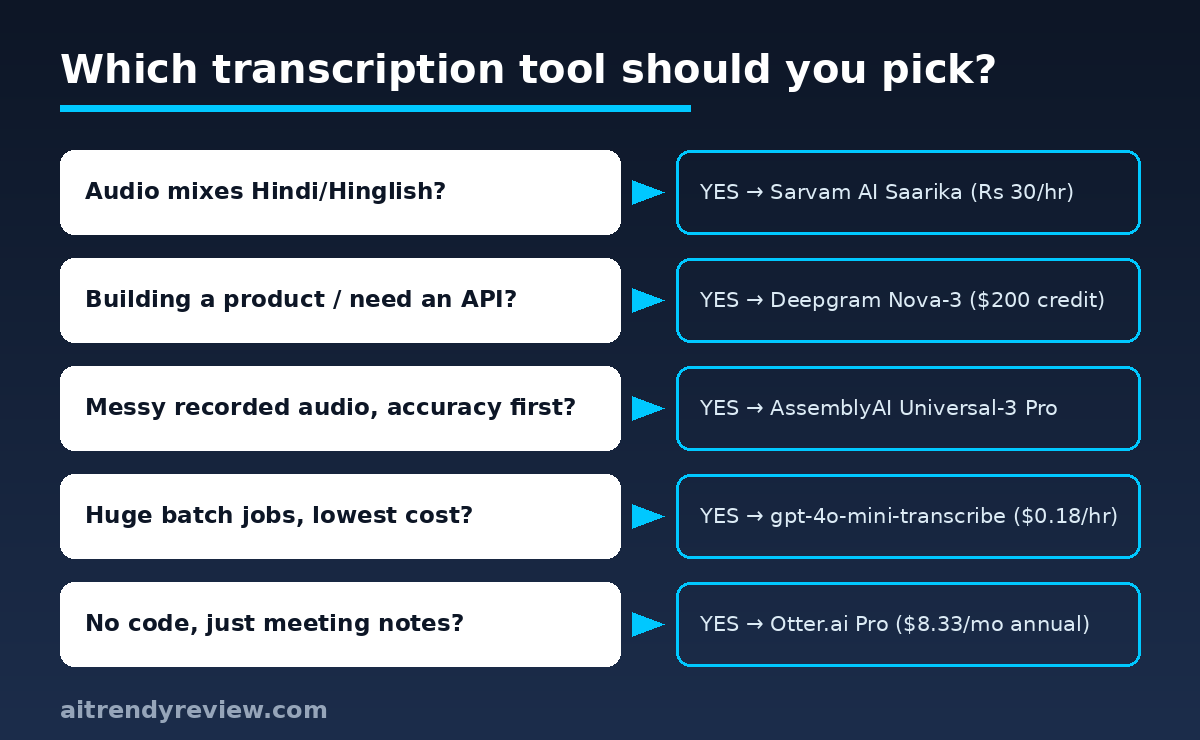
If you are a developer or a startup building transcription into a product for Indian users, get Deepgram Nova-3 Multilingual; the $200 credit and streaming latency settle it. If accuracy on messy recorded audio is the whole job, interviews, research calls, depositions, get AssemblyAI Universal-3 Pro. If your audio mixes Hindi or any Indian language with English, get Sarvam Saarika and do not overthink it. If you need the absolute lowest cost per hour for large batch jobs, get gpt-4o-mini-transcribe. If you are a solo professional who wants meeting notes with zero code, get Otter Pro on the annual plan. If you are a 50-person firm standardizing on meeting capture, Otter Business is defensible; just price the API alternative first so the premium is a choice, not an accident.
For adjacent needs, our reviews of ElevenLabs for voice generation and NotebookLM for research synthesis cover the other half of the audio workflow: turning text back into speech, and turning transcripts into answers.
Worth it if / Skip it if
Worth it if: you process more than an hour of Indian-accented audio a week, because every tool here beats manual transcription on cost by two orders of magnitude. APIs are worth it if you have any technical capacity at all. Sarvam is worth it the moment Hinglish appears in your recordings. Paid Otter is worth it if the meeting bot saves you from ever uploading a file manually.
Skip it if: your audio is rare, short, and clean, in which case free tiers cover you indefinitely. Skip consumer apps if you are cost-sensitive at volume. Skip Whisper large-v3 self-hosting unless data privacy compels it; the hosted models are more accurate on accented speech and the GPU you would rent costs more than the API. And skip any tool whose accuracy claims exist only in its own marketing until you have burned free credits testing it on your own voice.
FAQ: AI transcription for Indian accents
Which AI transcription tool is best for Indian accents in 2026?
AssemblyAI Universal-3 Pro and Deepgram Nova-3 lead for Indian-accented English via API, based on published noisy-audio benchmarks where they hold 7.9% and 8.2% word error rates. For Hindi-English mixed audio, Sarvam AI’s Saarika model is purpose-built for Indian speech at ₹30/hour and is the stronger choice.
Is Whisper good for Indian English?
Whisper large-v3 works for Indian English but trails the field, posting 11.4% word error rate on noisy real-world audio versus 7.9% for AssemblyAI. OpenAI’s newer gpt-4o-transcribe ($0.006/min) handles accents noticeably better. Self-hosted Whisper remains the best free option when audio cannot leave your servers.
Does Otter.ai support Indian accents?
Yes, Otter transcribes English in any accent, but it is optimized for North American speech and user reports note more errors on Indian names, technical terms, and code-switched sentences. Its free plan (300 minutes/month, 30 minutes per conversation) is enough to test it on your own meetings before paying.
What is the cheapest transcription API for Indian English?
OpenAI’s gpt-4o-mini-transcribe at $0.003 per minute, which is $0.18 per audio hour, is the cheapest hosted option from a major provider as of July 2026. AssemblyAI Universal-2 at $0.15/hour is comparable. Sarvam AI charges ₹30 (about $0.35) per hour and includes translation from Indian languages at no extra cost.
Can any AI tool transcribe Hinglish accurately?
Sarvam AI’s Saarika is the only major model trained natively on Hindi-English code-switching, making it the most reliable Hinglish option. Deepgram Nova-3 Multilingual handles language switches through automatic detection across 45+ languages. General-purpose tools like Otter or standard Whisper typically garble or mistranslate code-switched sentences.
Do transcription APIs charge extra for speaker labels?
Usually yes. Deepgram charges roughly $0.002/minute extra for diarization, AssemblyAI adds $0.02/hour, and Sarvam’s diarization tier is ₹45/hour instead of ₹30. Otter includes speaker identification in all plans, including the free tier, which is part of what its subscription premium pays for.
Is Willow Atlas-1 still available for transcription?
No. Willow retired Atlas-1 on July 7, 2026, 97 days after launch, replacing it with Frontier Pro and Frontier Mini inside its dictation apps. Its claimed 1.2% word error rate was never third-party verified. Willow’s apps continue, but there is still no API and no published accent-specific accuracy data.
How should I test a transcription tool on my own accent?
Record 10 minutes of your real working audio, including names, numbers, and any code-switching, then run it through free tiers: Deepgram gives $200 in credit, AssemblyAI $50, and Sarvam ₹100, none requiring a card. Count errors on proper nouns and figures specifically, since those cause the most downstream damage.
Sources
- Deepgram pricing — Prices checked July 25, 2026
- AssemblyAI pricing — Prices checked July 25, 2026
- Sarvam AI API pricing — Prices checked July 25, 2026
- OpenAI API pricing — Prices checked July 25, 2026
- Otter.ai pricing — Prices checked July 25, 2026
- CodeSOTA: Speech Recognition in 2026 — WER benchmark data
- Oravo: Indian Accent Speech Recognition (2026) — dialect analysis

Naveen Kumar Durai is the founder of Naveen AI Automation and the reviewer behind AITrendyReview. He builds AI automation systems daily and reviews AI tools from official docs, live pricing pages, and verified user reports — updated monthly as tools change.