Devin made a promise no other AI tool dared to make: hire a software engineer for the price of a Netflix family plan. Two years after launch, plenty of startups have discovered the fine print. The $20 Core plan meters every 15 minutes of work, the $500 Team plan is a real line item for a pre-seed company, and open-source agents now outscore Devin on the exact benchmark Cognition built its reputation on. If you run a startup and Devin’s bill (or its ceiling) is bothering you, you have more options in 2026 than ever before.
How we assess: this review is based on official documentation, pricing pages, changelogs, and verified user reports, not hands-on testing.
What is the best Devin AI alternative for startups in 2026? Claude Code is the best Devin alternative for most startups: $20 per month on the Pro plan buys an autonomous terminal agent without per-task metering. OpenHands is the best free option, scoring roughly 72% on SWE-bench Verified. Non-technical founders should pick Replit Agent instead, and GitHub Copilot Pro is the cheapest entry at $10 per month.
Key takeaways
- Devin costs $20/month (Core, pay-as-you-go at $2.25 per ACU) or $500/month (Team, 250 ACUs included) as of July 2026, and one ACU covers only about 15 minutes of agent work.
- Claude Code delivers comparable autonomous coding from $20/month with session-based limits instead of per-task ACU billing, and its Max tiers ($100–$200) scale with a team of 2–5 engineers.
- OpenHands is free under an MIT license and reaches about 72% on SWE-bench Verified with Claude models, roughly 20 points above Devin’s estimated score.
- GitHub Copilot Pro is the cheapest paid agent at $10/month, though its June 1, 2026 switch to credit billing (1 credit = $0.01) makes heavy agent use cost extra.
- Replit Agent builds and deploys full apps from prompts for $20–$25/month, but users report burning the included $25 of credits in 3–4 days of active building.
- 7 alternatives are compared below across price, free plan, best use case, and the one limit most likely to bite a startup.
Why Are Startups Looking Beyond Devin in 2026?
Startups leave Devin for three reasons: unpredictable ACU billing, a locked model stack, and better benchmark results elsewhere. Devin’s Agent Compute Unit system charges by agent effort, not outcomes, so a task that spirals costs more even when it fails. Open-source rivals now post higher SWE-bench Verified scores while letting you pick the underlying model.
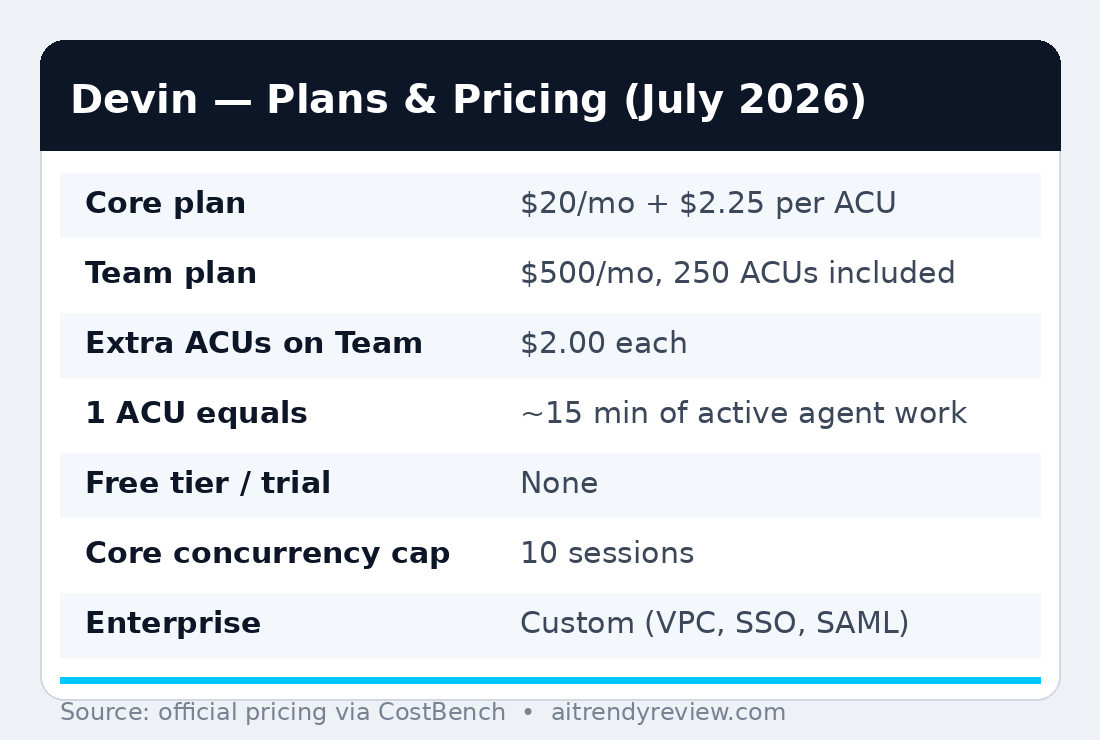
The ACU model deserves scrutiny because it shapes the entire cost curve. Cognition defines one ACU as roughly 15 minutes of active Devin work. On the Core plan you pay $2.25 per ACU as you go; on Team, 250 ACUs are included and extras run $2.00 each, per CostBench’s July 2026 breakdown. Simple math: a messy refactor that keeps Devin busy for five hours consumes about 20 ACUs: $45 on Core. Run tasks like that daily and the “cheap AI engineer” costs more than a Cursor Ultra subscription and a Claude Max plan combined.
There’s also the model lock-in problem. Devin runs on Cognition’s proprietary harness and you don’t choose what’s under the hood. Meanwhile Anthropic shipped Claude Opus 5 on July 24, 2026 at unchanged $5/$25 per-million-token pricing, per ThursdAI’s release tracker, and tools like OpenHands let you swap it in the day it lands. When frontier models improve every few weeks, the ability to switch matters more than any single vendor’s roadmap. Our full Devin AI review covers what Devin still does well; this guide is about what to use when the math stops working.
What Does Devin Actually Cost a Startup in 2026?
Devin has three plans as of July 2026: Core at $20 per month with pay-as-you-go ACUs at $2.25 each, Team at $500 per month with 250 ACUs included, and custom-priced Enterprise. There is no free tier and no free trial, so the cheapest way to evaluate Devin is a $20 commitment plus usage.
The Core plan caps you at 10 concurrent sessions and includes the Devin IDE, the Ask feature, wiki-style documentation, and API access. Team removes the concurrency cap, adds early feature access and an advanced mode, and prices overage ACUs at $2.00. Enterprise adds VPC deployment, SAML/OIDC SSO, and dedicated account management. Those are the sticker prices; CostBench also documents the quieter costs: human supervision time, onboarding, and ACU consumption that scales with task complexity in ways you can’t predict from a task description.
For a startup, the Team plan is the tricky one. $500 per month is $6,000 a year. That is real money at pre-seed, and the 250 included ACUs translate to roughly 62 hours of agent work per month. A team that treats Devin like a full-time junior engineer will blow through that allocation in week two and start paying $2.00 per ACU on top. That is the single most common complaint pattern in user reports: not that Devin is bad, but that its bill is a moving target.
What Are the Best Devin AI Alternatives for Startups in 2026?
The best Devin AI alternatives for startups in 2026 are Claude Code, Cursor, GitHub Copilot, Replit Agent, OpenHands, and Windsurf. Claude Code wins on price-to-autonomy, OpenHands wins on cost and benchmark scores, and Replit Agent wins for founders who don’t code.
The table below compares every alternative in this guide on the four things a founder actually checks first: monthly price, whether a free plan exists, the sharpest use case, and the limit most likely to hurt.
| Tool | Price (July 2026) | Free plan | Best for | Key limit |
|---|---|---|---|---|
| Claude Code | $20–$200/mo | No (Pro required) | Lean technical teams | 5-hour + weekly usage windows |
| Cursor | $20–$200/mo; Teams $40/user | Yes (Hobby) | IDE-centric engineers | Model usage pools vary by plan |
| GitHub Copilot | $10–$39/mo | Yes (2,000 completions) | Cheapest paid entry | Agent work drains $10 of credits fast |
| Replit Agent | $20–$25/mo (Core) | Yes (Starter) | Non-technical founders | $25 credits can vanish in days |
| OpenHands | Free (MIT) + API costs | Yes (entirely free) | Self-hosting teams | 10–15 min Docker setup, 4–8 GB RAM |
| Windsurf | ~$15/mo Pro | Yes | Budget IDE agent | Smaller ecosystem than Cursor |
| Devin (baseline) | $20 + $2.25/ACU; $500 Team | No | PM-integrated delegation | ACU billing unpredictability |
1. Claude Code — Best Overall Devin Alternative for Startups
Claude Code is Anthropic’s terminal-based coding agent, and it is the closest thing to Devin’s autonomy without ACU anxiety. It plans multi-step tasks, edits across files, runs tests, and iterates until the job is done, all from a $20 per month Claude Pro subscription rather than a metered per-task bill.
The pricing structure is the draw. Pro costs $20 per month ($17 annual) and includes Claude Code alongside the chat products. Max 5x at $100 and Max 20x at $200 multiply your usage limits, per CC for Everyone’s June 2026 guide. Limits work on two clocks: a 5-hour session window (doubled in May 2026) and a weekly cap. That’s a real constraint (hit the wall mid-sprint and you wait or upgrade), but it is a predictable constraint. A solo founder on Pro knows the worst case is $20. A Devin Core user finds out the worst case when the invoice arrives.
Claude Code’s weaknesses are the flip side of its design. It lives in the terminal, so there’s no Devin-style web dashboard where a PM can assign tickets, and its usage windows are shared across all Claude surfaces, so heavy chat use eats your coding budget. For a two-pizza engineering team, one Max 5x subscription per engineer still undercuts a single Devin Team seat by $300–$400 a month. We’ve covered the tool’s day-to-day behavior in our Claude Code review; the short version is that it rewards developers who already live in a shell.
My position: if your startup has at least one engineer comfortable in a terminal, start here before paying for anything metered.
2. Cursor — Best IDE-Native Agent
Cursor is an AI-first code editor whose Agent mode now covers most of what startups hired Devin to do: multi-file changes, background tasks, and cloud agents that work while you don’t. The difference is philosophical. Devin wants to replace an engineer; Cursor wants to multiply one.
Pricing as of July 2026: a free Hobby tier, Pro at $20 per month, higher Pro+ and Ultra tiers for power users, Teams at $40 per user, and a Teams Premium tier introduced in June 2026 at $120 per month (or $96 annual) with five times Standard’s usage allowance, per NxCode’s July 2026 pricing guide. The catch is that “included usage” now depends on which frontier model you pick; heavy Opus-class model use drains the pool faster than budget models. Cursor’s pricing page has become a system with more moving parts than any tool in this list except Devin itself.
For startups already living in VS Code, Cursor is the lowest-friction switch: same muscle memory, same extensions, plus an agent. Where it loses to Devin is unattended delegation; Cursor still assumes a human is nearby. Our Cursor review goes deeper on the editor itself, and our Cursor vs Copilot vs Claude Code comparison covers the three-way fight directly.
3. GitHub Copilot — Cheapest Paid Entry Point
GitHub Copilot is the least expensive way for a startup to put an AI coding agent to work: Pro costs $10 per month, and its coding agent can take a GitHub issue, open a branch, write the fix, and submit a pull request. For teams whose entire workflow already runs through GitHub, that integration is worth more than raw model quality.
The June 1, 2026 billing change matters, though. Copilot moved to AI credits where 1 credit equals $0.01 and each plan’s included credits match its price: Pro gets $10 of credits, Pro+ at $39 gets $39, Business runs $19 per user (~1,900 credits), and Enterprise $39 per user (~3,900 credits), per Guickly’s pricing analysis. Inline completions stay unlimited on paid plans, but chat, agent mode, code review, and the CLI all draw down credits at API token rates. Guickly also flags a second meter most teams miss: agent-driven code review consumes GitHub Actions minutes on top of credits.
What does that mean in practice? Ten dollars of credits disappears quickly once the coding agent handles real tasks, because a single complex agent run can consume dollars of tokens. Copilot Pro is the right choice for a startup that wants unlimited completions plus occasional agent runs, not for one delegating hours of autonomous work daily. The free tier (2,000 completions, 50 chat requests monthly) remains the best zero-dollar way to trial AI assistance inside an existing GitHub workflow. If your team is evaluating Copilot at the org level, our Tabnine review covers the main privacy-focused competitor worth shortlisting alongside it.

4. Replit Agent — Best for Non-Technical Founders
Replit Agent is the alternative for founders who cannot review Devin’s pull requests in the first place. Describe an app in plain language and Agent 3 designs, codes, tests, and deploys it: frontend, backend, database, and hosting included. No other tool in this list goes from idea to deployed URL with less technical involvement.
Pricing runs a free Starter tier, Replit Core at $20 per month annual ($25 monthly) with $25 of usage credits included, a Pro tier at $100 per month introduced February 2026 with up to 15 builders per subscription, and custom Enterprise, per Serenities AI’s 2026 breakdown. Billing is effort-based: simple tasks cost under $0.25, complex ones more, with documented real-world runs from about $2.50 for a landing page to $18+ for API integrations.
That effort-based model is also the sharpest complaint. Verified user reports describe the $25 monthly credit disappearing “in about 3–4 days of active development” and apps stranded half-finished when credits run out mid-build. Budget $50–$100 per month in practice if you’re building anything beyond a prototype. For validating an MVP before hiring engineers, Replit Agent is still the fastest path we know of; our Replit Agent review covers what it builds well and where it stalls.
5. OpenHands — Best Free and Open-Source Devin Alternative
OpenHands (formerly OpenDevin) is a free, MIT-licensed autonomous coding agent that you self-host with Docker. On the benchmark Devin made famous, it wins. OpenHands reaches roughly 72% on SWE-bench Verified when paired with Claude models, against an estimated ~50% for Devin, per Toolhalla’s 2026 agent comparison.
The trade is your time for Cognition’s margin. Setup takes 10–15 minutes with Docker, each concurrent session wants 4–8 GB of RAM, and you pay model providers directly for tokens. That last part is the strategic advantage: OpenHands swaps between Claude, GPT, Gemini, or local models via Ollama, so when a better model ships you adopt it that day. It even includes RBAC, audit logs, and SSO in the self-hosted version: enterprise features without enterprise pricing. Its cousin SWE-agent posts 74%+ on SWE-bench Verified in its stripped-down mini variant, with adoption at Meta, NVIDIA, and IBM, though it’s CLI-only and more researcher-flavored.
Who should not pick OpenHands: teams with nobody who enjoys maintaining infrastructure, and founders who want Jira or Linear integration out of the box (Devin still does turnkey project-management hookups best). But for a technical team burning $500 a month on Devin Team, a weekend of setup plus ~$100–$200 of monthly API tokens is a hard bargain to argue with. The code never leaves your infrastructure either, which shortens a lot of enterprise security questionnaires.
6. Windsurf — Budget IDE Agent Worth a Look
Windsurf is the value pick among AI-first editors. Its Cascade agent handles multi-file, agentic edits much like Cursor’s Agent mode, its free tier is usable for evaluation, and its Pro tier has consistently undercut Cursor’s equivalent at around $15 per month. After a turbulent 2025 (the abandoned OpenAI acquisition, the Google licensing deal, and the Cognition acquisition of what remained) the product kept shipping, which says something about the team.
The irony is hard to miss: Cognition, Devin’s maker, now owns Windsurf. That makes Windsurf both a Devin alternative and a Devin sibling, and it signals where Cognition thinks the market is going: toward human-in-the-loop IDE agents, not just fully autonomous ones. For a startup, Windsurf’s case is simple: most of Cursor’s agentic capability, a lower bill, and a cleaner first-run experience for developers new to AI editors. The ecosystem is smaller, model access can lag a release or two behind, and hiring engineers who already know the tool is less likely than with VS Code derivatives. Our Windsurf review has the full picture. It’s the right choice when the Cursor bill feels premature but a free tier feels too thin.
Which Devin Alternative Should Your Startup Pick?
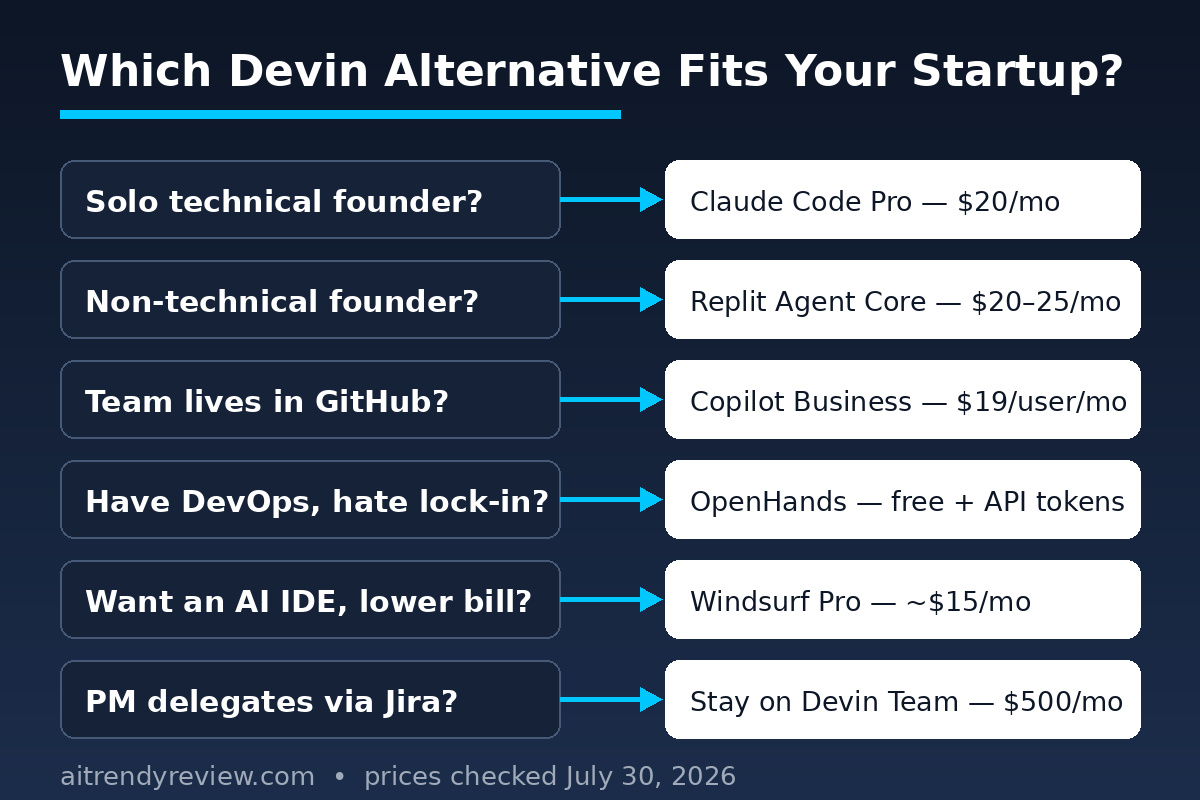
Match the tool to the person who will actually run it. If you’re a solo technical founder, get Claude Code Pro at $20 for predictable cost and real autonomy. If you’re a non-technical founder validating an idea, get Replit Core and budget $50–$100 a month for credits. If your team of 3–10 engineers lives in GitHub, run Copilot Business at $19 per seat and add Claude Code Max for the two people doing heavy delegation. If you have DevOps capacity and hate vendor lock-in, self-host OpenHands and pay only for tokens. If you want an AI editor but not Cursor’s price ladder, take Windsurf Pro. And if what you truly need is an agent that plugs into Jira and answers to a PM, Devin Team remains the most turnkey option; that specific workflow is still hard to replicate, and it’s the one scenario where $500 a month can defend itself.
Is Devin Still Worth $500 a Month for Teams?
For most startups, no. Devin Team at $500 per month with 250 included ACUs buys roughly 62 hours of agent work before $2.00-per-ACU overages begin, while a Claude Max 20x subscription at $200 or a self-hosted OpenHands setup delivers comparable or better SWE-bench performance for less money.
The honest case for staying: Devin’s zero-configuration setup (about two minutes), its native Jira and Linear integration, and its session parallelism are still unmatched as a package. A team that delegates well-scoped tickets to an agent the way it would to a contractor, with a PM doing the delegating rather than an engineer, gets real value from that harness. The case for leaving is everything else: benchmark parity has flipped to open source, ACU billing punishes exploratory work, and the $20 Core plan’s pay-as-you-go pricing means your “cheap” month is a function of how gnarly your codebase felt that month. Run the arithmetic on your last three months of ACU spend before renewing. If the number is consistently under $150, Core is fine. If it’s north of $300, one of the five tools above will do the same work for half the bill.
Worth It / Skip It: The Quick Verdicts
Claude Code — worth it if you have terminal-comfortable engineers and want predictable pricing. Skip it if you need a web dashboard for non-coders.
Cursor — worth it if your team lives in VS Code and wants agent power inside the editor. Skip it if tracking model-usage pools across plan tiers sounds exhausting.
GitHub Copilot — worth it if $10 a month and GitHub-native PRs cover your needs. Skip it if you plan hours of daily agent delegation, because credits won’t stretch.
Replit Agent — worth it if you’re non-technical and need a deployed MVP this week. Skip it if you can’t stomach variable, effort-based billing.
OpenHands — worth it if you can run Docker and want frontier performance for token costs only. Skip it if nobody on the team wants to own infrastructure.
Windsurf — worth it if you want 80% of Cursor for ~75% of the price. Skip it if ecosystem size and hiring familiarity matter to you.
Devin — worth it if PM-driven ticket delegation with Jira integration is your core workflow. Skip it if unpredictable ACU bills already sting.
Frequently Asked Questions
What is the best free alternative to Devin AI?
OpenHands is the best free Devin alternative in 2026. It’s MIT-licensed, self-hosted via Docker in 10–15 minutes, and scores about 72% on SWE-bench Verified with Claude models, above Devin’s estimated ~50%. You pay only for model API tokens, and you can swap between Claude, GPT, Gemini, or local models freely.
How much does Devin AI cost in 2026?
Devin costs $20 per month on the Core plan plus $2.25 per ACU consumed, or $500 per month on the Team plan with 250 ACUs included and overages at $2.00 each. One ACU equals roughly 15 minutes of agent work. Enterprise pricing is custom. There is no free tier or free trial as of July 2026.
Can an AI coding agent replace a junior developer at a startup?
Not fully. Agents like Devin, Claude Code, and OpenHands complete well-scoped tickets (bug fixes, tests, small features) but they still need a human to scope tasks, review output, and catch architectural mistakes. The realistic 2026 framing: one strong engineer plus an agent does the work of two or three, which changes hiring math without eliminating it.
Is Devin AI worth it for a small startup?
Usually not at the Team tier. $500 per month buys about 62 hours of included agent work, while Claude Code Pro at $20 or self-hosted OpenHands delivers comparable capability for far less. Devin earns its price mainly when a PM delegates tickets through Jira or Linear integration, a workflow smaller startups rarely have.
What is the cheapest AI coding agent for startups?
GitHub Copilot Pro at $10 per month is the cheapest paid agent, including $10 of AI credits monthly plus unlimited inline completions. OpenHands is cheaper still if you count only software: it’s free and open source, though you pay model providers for tokens, typically $50–$200 monthly for active use.
What is an ACU in Devin’s pricing?
An ACU (Agent Compute Unit) is Devin’s billing unit, representing roughly 15 minutes of active agent work. Core plan users pay $2.25 per ACU as they go; Team plans include 250 ACUs monthly with extras at $2.00. Complex or failed tasks consume ACUs regardless of outcome, which is why user reports call Devin’s bills unpredictable.
Which Devin alternative is best for non-technical founders?
Replit Agent. It takes a plain-language description and autonomously builds, tests, and deploys a working app with hosting included, no code review required. Replit Core costs $20–$25 per month with $25 of credits, though complex builds routinely need $50–$100 of monthly credits in practice. No other alternative requires less technical skill.
Does Claude Code have usage limits like Devin’s ACUs?
Yes, but they work differently. Claude Code uses time-window limits, a 5-hour session window plus a weekly cap, instead of per-task metering. You never get a surprise overage bill on a subscription; you either have capacity or you wait for the window to reset. Max plans at $100–$200 multiply those limits 5x–20x.
Sources
Prices checked July 30, 2026. Primary references: Devin (official), CostBench Devin pricing breakdown, CC for Everyone on Claude Code limits, NxCode Cursor pricing guide, Guickly GitHub Copilot pricing analysis, Serenities AI Replit Agent review, and Toolhalla’s Devin vs OpenHands vs SWE-agent comparison.

Naveen Kumar Durai is the founder of Naveen AI Automation and the reviewer behind AITrendyReview. He builds AI automation systems daily and reviews AI tools from official docs, live pricing pages, and verified user reports — updated monthly as tools change.