You made a track in Suno V5 that sounds better than half of what’s on Spotify. Now you want to put it in a YouTube video, license it to a client, or release it under your artist name. And suddenly the question that didn’t matter yesterday matters a lot: can you legally make money from this song, and who actually owns it? The answer depends almost entirely on one thing: which Suno plan you were on the moment you hit Create. Get that wrong and no upgrade, apology, or support ticket will retroactively fix it.
How we assess: this review is based on official documentation, pricing pages, changelogs, and verified user reports, not hands-on testing.
Can you use Suno V5 songs commercially? Yes, if the song was created while you had an active paid subscription (Pro at $10/month or Premier at $30/month). Suno assigns you commercial rights to those tracks, takes 0% of your revenue, and lets you distribute to Spotify, Apple Music, and YouTube. Songs made on the free plan are personal-use only, permanently.
Key takeaways
- Suno Pro costs $10/month (2,500 credits, roughly 500 songs) and is the cheapest plan with commercial rights (checked August 6, 2026).
- Free-plan songs are non-commercial forever; upgrading later does not convert even 1 of them.
- Songs created during a paid term keep commercial rights after you cancel; rights lock in at creation, 100% of the time.
- A track that is 100% AI-generated cannot be registered for US copyright; you get usage rights, not enforceable ownership.
- Suno settled with Warner Music in November 2025, but UMG and Sony litigation was still active into 2026.
- Suno takes 0% of streaming, licensing, or YouTube revenue on paid plans.
What do Suno’s commercial rights actually give you?
On Pro or Premier, Suno assigns you “all of its right, title and interest” in the songs you generate, which means you can monetize them on streaming platforms, license them for film, TV, ads, and games, sell them directly, and run them in monetized YouTube videos, with Suno taking no revenue share. That’s the short version from Suno’s own rights documentation.
Notice the wording, though. Suno assigns you its interest in the output. That is not the same as handing you a registered copyright, and Suno is unusually blunt about the difference: “due to the nature of machine learning, Suno makes no representation or warranty that any copyright will vest in any Output.” Suno gives you permission and steps out of your way. Whether anyone else has to respect your claim to the song is a copyright-office question, not a Suno question. We’ll get to why that matters more than most creators think.
One more subtlety worth pinning down: the rights are tied to the song’s creation moment, not to your account status today. Suno’s help center is explicit that subscribing does not grant commercial rights to songs you made before subscribing. The practical rule is simple. Subscribe first, create second.
How much does Suno V5 cost for commercial use in 2026?
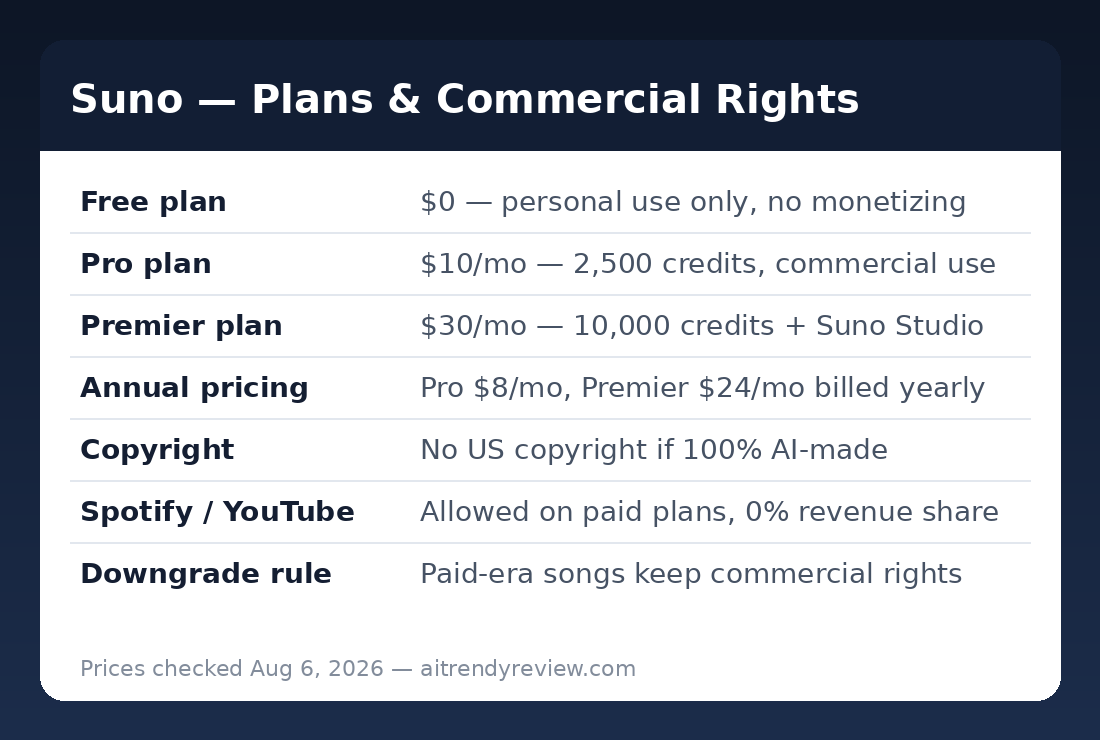
The cheapest path to commercial rights is Suno Pro at $10 per month, or an effective $8 per month billed annually. Premier is $30 per month ($24 per month annually) and carries identical commercial rights; you’re paying for volume and tools, not better legal terms.
Here’s how the plans break down as of August 6, 2026:
| Plan | Price | Free plan? | Best for | Key limit |
|---|---|---|---|---|
| Suno Free | $0 | Yes — 50 credits/day (~10 songs) | Testing prompts, hobby listening | Non-commercial only, attribution required, no downloads since the Warner deal |
| Suno Pro | $10/mo ($8/mo annual) | — | Solo creators, YouTubers, podcasters | 2,500 credits/mo (~500 songs) |
| Suno Premier | $30/mo ($24/mo annual) | — | High-volume producers, client work, Suno Studio users | 10,000 credits/mo (~2,000 songs) |
| Udio (post-UMG deal) | Subscription, licensed catalog | Limited | Streaming inside Udio’s ecosystem | Walled garden; generated tracks can’t be exported |
If you’re choosing between the two paid tiers: a solo YouTuber who needs a handful of background tracks a week will never exhaust Pro’s 2,500 credits. Premier earns its extra $20 only if you’re producing at catalog scale, running client work, or you want Suno Studio, the multitrack editing environment bundled with the top tier. For a fuller feature breakdown, our Suno V5 review covers the model quality and workflow side of the equation.
Can you monetize Suno free plan songs if you upgrade later?
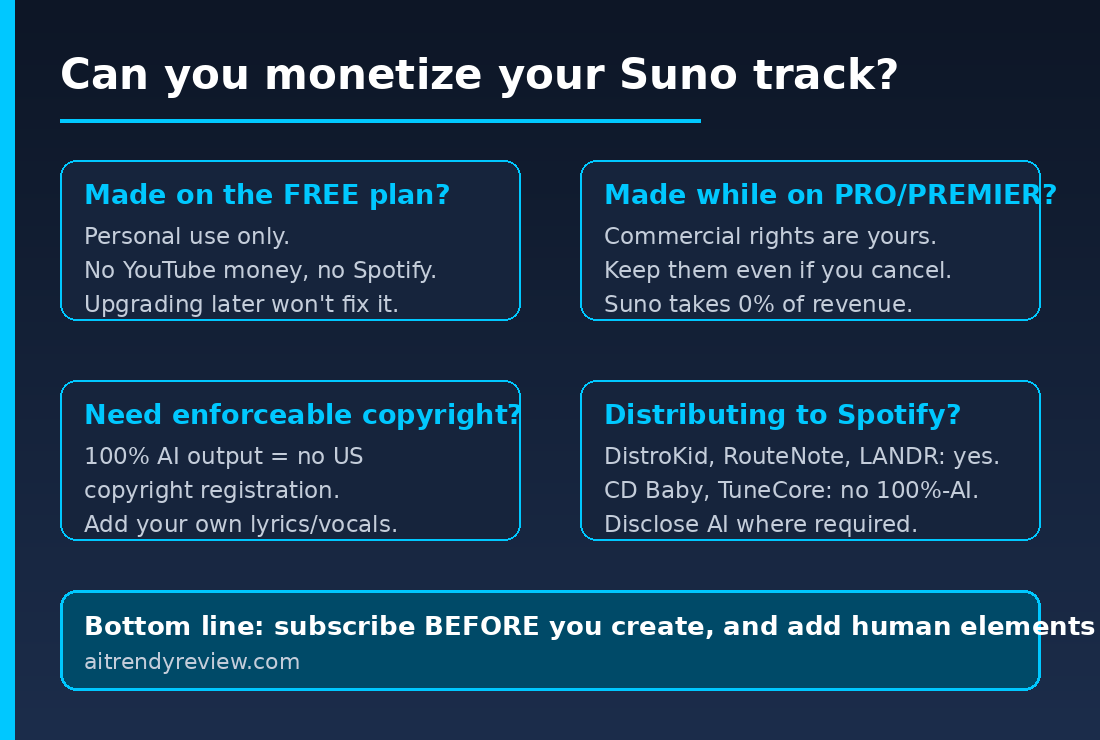
No. Songs created on Suno’s free plan are licensed for personal, non-commercial use only, and upgrading to Pro or Premier afterward does not retroactively commercialize them. Suno’s help center answers the question “If I subscribe, do I get rights for the songs I made before subscribing?” with a flat no: rights attach at creation time based on the subscription you held at that moment.
This is the single most common and most expensive misunderstanding in the entire Suno ecosystem. The forums are full of creators who prototyped 40 songs on the free tier, found one that took off on TikTok, upgraded to Pro, and then discovered the hit was permanently stuck in non-commercial status. The workaround most of them land on: recreate the track from the same prompt and lyrics while subscribed. That produces a new output with commercial rights, though never a bit-identical one.
The free plan got tighter in 2026, too. Following Suno’s settlement with Warner Music Group, free-tier downloads were removed entirely; free users can stream and share within Suno but can’t take files off the platform, according to reporting on the post-settlement platform changes. The free tier is now a demo, full stop. Treat it that way.
Do you actually own the copyright to Suno V5 songs?
Almost certainly not, if the track is 100% AI-generated. The US Copyright Office requires human authorship, and courts, including the D.C. Circuit, have upheld that a work generated entirely by a machine cannot be registered. Suno’s paid plans give you commercial permission; they cannot manufacture a copyright that US law says doesn’t exist.
Sit with the consequence of that for a second, because it’s strange: you can legally sell a song that nobody, including you, legally owns. If someone rips your fully-AI Suno track and reuploads it, you have no copyright registration to point at in a DMCA fight, and most distributors won’t put fully-AI works into Content ID fingerprinting programs for exactly this reason.
There’s a real fix, and it’s the strongest practical advice in this entire guide: add human authorship. Write your own lyrics; Suno confirms user-written lyrics remain your property on any plan. Record your own vocal. Rearrange, edit, layer. The human-authored portions of a hybrid work can qualify for copyright protection even when the AI-generated instrumental bed can’t. A song with your lyrics and your topline sung over a Suno V5 arrangement is a much more defensible asset than a pure text-to-song output. Solo hobbyist making background music? Skip the ceremony. Building an artist catalog you hope has resale value? Human elements aren’t optional.
Can you put Suno V5 songs on Spotify and Apple Music?
Yes: paid subscribers can distribute Suno songs to Spotify, Apple Music, and other DSPs, but your distributor choice matters more than you’d expect. Per Dynamoi’s distribution guide, DistroKid, RouteNote, LANDR, Amuse, UnitedMasters, and Symphonic accept AI-generated music, while CD Baby and TuneCore decline 100% AI content. Several platforms now require you to disclose AI tooling during upload, and quietly skipping that disclosure is a good way to get a takedown later.
Two practical notes from verified user reports. First, expect occasional manual review friction: distributors have tightened fraud screening as AI uploads exploded, and tracks with zero human elements get flagged more often. Second, remember the Content ID gap from the copyright section: your track can sit on Spotify earning royalties while remaining unprotected against copycats. Those two facts coexist, uncomfortably.
For YouTube specifically, Suno’s terms allow monetized videos on paid plans with no revenue share to Suno. Your channel, your AdSense, 100% yours. The risk on YouTube isn’t Suno’s terms; it’s YouTube’s own synthetic-media disclosure rules, which now require flagging realistic AI content. A disclosed AI soundtrack under a vlog is routine. An undisclosed AI song mimicking a real artist’s voice is a strike waiting to happen.
What happens to your rights if you cancel or downgrade?
Songs keep the rights they were born with. Every track created during an active Pro or Premier term retains its commercial-use status indefinitely, even after you cancel; Suno’s documentation and third-party guides agree on this point. Cancel in December, and the 300 songs you made in November remain monetizable forever. Anything you create after the downgrade reverts to free-tier, non-commercial status.
This makes Suno’s rights model surprisingly subscriber-friendly compared to the walled-garden direction of its main rival. When Udio settled with Universal Music Group in October 2025, it relaunched as a closed ecosystem where generated tracks stream inside the app but cannot be exported at all. Suno’s post-Warner model kept exports (with monthly download caps on paid tiers) and kept the perpetual rights grant. If portability of your catalog matters, that’s a structural advantage, and one we scored heavily in our Suno V5 vs Udio comparison.
A bookkeeping tip that costs nothing now and saves arguments later: keep dated records. Screenshot your billing history and export your song list while subscribed. If a distributor or client ever questions whether a track was made during a paid term, your Suno invoice dates plus the song’s creation timestamp are your proof.
Did the Warner settlement change Suno’s commercial rights?
The core rights framework survived, but the platform around it changed meaningfully. In November 2025 Suno settled with Warner Music Group, reported at roughly $500 million, retired its unlicensed models, and moved to versions trained on licensed catalog. The user-facing fallout: free-tier downloads disappeared, paid tiers gained monthly download caps, and the pre-settlement model era formally ended.
What did not change: paid subscribers still receive commercial rights at creation time, Suno still takes no revenue cut, and previously created songs kept their status. Meanwhile, Universal Music Group and Sony Music remained in active litigation against Suno into 2026, with the musicians’ union AFM filing its own amended suit over the label deals themselves, per Music Business Worldwide. The legal ground is firmer than it was in 2024, but it is not settled ground.
Should that stop you? For YouTube background music and client jingles, no. Your rights come from your subscription contract with Suno, and the settled-versus-pending litigation targets Suno’s training practices, not individual users. For a serious artist project where the catalog IS the business, the honest answer is that title-chain uncertainty still exists until UMG and Sony resolve. Price that risk into how much you invest.

How do Suno’s rights compare with Udio, Lyria, and ElevenLabs Music?
Suno currently offers the most permissive export-and-monetize deal among the major AI music generators. Udio post-UMG is a walled garden: impressive model, but your tracks live and die inside the app. Google’s Lyria 3, which we broke down in our Lyria 3 Pro review, watermarks output with SynthID and routes commercial use through Google’s ecosystem terms rather than a clean assignment of rights. ElevenLabs’ music product leans licensed-catalog and enterprise, with per-seat terms, closer to a production-music library than an ownership grant; its voice-side credit system works similarly to what we mapped in our ElevenLabs review.
The pattern across the industry after the 2025 settlements is clear: every platform is converging on licensed training data, and the variable that actually differentiates them now is what you’re allowed to do with the output. On that axis, Suno’s “create while paid, keep forever, export it, we take 0%” remains the strongest offer on the table, which is exactly why the remaining UMG and Sony lawsuits matter. They’re the only thing that could still force Suno toward the Udio model.
What counts as commercial use on Suno — and what doesn’t?
Commercial use, in Suno’s framing, is any use intended to generate revenue or promote a business: monetized YouTube and TikTok content, songs distributed to streaming platforms, music in paid client deliverables, podcast intros for sponsored shows, in-game audio for a game you sell, background tracks for a company’s ads or website. If money changes hands anywhere downstream of the song, it’s commercial, and it needs a paid-plan creation date behind it.
Non-commercial use is broader than people assume, which is why the free tier still has a real audience. Streaming your own songs inside the Suno app, sharing links with friends, playing tracks at a private party, using a song in an unmonetized personal video: all fine on the free plan, with attribution to Suno where you share it. The line that trips creators up is the gray zone: an unmonetized YouTube channel that you plan to monetize once it hits 1,000 subscribers. The moment monetization switches on, every free-plan Suno track in your back catalog becomes a terms violation sitting in public view. If a channel has any commercial future at all, create its music on a paid plan from day one; at $10 per month, the insurance is cheaper than re-scoring old videos later.
One edge case worth naming for client-work freelancers: the commercial rights belong to you, the subscriber, and standard practice is to license the finished deliverable onward to your client through your own contract. Nothing in Suno’s public documentation supports a client claiming the Suno-side rights directly from your account’s outputs, so put the grant in writing in your invoice terms the same way you would with stock assets.
Which Suno features don’t carry full commercial rights?
Not everything you can make inside a paid Suno account is monetizable, and this is where careful creators separate themselves from the ones who get takedown emails. Three features carry restrictions that survive even a Premier subscription, according to TechJack’s commercial use analysis of Suno’s terms.
Remixes of other people’s songs remain personal-use only. If you remix a track another Suno user made public, the output can’t be monetized regardless of your plan, because the underlying work isn’t yours to commercialize. The same logic applies to the Reuse Prompt feature when it’s pointed at someone else’s song; Suno’s help center explicitly flags both cases. Voice-model features are limited to your own voice: you can train and monetize a persona built on your recordings, but cloning anyone else’s voice is off the table, which after 2025’s wave of soundalike controversies should surprise nobody.
Extensions are the subtler case. When you extend someone else’s public track, ownership of the result follows the original creator’s rights, not yours. Extensions of your own paid-plan songs inherit your commercial rights normally. The safe operating rule across all of these: monetize only what started from your own prompt, your own lyrics, and your own account while subscribed. Everything collaborative or derivative inside Suno’s social layer is for fun, not for revenue.
Who should pay for Suno commercial rights — and who shouldn’t?
Map yourself to one of these and the decision makes itself. If you’re a YouTuber or podcaster who needs unlimited background music, get Pro at $10/month; one licensed stock track from a traditional library often costs more than that. If you’re a freelancer scoring client videos or ads, get Pro, add your own lyrics where you can, and invoice with confidence. If you run an agency or produce at volume, Premier’s 10,000 credits and Suno Studio justify the $30. If you’re an artist building a catalog you may someday sell or defend in court, use Suno as a co-writer, not a ghostwriter: your lyrics, your vocals, Suno’s arrangement, and register the human parts. And if you just make songs about your dog for the group chat, the free plan is plenty; you never needed commercial rights.
Worth it if / Skip it if
Worth it if: you monetize any content anywhere: YouTube, Spotify, TikTok, client work, in-game audio. At $10/month with a 0% revenue share and perpetual rights on everything you create while subscribed, Suno Pro is one of the cheapest commercial music licenses in existence, and rights that survive cancellation make it a genuinely low-risk subscription.
Skip it if: you need enforceable, registrable copyright on pure AI output (no plan can sell you that), you’re building a business on tracks you can’t afford to have challenged while UMG and Sony litigation is unresolved, or you only ever listen privately; the free tier covers that even with its download restrictions.
FAQ: Suno V5 commercial rights
Can I use Suno V5 songs in monetized YouTube videos?
Yes, if the songs were created while you held a Pro or Premier subscription. Suno grants commercial use rights and takes no share of your ad revenue. You should follow YouTube’s AI-content disclosure rules for realistic synthetic media, but a Suno background track in a monetized video is fully within the terms.
Do I need Suno Premier for commercial rights, or is Pro enough?
Pro is enough. Pro ($10/month) and Premier ($30/month) carry identical commercial rights; Premier only adds volume (10,000 credits versus 2,500) and Suno Studio access. Buy Premier for capacity and tools, never for legal coverage. Most solo creators never exhaust Pro’s roughly 500 songs per month.
What happens to my Suno songs if I cancel my subscription?
They keep their commercial rights permanently. Rights attach at the moment of creation, so every track made during an active paid term stays monetizable after you cancel. Only songs you create after downgrading fall back to the free plan’s personal-use-only license. Keep billing records as proof of your subscription dates.
Can I copyright a song I made with Suno V5?
Not if it’s 100% AI-generated, since the US Copyright Office requires human authorship. However, human contributions like original lyrics you wrote or vocals you recorded can be protected. Suno confirms your own lyrics remain your property on any plan, so hybrid human-plus-AI tracks are far more defensible than pure generations.
Can I put Suno songs on Spotify through DistroKid?
Yes. DistroKid, RouteNote, LANDR, Amuse, UnitedMasters, and Symphonic all accept AI-generated music from paid Suno subscribers. CD Baby and TuneCore currently reject 100% AI content. Disclose AI tooling where the distributor asks; nondisclosure is the most common cause of AI-track takedowns.
Are free-plan Suno songs ever usable commercially?
No. Free-tier songs are licensed for personal, non-commercial use with attribution, permanently. Upgrading later does not convert them. If a free-plan track takes off, your realistic option is regenerating a similar version from the same prompt and lyrics while subscribed, which creates a new song with commercial rights.
Did Suno’s Warner Music settlement affect my existing songs?
Existing songs kept the rights they had at creation. The November 2025 settlement changed the platform going forward: unlicensed models were retired, free downloads were removed, and paid tiers received monthly download caps. Commercial rights for paid subscribers survived unchanged, and Suno still takes 0% of your revenue.
Is Suno safer than Udio for commercial music in 2026?
For portability, yes. Udio’s October 2025 Universal settlement turned it into a walled garden where tracks cannot be exported, while Suno still lets paid subscribers download and distribute externally. Suno’s remaining legal risk is the unresolved UMG and Sony litigation, which targets Suno’s training practices rather than individual users.
Sources
- Suno Help Center — What rights do I have with a paid subscription?
- Suno Help Center — Rights & Ownership
- Suno — Pricing
- Suno — Release Notes
- Music Business Worldwide — AFM amended lawsuit over Suno/Udio label deals
- Dynamoi — Suno Commercial Use: Free vs Pro Rights
Prices checked August 6, 2026.

Naveen Kumar Durai is the founder of Naveen AI Automation and the reviewer behind AITrendyReview. He builds AI automation systems daily and reviews AI tools from official docs, live pricing pages, and verified user reports — updated monthly as tools change.