DeepSeek is about to do it again. The Chinese lab that crashed AI pricing in 2025 has told developers its V4 model family goes from preview to official release in mid-July 2026, and as of July 22 the AI community is refreshing the changelog daily. Reports from TechNode and China-based outlets point to a stable release landing within days, complete with a pricing scheme nobody in the West has tried: peak-hour API billing. This post separates what is confirmed about DeepSeek V4 from what is rumor, because the two are getting blended together in a lot of coverage right now.
How we assess: this article is based on official documentation/manufacturer specs, pricing pages, and verified user/owner reports, not hands-on testing.
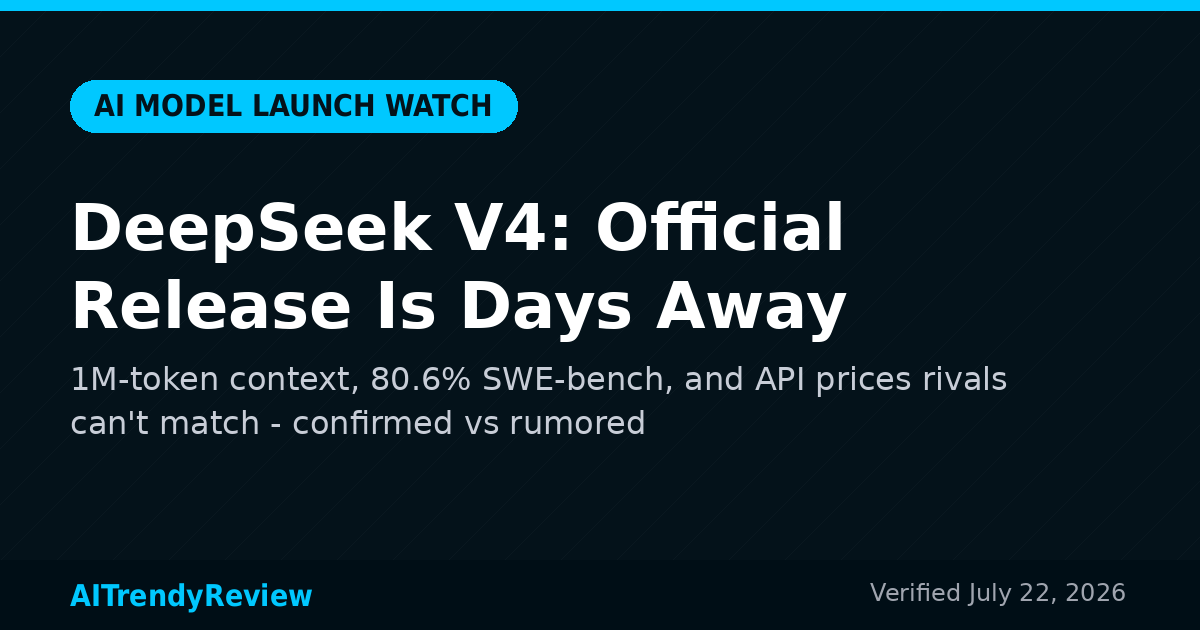
What is DeepSeek V4? DeepSeek V4 is the follow-up to V3.2: an MIT-licensed, open-weight model family with a 1-million-token context window. The preview launched April 24, 2026 in two sizes, V4-Pro and V4-Flash. The official stable release is expected mid-to-late July 2026, with output pricing around $3.48 per million tokens for V4-Pro, a fraction of what closed rivals charge.
Key takeaways
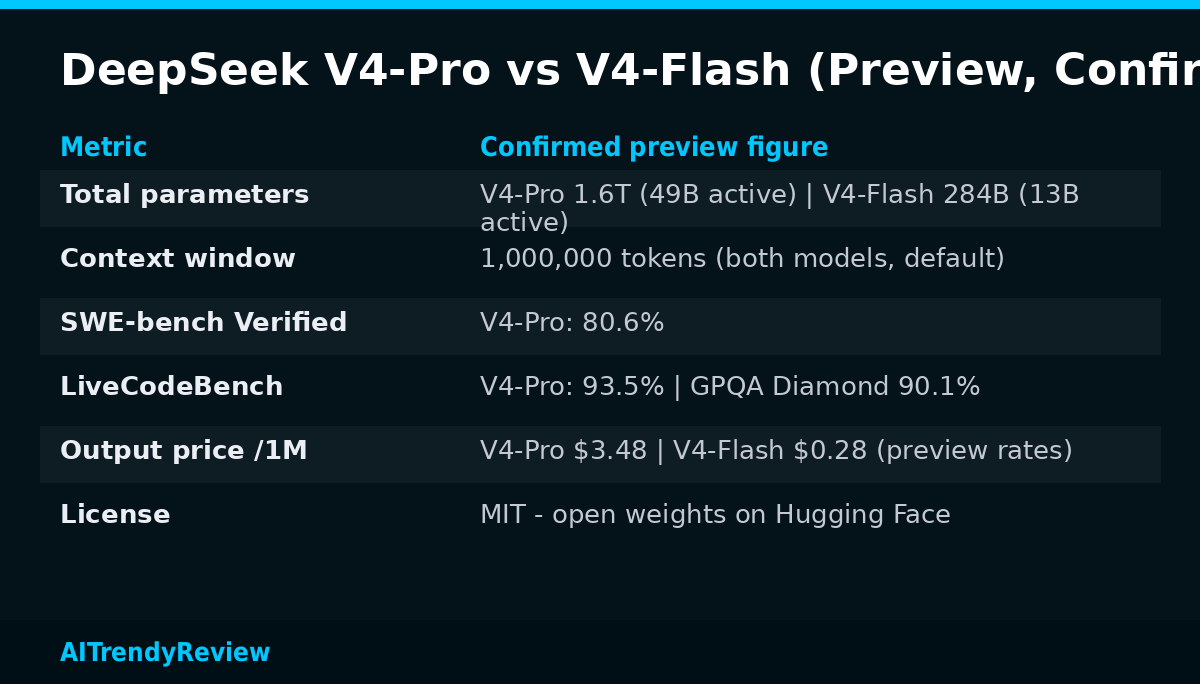
- 2 models confirmed: V4-Pro (1.6T total parameters, 49B active) and V4-Flash (284B total, 13B active), both MIT-licensed with open weights on Hugging Face.
- 1M-token context is the default across the lineup, matching the longest windows in the industry at a 10th of the cost.
- 80.6% on SWE-bench Verified and 93.5% on LiveCodeBench put V4-Pro’s preview scores in frontier coding territory.
- Preview pricing: $3.48 per 1M output tokens for V4-Pro and $0.28 for V4-Flash; cache hits drop input costs to $0.145 and $0.028.
- Mid-July official release was announced by DeepSeek itself; a 2x peak-hour API surcharge (9 a.m.-noon, 2-6 p.m. Beijing blocks) comes with it.
- Not yet confirmed: exact GA date, final GA pricing, image input on V4-Flash, and the rumored “Engram” memory feature.
What is officially confirmed about DeepSeek V4?
The confirmed record starts April 24, 2026, when DeepSeek shipped the V4 preview through its API and posted open weights to Hugging Face under an MIT license. Two variants exist. V4-Pro is a 1.6-trillion-parameter mixture-of-experts model that activates 49 billion parameters per token. V4-Flash is the efficiency play: 284 billion total, 13 billion active. Both default to a 1-million-token context window and both support Thinking and Non-Thinking modes, letting developers trade reasoning depth for speed on a per-request basis.
The architecture is the interesting part for anyone watching inference economics. V4 introduces what DeepSeek calls Compressed Sparse Attention (CSA) and Heavily Compressed Attention (HCA), which the company credits with roughly a 10x serving-cost reduction versus V3.2, per kie.ai’s technical rundown. That’s the mechanism behind the headline: million-token context at commodity prices.
On June 30, TechNode reported DeepSeek’s announcement that the formal V4 release lands in mid-July with differentiated API pricing: peak hours (9:00 a.m. to 12:00 p.m. and 2:00 p.m. to 6:00 p.m. Beijing time) billed at twice the off-peak rate. That structure is confirmed by DeepSeek’s own developer communications. It is the first major lab to price API calls like an electric utility.
How strong are the confirmed benchmark numbers?
Strong enough that the “cheap but mid” framing from the V3 era no longer fits. The preview V4-Pro posts 80.6% on SWE-bench Verified, 93.5% on LiveCodeBench, 90.1% on GPQA Diamond, and a 3206 Codeforces rating, per the figures kie.ai compiled from DeepSeek’s model card. For an open-weight model you can download and run yourself, those coding numbers sit within a few points of the best closed frontier models on the market in July 2026.
Context for those scores: when we reviewed GPT-5.4 and Claude Opus 4.7, the gap between open and closed models on agentic coding benchmarks was the story. V4’s preview numbers shrink that gap to a rounding error in several categories, while undercutting on price by an order of magnitude. One honest caveat from the same coverage: long-context performance is described as inconsistent in some third-party tests, and real production validation is still thin. Benchmarks are a floor for marketing and a ceiling for reality.
What does DeepSeek V4 cost compared to rivals?
Preview API pricing is published and concrete. Here’s the confirmed table as of July 22, 2026:
| Model | Input (cache miss) | Input (cache hit) | Output | Context | License |
|---|---|---|---|---|---|
| DeepSeek V4-Pro | $1.74 / 1M | $0.145 / 1M | $3.48 / 1M | 1M tokens | MIT, open weights |
| DeepSeek V4-Flash | $0.14 / 1M | $0.028 / 1M | $0.28 / 1M | 1M tokens | MIT, open weights |
| Frontier closed models (typical) | $2-15 / 1M | varies | $10-75 / 1M | 200K-1M | Proprietary |
Two wrinkles matter. First, multiple outlets, including kie.ai and igeekphone, expect some price increase at GA; the preview rates were explicitly provisional. Second, the peak-hour scheme means the same request can cost double depending on the Beijing clock. For US developers this is actually good news: US business hours fall mostly in DeepSeek’s off-peak window, so American workloads get the cheap rate by default. Batch jobs scheduled overnight US time hit peak Beijing hours, so flip your cron schedules accordingly.
DeepSeek also bills purely on usage with no prepaid subscription tiers, a structure igeekphone highlighted as a deliberate contrast to the $20-a-month chatbot economy.
What is still rumor, and how seriously should you take each claim?
Four claims are circulating without official confirmation. Treat them accordingly.
- The exact GA date. “Mid-July” is official; a specific day is not. Aggregators like BuildFastWithAI have floated July 24 for the stable release. DeepSeek has not published a date. Confidence: medium, since the mid-July window itself is company-stated.
- Image input on V4-Flash. Sourced to a single social account (@MiaAI_lab) and nothing official. Confidence: low.
- “Engram” conditional memory. Referenced in pre-launch coverage, absent from the actual preview release notes. Confidence: low.
- Viral capability demos. Bilibili videos show V4 one-shotting playable game builds. Impressive if real, but they come from unofficial channels with no reproducible prompts. Some commentators even speculated about request routing to external frontier models; kie.ai notes no credible evidence supports that theory. Confidence in the demos: unverifiable either way.
Our position: judge V4 on the published preview weights and benchmarks, which are independently downloadable, and ignore the demo circus until the stable release ships.
How does V4 fit the open-source AI race of summer 2026?
July 2026 has become the most crowded month for open-weight releases in AI history. Moonshot’s Kimi K3 put a 2.8-trillion-parameter open model at the top of coding leaderboards this month, to the point that Moonshot suspended new subscriptions on capacity grounds. Google’s Gemma 4 anchors the small-model end. And US labs are responding on price and agentic features rather than ceding the floor, as we covered in our Gemini 3.5 Pro confirmed-vs-hype breakdown.
V4’s angle in that race is cost-per-capability. Kimi K3 is bigger; frontier closed models are still a touch stronger on the hardest reasoning; but nothing published matches V4-Pro’s benchmark-per-dollar ratio. If the GA release holds preview pricing within even 2x, V4 becomes the default backbone for cost-sensitive agent pipelines, RAG systems chewing million-token contexts, and any startup whose unit economics die at closed-model prices.
There’s a policy wrinkle too: with Washington’s frontier-AI review framework expected before August 1 covering OpenAI, Anthropic, and Google, Chinese open-weight labs face no equivalent 30-day pre-release gate. Release velocity itself is becoming a competitive weapon.
If you’re building with AI today, what should you actually do?
If you run agent or coding pipelines: benchmark V4-Pro’s preview against your current stack this week, before GA repricing. The 80.6% SWE-bench score and $3.48 output rate make it the obvious candidate to replace mid-tier closed models in code-heavy loops, the same calculus we walked through in our Devin review.
If you process huge documents: the 1M-token default window plus $0.14 input pricing on V4-Flash is the cheapest long-context offer on the market. Test it on your longest real workloads first, though; this is exactly where third-party results are inconsistent.
If you self-host: the MIT license means the weights are yours. V4-Flash’s 13B active parameters put it in reach of serious but not exotic hardware.
If you’re a casual user: wait for the stable release. Previews get rate-limited and rebalanced without notice, and the consumer app will pick up V4 automatically once GA lands.
If you’re locked into a US vendor for compliance reasons: nothing here changes your stack, but V4’s pricing gives you fresh bargaining power in your next contract negotiation.
How do you test DeepSeek V4 preview this week?
If you build with AI, the smart move is to benchmark V4 against your current stack before the stable release reprices anything. The preview is already live and cheap enough that there’s no reason to wait. Start with V4-Flash rather than V4-Pro for first tests: at $0.14 per million input tokens and $0.28 output, you can run a substantial evaluation suite for a few dollars, and its 13-billion active-parameter footprint responds fast enough for interactive iteration.
Point your existing eval harness at the DeepSeek API endpoint and swap only the model name. Because the preview weights are also on Hugging Face under an MIT license, teams with GPU capacity can run the same tests locally and compare hosted-versus-self-hosted latency and cost side by side. Focus your evaluation on the tasks you actually ship: if you run agentic coding loops, replay a week of real tickets through V4-Pro and measure pass rate against your incumbent model rather than trusting the headline SWE-bench figure. Benchmarks are a starting hypothesis, not a verdict on your workload.
Pay special attention to long-context behavior, because that’s where third-party results have been inconsistent. Feed V4 your genuinely longest real documents, not synthetic 1-million-token filler, and check whether recall holds up across the full window. A model can advertise a million-token context and still lose the thread in the middle of a real 300-page contract. Test the failure mode you’ll actually hit in production.
What do CSA and HCA actually change?
The pricing story only makes sense once you understand the architecture underneath it. Standard transformer attention gets expensive fast as context grows, because every token attends to every other token, and that quadratic cost is why million-token windows have historically carried premium prices. DeepSeek V4 introduces two mechanisms to cut that cost: Compressed Sparse Attention (CSA) and Heavily Compressed Attention (HCA). Together, per kie.ai’s technical breakdown, they deliver roughly a 10x serving-cost reduction versus V3.2.
The practical upshot is that DeepSeek can offer a 1-million-token context window at commodity prices without losing money on every long call. That’s the whole trick behind the headline. For developers it means long-context work that would be prohibitively expensive on a closed frontier model becomes routine here: feeding an entire codebase, a full case file, or a book-length document into a single prompt stops being a budget decision. The caveat, again, is that aggressive attention compression is exactly the kind of optimization that can degrade recall in the middle of very long contexts, which is why the inconsistent long-context reports deserve real testing rather than a shrug.
What does peak-hour pricing mean for a US team’s bill?
DeepSeek’s peak-hour surcharge is unusual enough to be worth a concrete example. Starting with the official release, API calls run at double the standard rate during Beijing peak windows: 9:00 a.m. to noon and 2:00 p.m. to 6:00 p.m. China time. The rest of the day is off-peak at the standard rate.
For a US team this is quietly favorable. Beijing is 12 to 15 hours ahead of the continental United States depending on your time zone and daylight saving. That means a US workday, roughly 9 a.m. to 6 p.m. Eastern, lands largely in DeepSeek’s off-peak Beijing overnight, so your interactive daytime traffic gets the cheaper rate by default. The workflow to watch is batch processing: if you schedule heavy overnight jobs on US time, they can slam straight into Beijing’s morning peak and cost double. The fix is trivial once you know to look for it. Shift large scheduled batch runs to hit the Beijing off-peak window, and pin interactive traffic to US business hours where it already sits. Model this against your real traffic pattern during the preview so you’re not surprised by the first post-release invoice.
One more budgeting note: multiple outlets expect some price increase at general availability on top of the peak-hour system, and DeepSeek has called the preview rates provisional. If current pricing is load-bearing in your unit economics, benchmark now, document the numbers, and treat today’s rates as a ceiling that may rise rather than a floor you can count on forever.
How does V4 change the build-vs-buy math for startups?
The most consequential effect of a model like V4 isn’t which benchmark it tops. It’s that it moves the line between what you build on a hosted API and what you self-host. For most of the last two years, teams defaulted to closed frontier APIs because the open models that were cheap enough to self-host weren’t good enough to ship, and the open models that were good enough were too large to run affordably. V4 attacks both ends of that squeeze at once.
On the hosted side, V4-Pro’s preview pricing of $3.48 per million output tokens is low enough that a startup can run production traffic through it without the per-call cost quietly eating the margin, which is the failure mode that kills a lot of AI features before they reach scale. On the self-host side, V4-Flash’s 13-billion active parameters put it within reach of a single serious GPU server, and the MIT license means the weights are genuinely yours with no usage restrictions or rug-pull risk. That combination lets a team prototype fast on the hosted API, then move the highest-volume paths in-house once the economics justify the ops overhead, all on the same model family so behavior stays consistent across the migration.
If you’re weighing this decision, map it to volume. Below a few million tokens a day, the hosted API almost always wins on total cost once you price in engineering time and GPU idle. Above that, and especially for latency-sensitive or privacy-sensitive workloads, self-hosting V4-Flash starts to pencil out. The point is that V4 makes both columns viable where before you were often stuck with the expensive one, and that optionality is worth more to a young company than any single benchmark score.
Bottom line
DeepSeek V4 is the most consequential open-weight release of July 2026 that hasn’t fully shipped yet. The confirmed pieces (1M context, MIT license, frontier-adjacent coding scores, and pricing an order of magnitude under closed rivals) are already public and downloadable. The rumored pieces are mostly garnish. When the stable release drops in the coming days, we’ll run V4 through a full hands-on review; until then, the preview is real enough to start testing and cheap enough that there’s no excuse not to.
Track the official announcement on DeepSeek’s API changelog or try the current model at deepseek.com.
FAQ: DeepSeek V4 release
When is the official DeepSeek V4 release date?
DeepSeek has said mid-July 2026. As of July 22 the stable release has not shipped; aggregators point to the final week of July. The preview has been publicly available since April 24, 2026.
Is DeepSeek V4 free to use?
The weights are free under an MIT license on Hugging Face, so self-hosting costs only your hardware. The hosted API bills per token: preview rates are $3.48 per million output tokens for V4-Pro and $0.28 for V4-Flash, with no subscription required.
What is the difference between V4-Pro and V4-Flash?
V4-Pro is the flagship: 1.6T total parameters, 49B active, top benchmark scores. V4-Flash is the budget model: 284B total, 13B active, roughly 12x cheaper on output. Both carry the 1M-token context window.
How does DeepSeek V4 compare to GPT-5.4 or Claude?
On preview coding benchmarks V4-Pro lands within a few points of the closed frontier: 80.6% SWE-bench Verified and 93.5% LiveCodeBench. Closed flagships still lead on the hardest reasoning tasks and multimodal work, but charge 3x to 20x more per token.
What is peak-time API pricing?
Starting with the official V4 release, DeepSeek bills API calls at twice the standard rate during Beijing peak hours: 9 a.m. to noon and 2 p.m. to 6 p.m. China time. Most US daytime traffic falls off-peak and gets the cheaper rate.
Can I run DeepSeek V4 locally?
Yes. Both preview models are on Hugging Face under MIT terms. V4-Flash (13B active parameters) is realistic on high-end workstation or modest server hardware; V4-Pro’s 1.6T total parameters demand serious multi-GPU infrastructure.
Is DeepSeek V4 safe for business data?
Self-hosted weights keep data entirely on your infrastructure, which is the strongest privacy option available. Using the hosted API routes data through DeepSeek’s China-based servers, which many US enterprises restrict; check your compliance requirements before switching production workloads.
Will V4 preview pricing change at the official release?
Probably. Multiple outlets report GA repricing is expected on top of the confirmed peak-hour system, though DeepSeek hasn’t published final numbers. If current rates matter to your budget, benchmark now and lock in your findings.
Sources
- TechNode — DeepSeek to launch V4 in mid-July with peak-time API pricing (June 30, 2026). Verified July 22, 2026.
- Kie.ai — DeepSeek V4 Release: Leaks, Preview, and GA Signals (updated July 19, 2026). Verified July 22, 2026.
- iGeekPhone — DeepSeek V4 official release expected within days (July 19, 2026). Verified July 22, 2026.
- DeepSeek API Docs — V4 Preview Release notes (April 24, 2026). Verified July 22, 2026.
- BuildFastWithAI — AI News July 21, 2026 (V4 stable-release timing). Verified July 22, 2026.

Naveen Kumar Durai is the founder of Naveen AI Automation and the reviewer behind AITrendyReview. He builds AI automation systems daily and reviews AI tools from official docs, live pricing pages, and verified user reports — updated monthly as tools change.