Legal AI has split into two camps, and Harvey AI and CoCounsel sit at the top of each one. Harvey is the venture-backed specialist that raised $200 million at an $11 billion valuation in March 2026. CoCounsel is Thomson Reuters’ answer, wired directly into Westlaw. Law firms comparing the two usually discover the real difference isn’t features. It’s price, contract structure, and who each vendor will even sell to.
Which is better, Harvey AI or CoCounsel? CoCounsel is the better choice for most firms under 50 attorneys because it offers self-serve pricing (roughly $104–$639 per user per month) and built-in Westlaw research. Harvey AI suits large firms and legal departments that can meet reported 25–50 seat minimums and $50,000+ annual contracts in exchange for deeper custom workflows.
How we assess: this review is based on official documentation, pricing pages, changelogs, and verified user reports, not hands-on testing.
Key takeaways
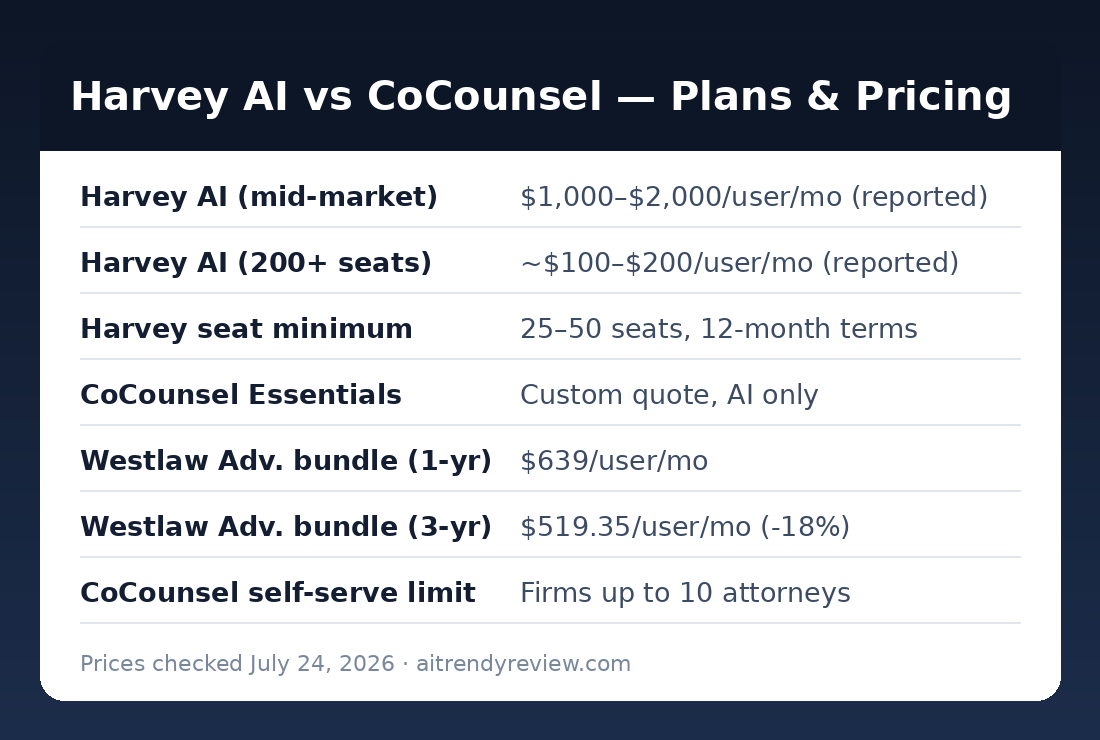
- Harvey AI has no published pricing; mid-market firms report paying $1,000–$2,000 per user per month, while 200+ seat firms negotiate down to roughly $100–$200.
- CoCounsel’s Westlaw Advantage bundle lists at $639 per user per month on a 1-year term, dropping about 18% to $519.35 on a 3-year commitment.
- Harvey’s reported seat minimums (25–50 seats, 12-month terms) lock out solo lawyers and firms under about 25 attorneys entirely.
- Thomson Reuters launched CoCounsel Legal on August 5, 2025, adding agentic Deep Research grounded in Westlaw’s KeyCite and Key Numbers.
- Harvey serves 70+ Am Law 100 firms and holds SOC 2 Type II plus four ISO certifications, including ISO 42001 for AI governance.
- Renewal increases of 10–25% have been reported on Harvey contracts that lack a negotiated price cap.
What Is Harvey AI?
Harvey AI is an enterprise legal AI platform built for large law firms and in-house legal departments. It is not a chatbot with a legal skin. The platform spans purpose-built agents that run multi-step legal work end to end, a document repository called Vault for bulk contract analysis, a research module called Knowledge covering legal, regulatory, and tax questions, and Contract Intelligence for deal review. A Command Center gives firm leadership adoption analytics, which matters more than it sounds: partners want proof the spend is being used.
The customer list explains the price tag. Harvey’s own site names A&O Shearman, Reed Smith, O’Melveny, Vinson & Elkins, Dentons, PwC UK, and Procter & Gamble among its users, and claims adoption across 70+ Am Law 100 firms and more than 200,000 professionals, with an average of 25+ hours saved per user per month (harvey.ai, checked July 24, 2026). Investors agree with the trajectory. In March 2026, Harvey closed a $200 million growth round at an $11 billion valuation, co-led by GIC and Sequoia (CNBC, March 25, 2026).
We covered the platform in depth in our full Harvey AI review. The short version: the product is real and the big-firm adoption is real. The barrier is everything around the product.
What Is CoCounsel?
CoCounsel is Thomson Reuters’ legal AI assistant, born from the company’s $650 million acquisition of Casetext in 2023 and now the centerpiece of its AI strategy. On August 5, 2025, Thomson Reuters launched CoCounsel Legal, which bundled three things: agentic Deep Research grounded in Westlaw content, Guided Workflows for complete legal processes, and a refreshed research platform called Westlaw Advantage (LawSites, August 5, 2025). The product expanded to the UK in January 2026.
Deep Research is the headline feature. Instead of summarizing search results, it builds a research plan, executes it iteratively against Westlaw’s Key Numbers, KeyCite, and statute annotations, and returns a report with arguments on both sides of a position. Westlaw Advantage adds a hallucination checker that flags potentially fictional citations, which addresses the single scariest failure mode in legal AI. Guided Workflows currently handle privacy policy drafting, complaint drafting, discovery requests and responses, and deposition transcript review. CoCounsel also plugs into Microsoft Word, Outlook, and Teams, so drafting help lands where lawyers already work. Lawyerist rates it 4.6 out of 5 in its June 2026 review.
How Much Does Harvey AI Cost in 2026?
Harvey AI does not publish pricing; verified reports put mid-market firms at $1,000–$2,000 per user per month, large firms with 200+ seats at roughly $100–$200 per user per month after volume discounts, with 25–50 seat minimums and 12-month terms standard.
Those numbers come from aggregated customer reports rather than a rate card, because no rate card exists (The Legal Prompts, 2026). Total annual contracts commonly land between $50,000 and $300,000+. Two details in the reporting deserve more attention than they get. First, the per-seat disparity: a 60-attorney firm can pay up to ten times more per seat than an Am Law 100 firm for the same product, because pricing tracks negotiating power, not usage. Second, renewals: uplifts of 10–25% have been reported at contract renewal when firms failed to negotiate a cap up front. If you sign with Harvey, cap the renewal in writing. That one clause is worth more than any feature comparison in this article.
There is no free tier and no self-serve trial. Every deal goes through enterprise sales.
How Much Does CoCounsel Cost in 2026?
CoCounsel pricing runs roughly $104–$639 per user per month depending on plan and term. The flagship Westlaw Advantage with CoCounsel Essentials bundle lists at $639 per user per month on a 1-year term, falling to $519.35 (about 18% off) on a 3-year commitment.
Thomson Reuters structures CoCounsel in four tiers: CoCounsel Essentials (AI assistant only, no Westlaw research, custom-quoted), Westlaw Advantage with CoCounsel Essentials (the published bundle above), Practical Law Dynamic Tool Set with CoCounsel Essentials (custom-quoted), and CoCounsel Legal, the everything tier (custom-quoted). Firms with up to 10 attorneys can price and buy through an online configurator; anything larger goes to negotiated quotes (CostBench, verified June 9, 2026). A 2-year term discounts 12%, a 3-year term 18%.
Watch the fine print. Westlaw research requires the upgraded bundle, not base Essentials. Multi-state jurisdiction coverage raises the price. Practical Law content is a separate line item. The advertised rates assume you commit for years. None of this is scandalous by legal-publishing standards, but the sticker price and the invoice can be strangers.
Harvey AI vs CoCounsel: Pricing and Plans Compared
Put side by side, the two tools are not really competing for the same buyer. Harvey AI prices like enterprise software with a floor most firms cannot reach. CoCounsel prices like a Thomson Reuters subscription: expensive, but published, tiered, and purchasable by a 5-person firm this afternoon.
| Tool | Price | Free plan | Best for | Key limit |
|---|---|---|---|---|
| Harvey AI | Unpublished; reported $1,000–$2,000/user/mo mid-market, ~$100–$200 at 200+ seats | No (no trial) | Am Law 200 firms, large in-house teams | 25–50 seat minimums, 12-month terms |
| CoCounsel Essentials | Custom quote | No | Firms wanting AI drafting/review only | No Westlaw research access |
| Westlaw Advantage + CoCounsel Essentials | $639/user/mo (1-yr); $519.35/user/mo (3-yr) | No | Litigation firms up to 10 attorneys (self-serve) | Multi-year term for best rate |
| CoCounsel Legal (full tier) | Custom quote | No | Firms wanting Westlaw + Practical Law + workflows | Practical Law priced separately on lower tiers |
The math for a real firm: a 10-attorney litigation shop on Westlaw Advantage with CoCounsel pays about $76,700 per year at the 1-year rate. That same firm most likely cannot buy Harvey at all. A 100-attorney firm negotiating Harvey might land near $150,000–$250,000 per year depending on scope, against a comparable negotiated CoCounsel Legal quote. At that size the decision stops being about price and starts being about what the firm already runs.
Which Is Better for Legal Research: Harvey AI or CoCounsel?
CoCounsel wins legal research for most firms because its Deep Research agent is grounded in Westlaw’s proprietary citator data: KeyCite, Key Numbers, and statute annotations that Harvey AI simply cannot access. Harvey’s Knowledge module is strong for regulatory and tax questions but lacks an equivalent authoritative case-law backbone.
This is the structural difference between the two products. Thomson Reuters spent decades building the citation graph that tells you whether a case is still good law, and CoCounsel’s August 2025 Deep Research release sits directly on top of it, producing research reports with supporting and opposing arguments plus a hallucination checker for fabricated citations. Harvey answers research questions well, and its tax and regulatory coverage through the Knowledge module is a differentiator for in-house teams. But when the question is “will this argument survive a motion,” the tool wired into KeyCite has an advantage no model quality can offset. Firms that already pay for Lexis+ AI will make a different calculation, and general-purpose models keep improving at legal reasoning, as our Claude Opus 4.7 review covers. For verifiable case-law research, though, CoCounsel is the safer answer.
Which Handles Document Review and Drafting Better?
Harvey AI leads on high-volume document work and custom workflows because Vault is built for bulk analysis across thousands of documents, and Harvey’s agents can be tailored to a firm’s own precedents. CoCounsel covers everyday drafting well through Guided Workflows and its Microsoft Word integration, but with less customization depth.
Harvey’s Vault is the tool a due-diligence team wants: load a data room, run contract analysis across the set, extract deal points at scale. Contract Intelligence extends that to negotiated positions, and Shared Spaces lets a firm and its client work the same matter. This is the part of Harvey that justifies enterprise pricing, and it is the part big transactional practices cite. CoCounsel’s strengths are more everyday: deposition transcript review, discovery requests and responses, complaint drafting, employee policies. Those Guided Workflows launched with CoCounsel Legal in August 2025 and Thomson Reuters ships more monthly, with user-built custom workflows on the roadmap. Drafting inside Word and Outlook is a genuine advantage for adoption. Litigation shops will find CoCounsel covers most of what they do; M&A teams pushing thousands of contracts will feel its ceiling.
Can Solo Lawyers and Small Firms Use Harvey AI or CoCounsel?
Solo lawyers and small firms can buy CoCounsel but effectively cannot buy Harvey AI. Harvey’s reported minimums of 25–50 seats and $50,000+ annual commitments exclude small practices by design, while Thomson Reuters offers a self-serve online configurator for firms with up to 10 attorneys.
This is the cleanest dividing line in the entire comparison. A solo practitioner can configure a CoCounsel plan online, pick a jurisdiction, and start the same week. Harvey does not sell in ones and twos, offers no trial, and its “mid-sized firm” packaging still targets firms far larger than the average American practice. If you’re solo or under 10 attorneys, your realistic comparison set is CoCounsel Essentials, Lexis+ AI, Spellbook for transactional work, or a general assistant like Claude or ChatGPT with careful confidentiality practices, a topic we compared in ChatGPT Plus vs Claude Pro. Do not spend cycles courting a vendor whose floor is 25 seats.
How Do Harvey AI and CoCounsel Handle Security and Confidentiality?
Both platforms meet big-firm security requirements, but Harvey AI publishes the longer certification list: SOC 2 Type II plus ISO 27001, ISO 27701, and ISO 42001, alongside GDPR and CCPA compliance. CoCounsel inherits Thomson Reuters’ enterprise security posture and keeps client data out of model training.
ISO 42001 is worth pausing on. It is the AI-governance standard specifically, and Harvey holding it signals the company expects procurement teams to ask hard questions about model management, not just data storage. For CoCounsel, the practical security argument is different: it lives inside the Thomson Reuters ecosystem firms already vetted when they bought Westlaw, so security review adds little friction to an existing vendor relationship. Neither vendor trains foundation models on your client data. For most ethics-committee purposes, both clear the bar; the diligence questionnaire will take longer than the decision.
What Do Users Actually Complain About?
The complaint patterns for these two tools are almost mirror images, and they tell you more than the marketing pages do.
For Harvey AI, nearly every documented complaint is commercial rather than technical. The pricing opacity frustrates buyers: no rate card, no trial, and a sales process that can run months before a firm sees a number. The reported ten-to-one per-seat spread between mid-market and Am Law 100 pricing rankles smaller firms that do get quotes. And the renewal behavior, with 10–25% uplifts reported on uncapped contracts, has made “negotiate the cap” standard advice in legal-ops communities. On the product side, the recurring gripe is the missing citator: Harvey can research, but it cannot tell you with Westlaw-grade authority whether a case is still good law, so firms end up running the citation check in a second tool anyway.
For CoCounsel, complaints cluster around the ecosystem toll. Lawyerist’s June 2026 review flags that it is expensive relative to general-purpose AI and functions best as an add-on to existing Thomson Reuters subscriptions, which is a polite way of saying the value depends on how deep you already are in the Westlaw world. Buyers report surprise at the tier boundaries: base Essentials lacking Westlaw research, Practical Law priced as its own line, jurisdiction scope moving the quote. Firms above 10 attorneys lose self-serve pricing entirely and enter the same negotiated-quote process they hoped to avoid. The product itself draws fewer complaints than the packaging, which, for a research tool lawyers stake their reputation on, is the right kind of problem to have.
Neither tool has a meaningful pattern of accuracy scandals in 2026 reporting. That is a low bar legal AI failed to clear two years ago, and both vendors’ investment in citation grounding and hallucination checking is why the bar is now met.
The Bottom Line
CoCounsel is the default recommendation for the vast majority of firms comparing these two tools, purely on access and predictability: published pricing from $104 to $639 per user per month, a self-serve path for firms up to 10 attorneys, and research grounded in the Westlaw citator lawyers already trust. Harvey AI is the better platform for the firms it will actually sell to: 50+ seat organizations with transactional volume, custom workflow needs, and procurement teams that negotiate for a living. The two-sentence version: buy CoCounsel if you have to ask the price. Consider Harvey if your firm is large enough that nobody has to.
Which Should Your Firm Choose?
Map yourself to the closest profile below. The right answer follows from firm size and existing stack far more than from feature checklists.
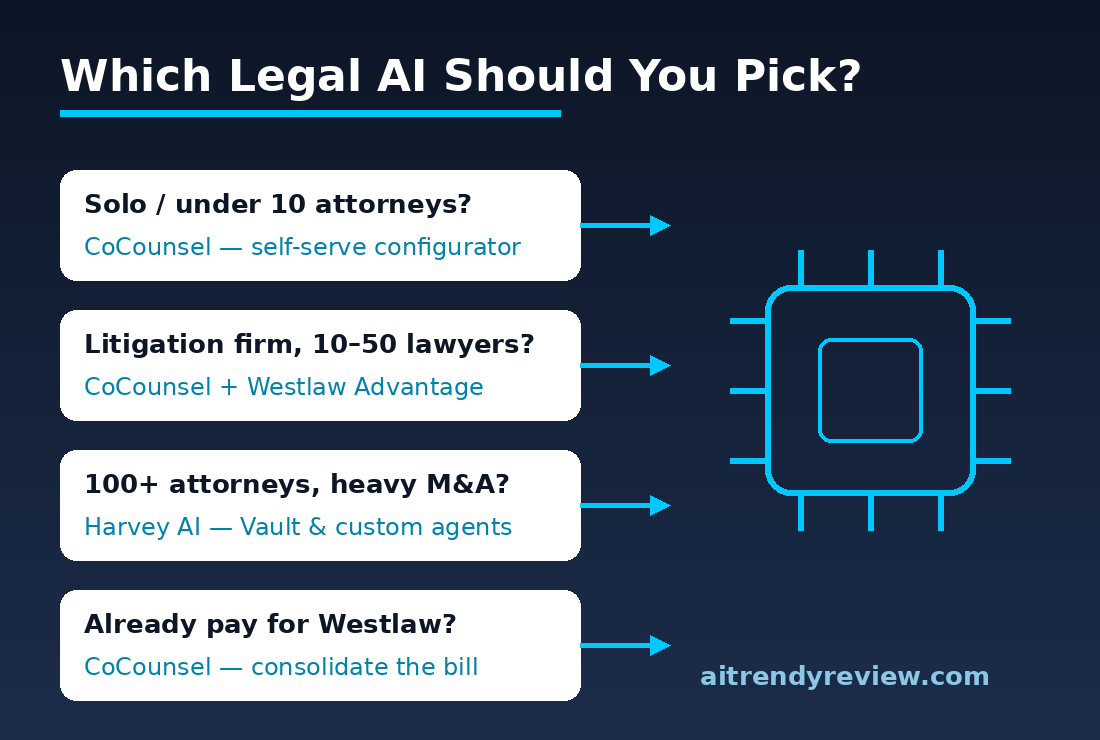
If you’re a solo lawyer or a firm under 10 attorneys, get CoCounsel. It is the only one of the two you can actually buy, the configurator gives you a real price without a sales call, and the Westlaw grounding protects you from citation embarrassments.
If you’re a litigation-focused firm of 10–50 attorneys, get CoCounsel on the Westlaw Advantage bundle, and negotiate the 2- or 3-year term only if you have already run a pilot group. Deep Research and the Litigation Document Analyzer map directly onto brief-writing and motion practice.
If you’re a 100+ attorney firm with a heavy transactional practice, evaluate Harvey seriously. Vault’s bulk document analysis and firm-specific agent workflows are what your due-diligence teams keep asking for, and at your seat count the negotiated per-seat price falls into defensible territory.
If you’re an in-house legal department, Harvey’s Knowledge module (legal, regulatory, and tax) and Shared Spaces collaboration lean your way, provided you can meet the seat minimum. Under roughly 25 seats, CoCounsel Essentials or a governed general-purpose assistant is the honest answer.
If your firm already pays for Westlaw, the switching math favors CoCounsel heavily. You are consolidating an invoice, not adding a vendor.
Harvey AI: Worth It If / Skip It If
Worth it if you have 50+ seats and real negotiating power; your practice is transactional at scale; you want custom agent workflows built on firm precedent; you need tax and regulatory research alongside legal; and your procurement team will cap renewal increases in the contract.
Skip it if you’re under 25 attorneys; you need a published price before engaging sales; your work is primarily case-law research where Westlaw grounding matters; or a $50,000+ annual floor would strain the budget. Harvey reportedly raised prices 10–25% at renewal for firms without caps, so skip it too if you cannot stomach negotiating every year.
CoCounsel: Worth It If / Skip It If
Worth it if you already subscribe to Westlaw or Practical Law; you’re a firm of 1–50 attorneys wanting verifiable research; you draft in Microsoft Word and want AI inside it; or you need litigation workflows (discovery, depositions, complaints) that work out of the box.
Skip it if you need bulk contract analysis across thousand-document data rooms; you want deep workflow customization; you’re primarily a Lexis shop (the Westlaw bundle is the whole point); or you’d sign a 3-year term just to get the advertised price without piloting first. The $639 list rate is real money at 1-year terms, and the discounts require commitment.
Alternatives Worth a Look
Legal AI is not a two-horse race. Lexis+ AI is the direct Westlaw-ecosystem rival, grounded in Shepard’s citations. Spellbook targets transactional lawyers inside Word at a small-firm price. Briefpoint automates discovery documents. And plenty of lawyers quietly run research summaries through general models; our comparison of Perplexity vs ChatGPT for research and our NotebookLM review cover how far consumer research tools have come, and where they stop being appropriate for confidential client work. The pattern across professional services is the same one we flagged in our Pilot AI bookkeeping review: specialist tools win where verifiability matters, general tools win on price everywhere else.
FAQ: Harvey AI vs CoCounsel
Is Harvey AI or CoCounsel cheaper?
CoCounsel is cheaper and more predictable for small and mid-sized firms, with published bundle pricing at $639 per user per month (1-year term) and a range of roughly $104–$639 across plans. Harvey AI is custom-priced, with mid-market firms reportedly paying $1,000–$2,000 per user per month and annual contracts starting around $50,000.
Does CoCounsel include Westlaw?
Not automatically. Base CoCounsel Essentials includes AI drafting and review but no Westlaw research. You need the Westlaw Advantage with CoCounsel Essentials bundle, or the full CoCounsel Legal tier, to get primary-law research, KeyCite, and Deep Research grounded in Westlaw content. That distinction is the most common pricing surprise buyers report.
Can a solo lawyer buy Harvey AI?
Effectively no. Harvey AI carries reported seat minimums of 25–50 seats with 12-month contract terms and offers no free trial or self-serve signup. Solo practitioners and small firms should compare CoCounsel Essentials, Lexis+ AI, or Spellbook instead, all of which sell at small-firm scale.
What is the minimum contract for Harvey AI?
Verified reports put Harvey’s floor at roughly 25–50 seats on 12-month terms, with total annual contracts commonly running $50,000–$300,000+. Bespoke offerings reportedly require around 100 seats. Renewal increases of 10–25% have been reported when firms did not negotiate a cap up front.
Does CoCounsel work inside Microsoft Word?
Yes. CoCounsel integrates with Microsoft Word, Outlook, and Teams, so lawyers can draft, summarize, and review documents without leaving the tools they already use. Guided Workflows for complaints, discovery requests, and deposition review run alongside those integrations.
Which tool is safer with confidential client data?
Both meet enterprise standards and neither trains models on client data. Harvey AI publishes SOC 2 Type II, ISO 27001, ISO 27701, and ISO 42001 certifications with GDPR and CCPA compliance. CoCounsel runs on Thomson Reuters’ vetted enterprise infrastructure, which most firms have already cleared through prior Westlaw procurement.
Do Harvey AI or CoCounsel replace Westlaw or Lexis?
No. CoCounsel is built on top of Westlaw rather than replacing it, and Harvey AI does not include a primary-law citator at all. Firms still need an authoritative research database; the AI layer accelerates the work but the citation backbone remains Westlaw or Lexis.
Why did Harvey AI’s valuation jump to $11 billion?
Harvey closed a $200 million growth round in March 2026 at an $11 billion valuation, co-led by GIC and Sequoia, months after an $8 billion mark. Investors are betting on rapid enterprise adoption: Harvey reports 70+ Am Law 100 firms and over 200,000 professionals on the platform.
Sources
Prices checked July 24, 2026.
- Harvey AI official site — product modules, customers, certifications
- CNBC (March 25, 2026) — Harvey $200M raise at $11B valuation
- The Legal Prompts — reported Harvey seat pricing and contract terms
- CostBench (verified June 9, 2026) — CoCounsel plan structure and list pricing
- LawSites (August 5, 2025) — CoCounsel Legal launch details

Naveen Kumar Durai is the founder of Naveen AI Automation and the reviewer behind AITrendyReview. He builds AI automation systems daily and reviews AI tools from official docs, live pricing pages, and verified user reports — updated monthly as tools change.