On July 22, 2026, OpenAI launched Presence, an enterprise platform for deploying AI voice and chat agents into customer support, sales, IT, and HR workflows. The pitch is blunt: stop stitching agents together from raw API calls, and let OpenAI’s own engineers wire “trusted” agents directly into your systems, with guardrails and simulations included.
What makes this launch different is the delivery model. There is no self-serve tier, no published price list, and no free trial. Deployments are led by OpenAI’s Forward Deployed Engineers and select systems integrators, which means Presence looks less like a SaaS product and more like a consulting engagement with software inside it.
That model raises exactly the questions enterprise buyers are typing into Google right now: what does it cost, how does it compare to Salesforce Agentforce and Microsoft Copilot Studio, and is it worth piloting before the pricing picture clears up? Here is what the record actually shows two days after launch.
How we assess: research/news-based analysis, not hands-on testing.
What is OpenAI Presence? OpenAI Presence is an enterprise platform launched July 22, 2026 for deploying AI voice and chat agents with built-in guardrails, approved actions, and connections to enterprise data and systems. It is in limited general availability, with deployments led by OpenAI engineers rather than sold as self-serve software. Pricing is not yet public.
Key takeaways (verified as of July 24, 2026)
- Launched July 22, 2026, in limited general availability for eligible enterprise customers only.
- 3 named companies are exploring it: BBVA, SoftBank, and IAG. None is described as a full production customer yet.
- 75% of inbound calls on OpenAI’s own English-language support line are resolved without human help, per OpenAI’s self-reported figure.
- 15 percentage points: the drop in human handoffs OpenAI says its Codex-powered improvement loop delivered in 10 days.
- 0 published prices. Every deployment is individually scoped; OpenAI says broader pricing details will follow as the program expands.
- Runs on OpenAI’s frontier models, with MLQ reporting GPT-Live handles real-time voice conversations.
What exactly does OpenAI Presence do?
Presence packages everything needed to put an AI agent on the phone or in a chat window for a real company: policies, guardrails, approved actions, simulation testing, and a continuous improvement loop. OpenAI describes it as a deployment platform rather than a standalone model, and that framing matters. You are not buying a smarter GPT; you are buying the scaffolding that makes a GPT safe to point at your customers.
The platform covers both real-time voice and chat, aimed at customer support, outbound sales, and internal service desks for IT and HR. According to OpenAI’s launch post, an agent built on Presence can verify a caller’s identity, pull their account data, apply company policy, and take approved actions such as resolving a billing issue, then escalate to a human when the conversation moves outside its boundaries.
Three components stand out. First, companies encode their standard operating procedures and policies, so the agent behaves like a trained employee rather than a general-purpose chatbot. Second, before launch, Presence runs simulations against common requests, edge cases, and higher-risk scenarios, and graders score each run on whether the agent reached the correct outcome, followed policy, used tools appropriately, and escalated when it should have. Third, after launch, a Codex-powered loop reviews production interactions and proposes behavioral improvements, which staff approve before they go live.
OpenAI’s proof point is its own operation: the company says Presence resolves 75% of inbound issues on its English-language support line without human assistance, and that the Codex loop cut human handoffs by 15 percentage points within 10 days. TECHi’s analysis correctly flags the caveat, calling that number “company-reported, measured on the friendliest possible customer: OpenAI itself.” It proves the system works somewhere. It does not predict your resolution rate.
The named early explorers give a sense of the target buyer. BBVA is exploring voice support for banking customers in Mexico. SoftBank is testing Japanese-language conversations and rated the quality “natural and accurate.” IAG, the Australian insurer, wants coverage during high-demand moments such as severe weather events. Banks, telecoms, insurers: regulated, high-volume, voice-heavy.
What has OpenAI confirmed, and what is still rumor?
Confirmed facts and press speculation diverged within hours of launch, so it pays to separate them explicitly. Everything in the first list below comes from OpenAI’s own announcement or on-record statements; everything in the second is reporting, inference, or aggregation-site framing.
CONFIRMED by OpenAI: the July 22, 2026 launch date; voice and chat modality; the guardrails, approved actions, simulation, and Codex improvement loop; limited general availability with no self-serve option; deployment by Forward Deployed Engineers and select global systems integrators; BBVA, SoftBank, and IAG as named companies exploring the platform; and the 75% self-resolution figure on OpenAI’s own support line. Also confirmed, by omission and by direct statement: pricing is not published, and “broader pricing and availability details will follow as the limited GA program expands.”
REPORTED, not confirmed: the cost picture. Ground News framed the launch as OpenAI “charging enterprises boots-on-the-ground prices,” language that implies premium consulting-level fees but comes from an aggregator’s headline, not an OpenAI rate card. TECHi notes that VentureBeat asked OpenAI about pricing twice and got no answer. One aggregated report claimed Presence can route to third-party models, including China’s GLM-5 and Kimi, via APIs; no other source we reviewed corroborates that, and OpenAI’s own materials do not mention it, so treat it as unverified. Similarly, the exact model mix is only partially disclosed: OpenAI says “frontier models,” and MLQ reports GPT-Live powers real-time voice, but there is no confirmed public mapping of which model versions sit behind which Presence capability.
Timing context is also worth logging. Reworked pointed out that Presence, a product sold on the word “trusted,” launched a day after OpenAI acknowledged a Hugging Face-related security incident. That juxtaposition is fair commentary, not a product fact, but risk teams evaluating Presence will bring it up.
How much does OpenAI Presence cost?
OpenAI has not published any pricing for Presence, and that is the single most important fact for buyers right now. There is no rate card, no per-conversation fee, no seat license, and no calculator. OpenAI’s own language is that deployments are “individually scoped based on each customer’s use case and implementation needs,” which is enterprise-speak for: the price is whatever your negotiation produces.
The structure of the offering tells you more than any leak. Because every deployment involves OpenAI Forward Deployed Engineers or a global systems integrator, the real cost is software plus services. Anyone who has scoped an FDE-style engagement, the model Palantir made famous, knows these arrangements start in six figures annually and climb from there. Ground News’s “boots-on-the-ground prices” framing points the same direction. But to be precise: that is an inference from the delivery model, not a confirmed number. Nobody outside OpenAI’s sales conversations has seen a Presence invoice.
What we can say with confidence is what the pricing is not. It is not self-serve usage pricing like the OpenAI API, where you can estimate cost from token math before you commit. It is not published per-conversation pricing of the kind Salesforce used to introduce Agentforce. And it is not free to evaluate: entry runs through OpenAI account teams, which itself filters out smaller buyers.
Budget-wise, the honest guidance for a 2026 planning cycle looks like this. If your organization cannot comfortably fund a low-to-mid six-figure USD annual engagement covering platform access, integration work, and ongoing tuning, Presence is probably not addressable for you yet, and you should watch for the pricing details OpenAI says will come as limited GA expands. If you can, the lack of a public price is a negotiating variable, and TECHi’s buyer checklist advice applies: surface pricing, geographic limits, and contract terms early, because right now they are “unnegotiated rather than unknowable.” We will update this analysis when OpenAI publishes real numbers.
How do Presence’s guardrails work?
Presence’s guardrails operate at three points in an agent’s life: before launch, during a live conversation, and after deployment. That lifecycle design, more than any single feature, is what OpenAI is selling under the word “trusted.”
Before launch, companies define policies, standard operating procedures, and the specific approved actions an agent may take against connected systems. The agent then runs through simulated conversations covering common requests, edge cases, and higher-risk scenarios. Automated graders evaluate each simulated run on four axes: did the agent reach the correct outcome, did it follow policy, did it use tools appropriately, and did it escalate when it should have. An agent that fails does not ship.
During a live interaction, OpenAI says “guardrails can intervene when an interaction moves outside the company’s boundaries.” In practice that means the agent is constrained to its approved action list, and conversations that drift beyond policy get redirected or escalated to a human handler. This is the part regulated buyers like BBVA care about most: a banking agent that can check a balance but structurally cannot promise a loan rate it was never authorized to quote.
After deployment, the Codex-powered improvement loop reviews production interactions, identifies failure patterns, and proposes behavior changes. Critically, humans approve every change before it reaches production, so the agent does not silently rewrite its own rules. OpenAI’s evidence that the loop works is the 15-percentage-point drop in human handoffs on its own support line over 10 days.
Two limits deserve mention. Everything above is OpenAI’s description of its own system; no independent red-team assessment of Presence guardrails existed as of July 24, 2026. And guardrails constrain actions, not liability. If a Presence agent misstates a refund policy to a customer in a recorded call, the legal exposure sits with the deploying company. Ask how intervention events are logged, who reviews them, and how fast a discovered failure gets patched. TECHi’s checklist puts it well: “show the intervention, not the demo.”
OpenAI Presence vs Salesforce Agentforce: what’s the difference?
The short answer: Agentforce is a product you configure inside a CRM you already own; Presence is an engagement where OpenAI’s engineers build the agent around whatever systems you run. Both aim at the same budget line, the customer service and sales automation spend, but they get there from opposite directions.
Salesforce Agentforce, on the market since late 2024, lives natively in the Salesforce ecosystem. Its agents draw on Data Cloud, respect existing CRM permissions, and are configured largely by admins and partners through Salesforce tooling. Salesforce has published consumption-style pricing from the start, beginning with per-conversation rates and evolving into its Flex credit model. You can pilot Agentforce inside an existing Salesforce org without signing a bespoke services contract, and thousands of organizations have.
Presence flips every one of those attributes. It is CRM-agnostic, which is a genuine advantage for enterprises whose customer data does not live primarily in Salesforce. It arrives with OpenAI’s frontier models as first-class citizens, including real-time voice, an area where Agentforce has historically leaned on integrations and partners rather than a native flagship voice model. And it comes with OpenAI’s Forward Deployed Engineers, meaning the vendor, not your admin team, carries the integration burden.
The trade-offs follow directly. Agentforce offers published pricing, self-serve piloting, a mature partner ecosystem, and deep native access to Salesforce data, but it ties your agent strategy to a single vendor’s data platform. Presence offers frontier-model quality and white-glove deployment, but with undisclosed pricing, a gated program, and a two-day-old track record outside OpenAI’s own support line.
A practical rule: if your customer operations already run on Salesforce and your data lives in Data Cloud, Agentforce is the lower-friction pilot and you can price it today. If you are voice-first, multi-system, or specifically want OpenAI’s models under the hood with someone else doing the wiring, Presence is the one to evaluate, once you get an answer on cost. For a sense of how OpenAI’s underlying models perform, our GPT-5.4 review covers the model line Presence builds on.
How does Presence compare to Microsoft Copilot Studio and Google’s agent stack?
Against Microsoft and Google, Presence competes on depth of deployment rather than breadth of access. Microsoft Copilot Studio is the volume play: a low-code agent builder woven into Microsoft 365 and Azure, with published pricing through message packs and pay-as-you-go metering, usable by a mid-market IT team without a services contract. Google sells agents through its cloud AI stack, Vertex AI’s agent tooling and its Gemini-based enterprise offerings, aimed mainly at organizations already building on Google Cloud. Both give you tools; Presence gives you an outcome, delivered by OpenAI’s own people, at a price you learn in a sales cycle.
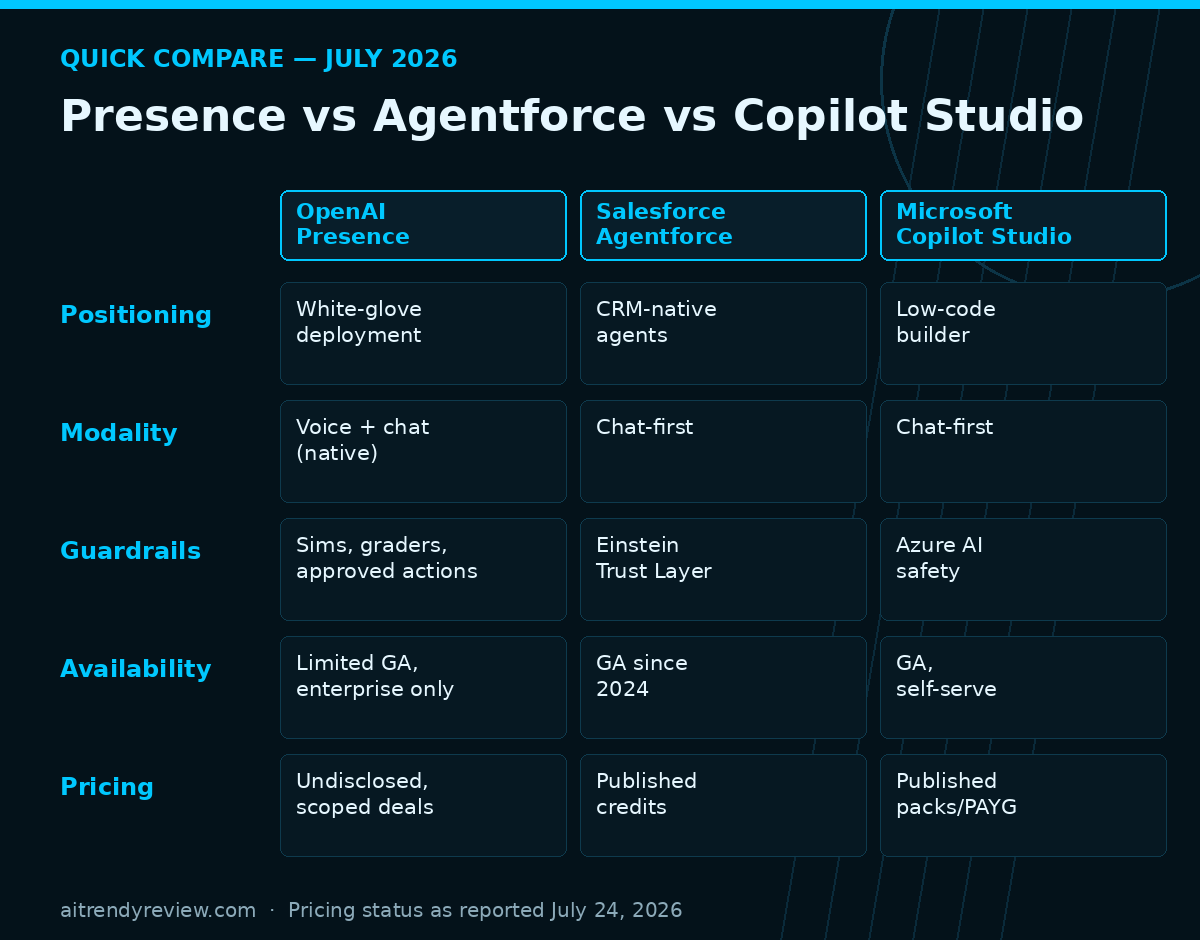
| Dimension | OpenAI Presence | Salesforce Agentforce | Microsoft Copilot Studio |
|---|---|---|---|
| Positioning | White-glove agent deployment; OpenAI engineers lead builds | Agents native to Salesforce CRM and Data Cloud | Low-code agent builder inside Microsoft 365/Azure |
| Modality | Real-time voice + chat, native | Chat-first; voice via integrations | Chat-first; voice channels via connectors |
| Guardrails | Policy encoding, approved actions, simulation graders, human-approved Codex updates | Einstein Trust Layer, CRM permissioning | Azure AI content safety, admin governance controls |
| Availability | Limited GA, enterprise only, via account teams | Generally available since 2024 | Generally available, self-serve |
| Pricing status (July 2026) | Undisclosed; individually scoped per deployment | Published consumption pricing (credits/conversations) | Published pricing (message packs, pay-as-you-go) |
The strategic difference is who carries the risk of a bad deployment. With Copilot Studio or Google’s tooling, a failed agent project is your project that failed. With Presence, OpenAI’s engineers are on the hook alongside you, which is precisely why the delivery cost should be expected to be high. Anthropic sits in this market too, primarily as a model supplier through Claude rather than a packaged deployment service; our Claude Opus 4.7 review looks at the strongest current alternative to OpenAI’s frontier line.
Who is OpenAI Presence for, and who should skip it?
Presence is built for large enterprises with high-volume customer conversations, regulated workflows, and the budget for a services-led deployment. The three named explorers are the template: a multinational bank (BBVA), a telecom giant (SoftBank), and a major insurer (IAG). If your organization looks like them, you are the target.
Map it to your situation. If you are a bank, insurer, telecom, airline, or utility with regulated, policy-heavy customer interactions and call volumes in the hundreds of thousands or millions, Presence’s approved-actions model and simulation testing address the exact reason your compliance team has blocked chatbot projects before. Request a scoping conversation through your OpenAI account team, and per TECHi’s checklist, demand simulations on your own call mix rather than accepting the 75% figure from OpenAI’s support line.
If you are a mid-market company with an existing Salesforce or Microsoft footprint, skip Presence for now. You cannot buy it self-serve, you likely cannot fund the services engagement, and Agentforce or Copilot Studio will get a competent agent into production this quarter at a price you can model in a spreadsheet. Revisit Presence when OpenAI publishes broader pricing and availability, which it has said will come as limited GA expands.
If you are an SMB, Presence is categorically not for you, and that is fine. A small support team gets further with off-the-shelf tools: a helpdesk with built-in AI answers, or workflow AI of the kind we compare in our Notion AI vs ClickUp AI breakdown. For voice specifically, purpose-built voice AI platforms remain the accessible route; our ElevenLabs review covers what production-grade AI voice costs when you can actually see the price.
One more group should pay attention: teams already running autonomous-agent experiments internally. The pattern Presence formalizes, simulate, grade, gate, then improve with human approval, is the same discipline that separates working agent deployments from demos, whether the agent answers phones or writes code the way Devin does. The playbook is worth copying even if you never buy the product.
Should your company pilot Presence in 2026?
Pilot it this year only if three things are true: you fit the enterprise profile above, you can get real answers on pricing and data terms during scoping, and you have a contained, high-volume use case to test. If any of those fails, wait for the program to widen. Two days after launch, there is no independent deployment evidence, and paying consulting-grade fees for a platform whose only public benchmark is the vendor’s own support line is a bet, not a purchase.
The case for moving now is real, though. Limited GA programs are where reference customers get made, and reference customers historically get attention, engineering time, and pricing that later buyers do not. BBVA, SoftBank, and IAG are effectively getting OpenAI’s best people to build their agent infrastructure while the vendor is motivated to prove the category. If voice automation is on your 2027 roadmap anyway, a 2026 Presence pilot buys you a year of learning with the team that built the models.
The case for waiting is equally concrete. Pricing is undisclosed. Contract terms, geographic limits, and data-export policies are unpublished, and TECHi reports that direct questions about pricing went unanswered twice. Switching costs are unknown: nobody can yet say what it takes to migrate a Presence agent’s policies, evaluations, and tuning to another platform if the relationship sours. And the trust positioning arrived a day after a security incident disclosure, which your risk committee will notice.
If you do pilot, structure it defensively. Scope one workflow, not your whole contact center. Insist on simulation results against your historical call transcripts before go-live. Get intervention logs and escalation response times in the contract. Cap the engagement at two or three quarters with defined resolution-rate targets, using your current human baseline, not OpenAI’s 75%, as the comparison. Enterprise AI tools earn their fees when the metric they move is one you already measure; that standard applies to a $500-per-seat legal tool like Harvey, and it applies tenfold to an unpriced agent platform.
Verdict: promising architecture, credible early names, honest-looking guardrail design, and a pricing vacuum that makes “wait and scope” the right call for everyone except large regulated enterprises with 2026 budget to spend.
Frequently asked questions
When did OpenAI Presence launch?
OpenAI Presence launched on July 22, 2026, in limited general availability. It is available to eligible enterprise customers through OpenAI account teams, with deployments led by OpenAI Forward Deployed Engineers and select systems integrators rather than sold as self-serve software.
How much does OpenAI Presence cost?
OpenAI has not published pricing for Presence as of July 24, 2026. Deployments are individually scoped per customer, and the services-led delivery model implies six-figure annual engagements, but that is an inference from the structure, not a confirmed figure. OpenAI says broader pricing details will follow as limited GA expands.
Which companies are using OpenAI Presence?
OpenAI named three companies exploring Presence at launch: BBVA, which is exploring voice support for banking customers in Mexico; SoftBank, which is testing Japanese-language agent conversations; and insurer IAG, which is looking at support during high-demand events such as severe weather. None is described as a full production customer yet.
What models power OpenAI Presence?
OpenAI says Presence is built on its frontier models and is designed to evolve with new releases. MLQ reports that GPT-Live handles real-time voice conversations and that a Codex-powered agent runs the post-deployment improvement loop. OpenAI has not published a full mapping of model versions to Presence capabilities.
Is OpenAI Presence available to small businesses?
No. Presence has no self-serve tier and is limited to eligible enterprise customers working through OpenAI account teams. Small and mid-sized businesses that want AI agents today are better served by self-serve platforms such as Microsoft Copilot Studio, Salesforce Agentforce, or vertical AI tools with published pricing.
How is OpenAI Presence different from the OpenAI API?
The API sells raw model access with usage-based pricing, leaving integration, guardrails, and testing to your team. Presence packages policies, approved actions, simulation testing, live guardrails, and a human-approved improvement loop, with OpenAI engineers doing the deployment. It is an outcome-focused service, not a developer building block.
What guardrails does OpenAI Presence include?
Presence encodes company policies and standard operating procedures, restricts agents to approved actions, and tests agents in simulations graded on correct outcomes, policy compliance, tool use, and escalation before launch. In production, guardrails intervene when conversations move outside company boundaries, and all Codex-suggested behavior changes require human approval.
Should we pilot OpenAI Presence or wait?
Pilot in 2026 only if you are a large enterprise with high-volume, policy-heavy customer conversations, budget for a services-led engagement, and a contained use case with measurable targets. Everyone else should wait for published pricing and independent deployment evidence, and pressure-test alternatives like Agentforce or Copilot Studio meanwhile.
Sources
- OpenAI: Introducing OpenAI Presence — Verified July 24, 2026
- Help Net Security: OpenAI Presence connects AI agents to enterprise data with built-in guardrails — Verified July 24, 2026
- MLQ: OpenAI Launches Presence, an Enterprise AI Agent Platform — Verified July 24, 2026
- TECHi: OpenAI Presence sells trusted agents. Here is the buyer’s checklist — Verified July 24, 2026

Naveen Kumar Durai is the founder of Naveen AI Automation and the reviewer behind AITrendyReview. He builds AI automation systems daily and reviews AI tools from official docs, live pricing pages, and verified user reports — updated monthly as tools change.