Real estate is a business of speed and follow-up, which is exactly what AI is good at. The agents pulling ahead in 2026 aren’t the ones who write the best listing prose by hand; they’re the ones who let software draft it, stage the photos, and call the leads back in ninety seconds while competitors are still at dinner. This is an independent look at the AI tools worth a real estate agent’s money right now, sorted by the job each one does, based on published pricing and vendor documentation rather than a paid placement.
How we assess: this guide is based on official documentation/manufacturer specs, pricing pages, and verified user/owner reports, not hands-on testing.
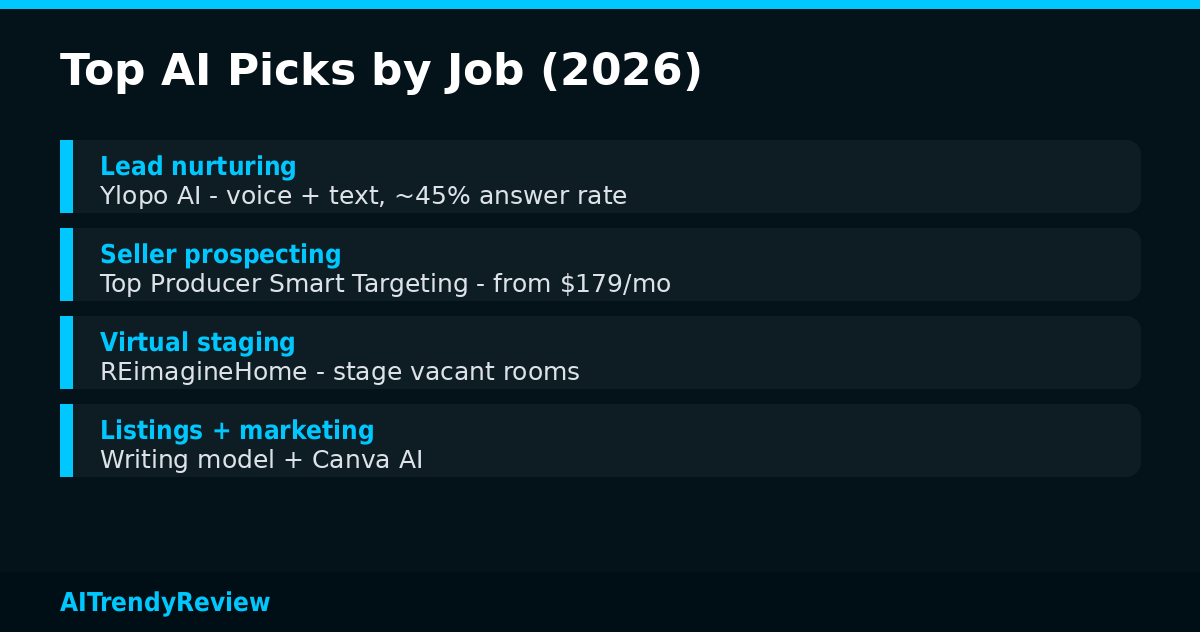
What are the best AI tools for real estate agents in 2026? The strongest picks by category are Ylopo for AI lead nurturing, Top Producer Smart Targeting for seller prospecting, REimagineHome for virtual staging, and a general writing model plus Canva AI for listings and marketing. Most agents don’t need all of them; they need one from the two or three categories that match their biggest bottleneck.
Key takeaways
- Lead follow-up: Ylopo AI calls and texts leads automatically, reportedly reaching a 45% answer rate across a 90-day nurture.
- Seller prospecting: Top Producer Smart Targeting uses predictive analytics to flag likely sellers, from about $179/month.
- Virtual staging: REimagineHome stages and re-renders empty rooms so vacant listings photograph like furnished ones.
- Listings + marketing: a strong writing model handles descriptions while Canva AI produces flyers and social graphics.
- Pick by bottleneck: buy for the one task costing you the most deals, not the longest feature list.
- Watch the pricing model: several tools are quote-only or usage-based, so total cost can climb fast at scale.
How should an agent choose AI tools?
Start with your bottleneck, not the shiniest tool. If leads go cold because you can’t call them back fast enough, a nurturing tool pays for itself in one saved deal. If your problem is empty listings that photograph badly, virtual staging is the spend. If you’re drowning in paperwork and listing copy, a writing model and a transaction organizer matter more. Buying an all-in-one platform before you know your bottleneck is how agents end up paying four figures a month for features they never open.
The second filter is pricing transparency. Some of the best tools here publish clear monthly rates; others are quote-only or charge per use, which can balloon at volume. For a solo agent or small team, a predictable subscription usually beats a usage-based tool that surprises you at closing season. Read the pricing model, not just the headline number.
Best for lead nurturing: Ylopo AI
Lead follow-up is where most agents lose money, and Ylopo is built to close that gap. Its AI places voice calls and sends texts to leads automatically, qualifying them before a human ever picks up. The company reports its AI voice product calls leads repeatedly across a 90-day window and reaches roughly a 45% answer rate, which is far above what a busy solo agent manages by hand. Leads that would have gone cold get worked while you’re showing a house.
Ylopo is enterprise-leaning: pricing is quote-based with a setup cost commonly cited in the four figures, so it fits teams and high-volume agents more than a brand-new solo. If your pipeline is big enough that leads slip through the cracks, the recovered deals justify it. If you close a handful a year, start with a cheaper follow-up workflow first. Pair it with a fast, conversational model like the ones we cover in our Claude Opus review for drafting the human follow-ups.
Best for seller prospecting: Top Producer Smart Targeting
Finding sellers before they list is the highest-value prospecting an agent can do, and Top Producer’s Smart Targeting uses predictive analytics to identify homeowners in your farm area who are statistically likely to sell soon. Instead of door-knocking a whole neighborhood, you focus outreach on the addresses the model flags. It starts around $179 per month, with a Pro plus Farming tier around $599 for agents who want deeper territory coverage.
The value depends on your market. In a stable, data-rich suburban farm, predictive seller signals can meaningfully sharpen your prospecting. In a thin or unusual market, the model has less to work with. Treat the entry tier as a test: run it against one farm for a quarter and measure listings sourced before committing to the higher plan.
Best for virtual staging: REimagineHome
Vacant homes photograph cold and sell slower, and traditional staging costs thousands. REimagineHome uses AI to stage and re-render empty rooms, dropping in furniture and finishes so a listing looks lived-in without a single real sofa. It also handles renovation visualization, useful for showing buyers the potential in a dated space. For agents with vacant inventory, it turns a weak photo set into a competitive one in minutes.
Disclose AI-staged photos per your MLS and local rules; buyers should know a room is virtually furnished. Used honestly, virtual staging is one of the clearest ROI plays in real estate AI, since better listing photos directly drive more showings. For the listing hero images themselves, some agents also lean on generative image tools like the one in our Midjourney V7 review for marketing collateral, though for factual listing photos, staging tools tied to the real room are the right call.
Best for listings and marketing: a writing model + Canva AI
Listing descriptions, email nurtures, and social captions are pure volume work, exactly what a good writing model eats through. A general assistant drafts a compelling, MLS-appropriate description from your bullet points in seconds, then adapts it into an email and three social captions. For agents comparing options, our Jasper AI review covers a marketing-focused tool with real-estate templates, while a general model handles the same job more cheaply if you’re comfortable prompting.
Pair the words with Canva AI for the visuals. Canva’s design suggestions turn a listing into flyers, just-listed graphics, and social posts without a designer, and it has a free tier plus affordable paid plans. Together, a writing model and Canva cover the entire listing-marketing pipeline for a fraction of hiring out, and both scale from one listing to fifty without extra cost.
AI tools for real estate agents: comparison (2026)
| Tool | Job it does | Best for | Pricing model |
|---|---|---|---|
| Ylopo AI | AI voice + text lead nurturing | Teams / high-volume agents | Quote-based, setup fee |
| Top Producer Smart Targeting | Predictive seller prospecting | Farm-area listing agents | From ~$179/mo |
| REimagineHome | Virtual staging + renovation renders | Agents with vacant listings | Subscription (check site) |
| Writing model (general) | Listing copy, emails, captions | Every agent | Low monthly / usage |
| Canva AI | Flyers, social graphics | Every agent | Free tier + paid plans |
What about all-in-one real estate platforms?
Bundles like Lofty (formerly Chime), kvCORE, and others fold lead gen, CRM, and marketing into one subscription, and they can be worth it for a team that wants a single system of record. The risk is paying for a broad platform to get one feature you’d buy standalone for a fraction of the cost. If you already run a CRM you like, adding a focused tool for your specific bottleneck usually beats ripping everything out for an all-in-one. If you’re starting from nothing and want one login, a platform can make sense, just price it against the sum of the point tools it replaces.
Property valuation is another category worth a mention: tools like HouseCanary provide automated valuation models and portfolio risk data, valuable for investors and listing agents who price a lot of homes, though pricing is quote-based and aimed at heavier users.
If you’re an agent, here’s where to start
If leads go cold before you call them back, a nurturing tool like Ylopo is your highest-ROI spend, provided your volume justifies the enterprise pricing. Below that volume, start with a writing model to speed up manual follow-ups.
If you want more listings, test Top Producer Smart Targeting against one farm area for a quarter and measure sourced listings before scaling the plan.
If your listings sit vacant, virtual staging with REimagineHome is the fastest way to make photos compete, just disclose it.
If you’re a solo agent on a budget, a general writing model plus Canva AI covers listings and marketing for very little, and it’s the right first purchase for almost everyone.
Bottom line
The best AI tools for real estate agents in 2026 aren’t a single platform; they’re a small stack matched to your bottleneck. Ylopo for follow-up, Top Producer for seller signals, REimagineHome for staging, and a writing model plus Canva for the listing pipeline cover the four jobs where AI actually moves deals. Buy for the task costing you closings, watch the quote-only pricing, and disclose AI-generated media. Do that, and the tools earn their keep instead of becoming another subscription you forget to cancel.
FAQ: AI tools for real estate agents
What are the best AI tools for real estate agents in 2026?
The strongest by category are Ylopo for AI lead nurturing, Top Producer Smart Targeting for seller prospecting (from about $179/month), REimagineHome for virtual staging, and a general writing model plus Canva AI for listings and marketing. Choose based on your biggest bottleneck rather than buying all of them.
How much do AI tools for real estate cost?
It ranges widely. Writing models and Canva start low or have free tiers; Top Producer Smart Targeting starts around $179 per month; and enterprise tools like Ylopo are quote-based with setup fees often in the four figures. Watch for usage-based pricing that scales with volume.
Can AI write real estate listing descriptions?
Yes, and it’s one of the clearest wins. A writing model drafts an MLS-appropriate description from your bullet points in seconds and adapts it into emails and social captions. Always review for accuracy and fair-housing compliance before publishing.
Is AI virtual staging allowed in real estate listings?
Generally yes, but you must disclose it. Most MLSs and local rules require noting that photos are virtually staged so buyers aren’t misled. Used transparently, tools like REimagineHome are a legitimate, high-ROI way to market vacant homes.
Do I need an all-in-one platform or individual tools?
It depends. All-in-one platforms suit teams wanting a single system of record, but solo agents often get better value buying a focused tool for their specific bottleneck and keeping a CRM they already like. Price the platform against the point tools it would replace.
What is the best AI tool for real estate lead generation?
For automated follow-up and qualification at volume, Ylopo’s AI voice and text nurturing is a leading option, reportedly reaching a 45% answer rate over a 90-day cadence. For sourcing seller leads specifically, Top Producer’s predictive Smart Targeting is the category pick.
Are AI tools worth it for a solo real estate agent?
Yes, if you start small. A general writing model plus Canva AI costs very little and speeds up listings and marketing immediately. Hold off on enterprise lead-nurturing platforms until your deal volume justifies the price.
Can AI replace a real estate agent?
No. AI handles repetitive work, drafting, staging, follow-up, prospecting signals, but negotiation, local judgment, relationships, and fiduciary duty remain human. The agents who win use AI to do more of the human work, faster, not to remove themselves from it.
Sources
- Re-Leased — 12 Best AI Tools for Real Estate Professionals in 2026 (tools, use cases, pricing). Verified July 22, 2026.
- Ylopo — AI voice and text lead nurturing (official site). Verified July 22, 2026.
- Top Producer — Smart Targeting predictive prospecting (official site). Verified July 22, 2026.
- REimagineHome — AI virtual staging (official site). Verified July 22, 2026.

Naveen Kumar Durai is the founder of Naveen AI Automation and the reviewer behind AITrendyReview. He builds AI automation systems daily and reviews AI tools from official docs, live pricing pages, and verified user reports — updated monthly as tools change.